
02 · Inconsistent work

The same result every time, whoever does the job.

The same job comes out differently, depending on who did it.

We document each job to your standard, so it comes out the same whoever does it.

What owners told us

  • “Team not following clear process and everyone working differently.”
  • “Company standards not all the same.”
  • “I need to know that stuff is getting done without having to micromanage.”

What you want

The same result from your newest starter as from your best person.

Each job has one agreed way of doing it, with a picture of the finished result and the checks that matter. Anyone can check their own work against it before it reaches a customer.

You stop redoing jobs at night, and you can see the work is right without standing over the person who did it.

What owners told us they want

  • “So that every single job goes out the door exactly the same.”
  • “I just want everyone to be working from the same, like the same process, the same way.”

What it looks like day to day

  • You can tell who did a job just by looking at it.
  • Ask your team, and each person describes the job differently.
  • You wrote an SOP, and the same mistake still happens.
  • Your experienced people drift back to the way they’ve always done it.
  • Quality shifts every time you change staff or contractors.
  • Jobs have to be redone, and some work is never billed.

What you’ve already tried

They stall because the standard was never fully written down.

A checklist

It lists what to do and leaves out how, so each person does it their own way.

Retraining the person

People forget what they were shown. A month later they’re back to their own version.

Checking everything yourself

You become the quality check, which puts you back in the middle of every job.

Hiring an A-player to set the standard

They bring their own habits, and become the next person you can’t afford to lose.

Replacing the person

The next person gets the same unclear instructions, so the result doesn’t change.

ChatGPT or Claude drafts

They write the internet’s average version of the job. They haven’t seen yours done, so they can’t pick the right one.

Why it happens

Nobody comes to work to do it wrong.

When the steps leave room for guessing, people fill the gaps their own way. That is where the mistakes and the rework come from.

A complete process removes the guessing. It shows the job being done, with every step marked up and the checks included.

Until then, you pay for each mistake when the job is done and again when it’s put right, often by you. Count the jobs you redid last month.

Worth knowing

Would ten new people get the same result?

Imagine handing the process to ten people who have never done the job. If they wouldn’t all come back with the same result, the gaps are in the document.

“Make sure it looks good” means something different to each person. A picture of the finished result shows everyone what’s expected.

How close the work comes to your standard

Today

The aim

  • One person’s result
  • Your standard

Each mark is one person’s result on the same job. The aim is that every result meets your standard, whoever does it.

Why a standard you write yourself rarely sticks

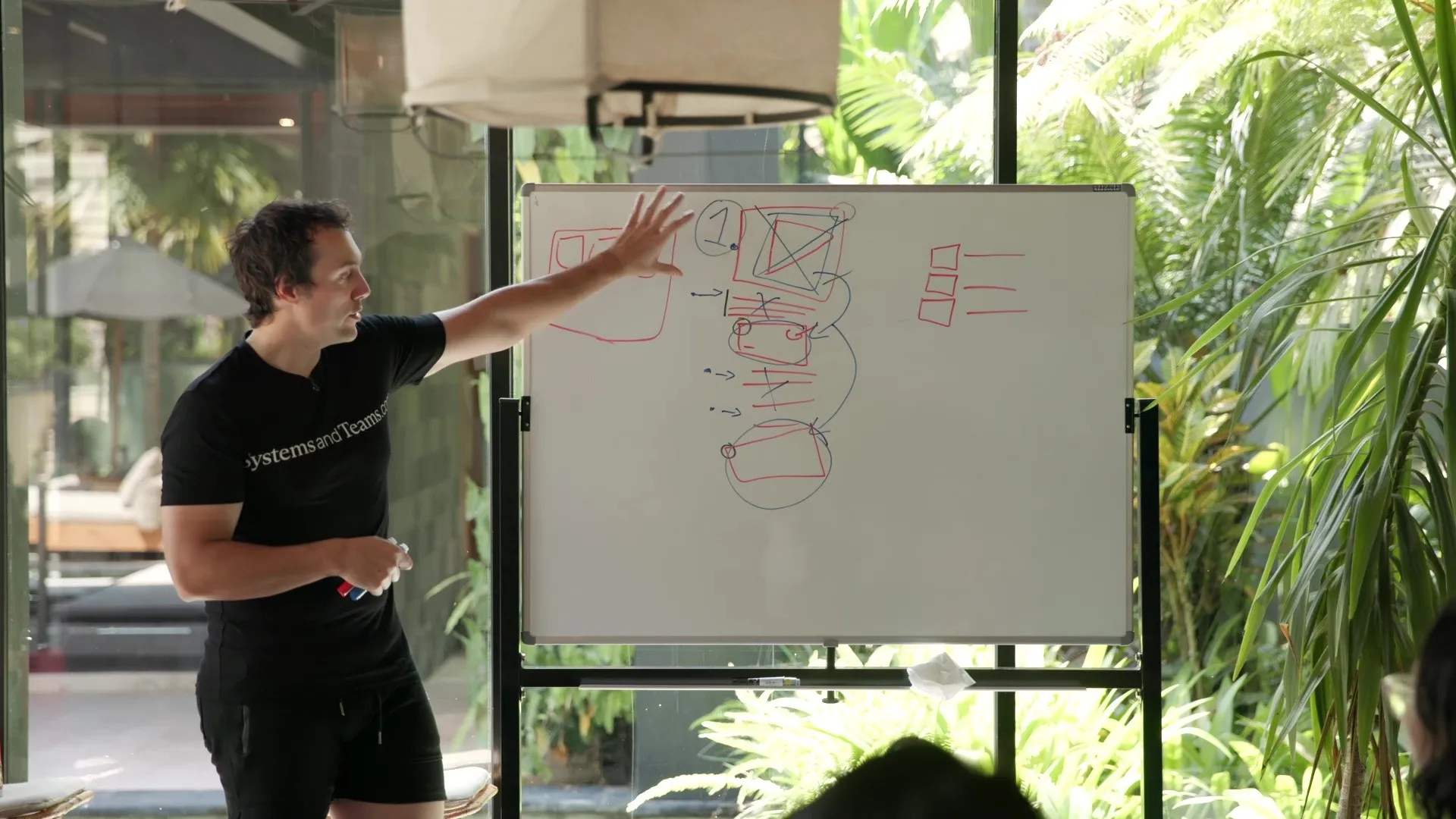
Jamie Stenhouse sketching the parts of a complete process

Someone has to pick one right way out of several and get the team to agree. That’s hard to judge when one of the versions is usually yours.

The steps that cause the differences are the ones the writer takes for granted. A document that works for your best person can still fail everyone else, so it has to be tested on someone new.

And nobody tells you it’s broken. People assume that’s how it’s meant to be, and work around it.

How we get you there

How one standard is agreed and kept

  1. 1

    Agree the right way

    Where your people do it differently, we agree one version with you.

  2. 2

    Show us once

    Your best person records the job as they do it. We ask about every step they take for granted.

  3. 3

    Document the standard

    Video, every step written out, a marked-up image for each, a picture of the finished result and the checks that matter.

  4. 4

    Test it on someone new

    If anyone still has to guess, we fix the process.

What changes once it’s documented

  • The same result, whoever does the job
  • Fewer mistakes reaching customers
  • Less rework, and fewer late nights fixing it
  • Work you can check without micromanaging

2 to 4 hours a week of your time. To your standard, or you don’t pay.

Case studies

Tony F

Tony F

RecruitmentUnited States

A new way of working, well received by the team

Batching and tracking went in one morning, and the team built their schedules around it straight away.

“I introduced batching and tracking this morning. It was very well received and we did a bunch of exercises to create their schedule! ... As usual, score another win for Systems and Teams.”

Result: Team on board

Mandy P

Mandy P

Home maintenanceCanada

Daily problems no longer dreaded

Small daily problems used to be dreaded. Now they can be fixed for good.

“Instead of having the attitude of dreading dealing with small daily issues, I feel more positive, because I know they can be fixed long term.”

Result: Fixable long term

“Makes it easy so I can work on my business, not in it.”

ConstructionUnited States

View 80+ case studies

Questions owners ask

Will a written process stop my team using their judgement?

No. It sets the standard and the steps that can’t be skipped. Within that, people still bring their own skill. Where a decision is needed, a decision tree shows them how to make it.

Every job we do is different. Can it still be standardised?

Yes. The result changes, but most of the work around it repeats. We document the repeating steps once and keep each job’s details separate.

How does the guarantee work?

We judge every process against the recordings and examples you gave us. If one falls short, we revise it at no charge. If it still isn’t right, you get a full refund.

How do I know the work is right without checking it all?

Each process ends with the checks that matter, so people check their own work. If you need it, a one-page scorecard shows the numbers that tell you it’s on track.

Go deeper

Longer reading, if you want the detail.

The six ways a process fails

When work comes out differently, the cause is almost always in the instructions, and six faults cover most of it.

They are a standard nobody can measure, such as “make sure it looks good”; room to assume; key points open to interpretation; creative freedom where it doesn’t belong; confusing detail; and missing inputs, where the person doesn’t have what they need to start.

Why detail matters

Owners often hold back on detail because spelling out the basics feels like talking down to experienced people.

Detail is what lets a new person get it right the first time, and experienced staff can skim straight past it. Jamie would rather see a long, detailed process than a three-step checklist.

A useful standard: write every process as if someone who has never seen your business will follow it.

Checks people can run themselves

Every check has the fix written under it, so whoever spots a mistake can put it right without coming to you.

When it still comes out wrong

Ask the person to read the steps aloud while they do the job. Where what they read and what they do differ, that part of the process needs rewriting.

More help with this problem

A short video

Jamie explains how we get the work out of your head and document it with you.

The free assessment

28 questions and a few minutes for a scored report on where your business stands.

Take the assessment

Get every job done your way.

Bring the job that goes wrong most often, and anyone who shares the decision. We find what to document first, and if we’re a fit, you get a fixed price on the call. You leave with a plan either way.

To your standard, or you don’t pay1,121 businesses since 201796 industries24 countries

  • Australia
  • United States
  • United Kingdom
  • New Zealand
  • Canada
  • Netherlands
  • Sweden
  • Ireland
  • Denmark
  • Germany
  • Finland
  • Singapore
  • Switzerland
  • South Africa
  • Japan
  • Philippines
  • Costa Rica
  • Greece
  • India
  • Monaco
  • Slovenia
  • Norway
  • Luxembourg
  • Spain