
Nick K
Cleaning
38% growth in a year
Up 38% on the previous financial year, and ahead again in the first quarter.
“We have grown 38% since the last financial year and are well up on that for the first quarter this year.”
Result: +38% year on year
FAQ
If yours isn’t here, ask it on the call or send it to us.
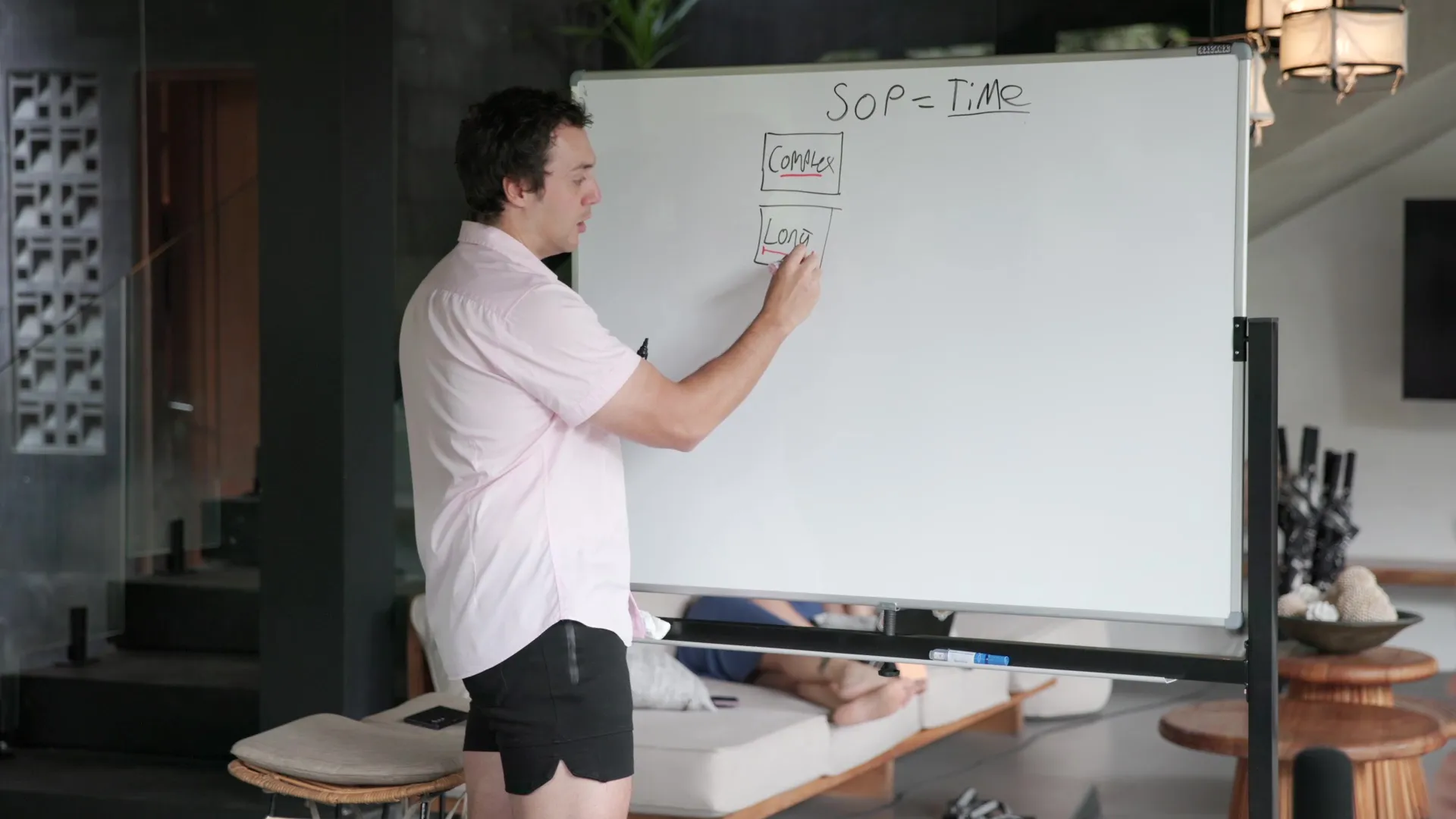
A complete, franchise-level process for every job you hand us. Each process has a video of the job, every step written out with a marked-up image, the checks that matter and the hand-off to the next person.
We keep them current as your business changes. Our sample processes show what one looks like.
Every job you hand us, written down and set up in the place your team already works, with each one given to the person who does it. When a question comes up, your team can find the answer in the process. We keep each process current as your business changes, and we advise you on what to document next.
Systems Integrator is the name of our service. It means we document how your business actually runs, done with you, so your team can run it without you.
You or your best person show us each job once. Our team turns it into a complete, step-by-step process that anyone on your team can follow.
None of those. We’re a documentation firm. You or your best person show us how the work is actually done, and our team turns it into step-by-step processes your team can follow.
Each process covers one job from start to finish. It opens with when the job happens, the tools or logins it needs and why it matters. Then the video of the job, every step in order with a marked-up image, and any templates, scripts or forms the job uses. It closes with the checks that matter, what happens next and who to ask if something is unclear.
We check every process the same way: someone new should be able to follow it and get the same result without asking you.
Each format does a different job. The video shows the whole job done the right way, the same way every time, so it doubles as training for new starters. The written steps let someone go straight to the step they need without rewatching the whole video. The marked-up images show where to click, what to pick up or what to check.
People also learn differently. Some prefer to watch and others to read, and most use both.
A checklist is a useful outline, but it leaves the detail to the reader. “Take out the rubbish” sounds clear until someone asks which bin, which door and where the new bags are kept. Each of those gaps becomes a question for you, or a mistake.
A complete process explains how to do each item on the list.
Yes, if you need them. Alongside the processes, we can set up a short scorecard: the few numbers that show whether the work is getting done, and done well. You see at a glance how your team is doing, without micromanaging anyone.
Yes. We start by reviewing what you have. We keep anything that already gets the same result whoever follows it, and rebuild the rest, using your existing documents and videos as the starting point.
Yes. Every process we document for you belongs to your business, along with the templates and scripts inside it. They carry your name and logo, and you can edit them at any time.
It starts with a call to find where your business still runs through you. If we work together, a launch call sets the priorities: which jobs to document first, and in what order.
From there, you or your best person show us each job, either on a video call or by recording it as you work. Our team turns each job into a complete process, you check it, and we help put it where your team already works. We review progress with you at regular check-ins. Our What to expect page covers each stage in detail.
There’s no fixed length. It depends on the size of your business, how many jobs you want documented and how much time you can give it each week. It begins with working out where your time goes and what to document first, then moves into recording and documenting, with the first processes coming back to you early.
We’ll give you a realistic timeline for your business on the call.
A recording of the real job being done, from start to finish, with sound, so we can see and hear every action. For work at a computer, that’s a screen recording. For hands-on work, it’s a video on your phone. If it’s easier, you can talk us through a job on a call.
You don’t need any special equipment, and we tell you what to record for each job.
Yes. Much of what we document happens away from a desk: loading a van, setting up on site, preparing a treatment room, using a workshop machine. You film the job once as you do it, talking through what you’re doing, and we turn the footage into steps with images taken straight from it.
Some owners use a phone on a tripod, or a pair of camera glasses, so they can keep both hands free.
Yes. If the work happens on a screen, a screen recording captures it, whichever program it’s in. We mark up each step so your team can see where to click and what to enter.
Yes. Working sessions run on video calls, and recordings are shared online, so you can take part wherever you are. We also meet clients in person at our events.
As they’re finished. Each process comes back to you to check, and once it’s right your team can start using it. You get the first processes early, without waiting for the rest to be finished.
Then it’s worth settling now, before a customer finds out. We map the job with the people involved, you agree how it should be done, and that is the version we record and document. From then on, every new starter learns the agreed way.
2 to 4 hours a week, mostly showing us how the work is done and answering our questions. You can hand much of that to your best person. It moves faster if you can give it more time.
It takes 2 to 4 hours a week, from you or someone on your team. Often that’s the person who has done the job the longest. They show us the work and answer our questions, and our team does all the writing.
An hour or two a week in working sessions with us, mapping the work and agreeing what to document next. Then an hour or two recording jobs you or your team already do. Much of the recording happens while the work is being done anyway.
It’s busier at the start and lighter once the first processes are in place.
No. Your part is showing us: you or your best person walk us through each job once, or record it as you work, and answer our questions. Our team does the documenting. People who know a job well skip the steps they take for granted, which is why it’s better done by someone outside the job, who asks about every step.
Yes. Many owners hand the day-to-day to a manager or their most experienced person, and team members can join sessions or send recordings. We still need you at the start to set the priorities and agree the standard, and now and then for a decision only you can make.
Very little. The person who does a job best records it once while doing it, and our team does the documenting. That takes far less time than the questions and retraining it replaces.
No. Many of the owners we work with chose a trade to stay away from computers. If you can record a video on your phone, you can do your part. Our team handles the rest, and we build the finished processes to be simple for your team to open and follow.
Most owners say this. Much of a busy week goes on questions and fixes that a documented process would take off you. We begin with short, repeated jobs, so you get time back early.
You don’t need a number before the call. We list the jobs your team does, then start with the ones behind the most questions and mistakes, the shortest and most repeated. Every job you hand us gets documented, and you decide how far to go.
The short, repeated jobs behind the most questions, mistakes and interruptions. They’re quick to document and give you time back fastest. Behind-the-scenes work such as admin, onboarding and job preparation comes before customer-facing work, and sales comes last.
Yes. The finished result changes from job to job, but most of the work around it repeats: the enquiry, the quote, the preparation, the checks, the clean-up and the invoice.
Where a job branches, we document the choices as a decision tree: if this happens, do that.
Yes. We capture the reasoning behind each decision as a decision tree: the conditions, the options and which way to go. When people are told to use their judgement, each one decides differently. Written rules let your team make each decision the way you would.
Expert work comes later, once the simpler jobs have given you time back.
Yes. Enquiries, bookings, follow-ups, setting expectations at the start of a job and booking the next appointment can all be documented, with the words to use. A script gives your team a structure to follow, and they can still say it in their own way.
Yes, and it’s one of the most common places owners start. New starters work through the processes for their role, and when they forget a step, they look it up.
It’s better to wait until someone is doing the job. A process written for work nobody does yet usually changes once the work starts. We document jobs that already happen, so the process matches how the work is done.
Yes. Many owners start with one area, such as the office or a single crew, and extend to the rest once the first processes are working.
Yes. If a job has to meet a safety, quality or industry standard, those requirements are written into its steps and checks, so following the process means meeting them. We document how your business meets its obligations. Certification and audits are done by others.
For one of four reasons. They can’t find the right one quickly when they need it. It’s longer than the way people already do the job. It leaves gaps, so people still have to guess or ask. Or nobody expects it to be followed.
Each has a fix, and we work out which one applies at the start.
We make each process easy to find and quick to follow, and people can watch it, follow the images or read the steps. When a question still comes up, we fix the process.
Very little. Show people where to find a process, and they can follow it. We introduce processes gradually, so your team isn’t handed everything at once.
Not when the processes make their job easier, which is the point of them. Most people would rather know what good looks like than guess and be corrected. A written standard also makes feedback less personal, because everyone is checking against the same agreed steps.
No. A process sets the standard and the steps that must not be skipped. Within that, people still bring their own skill and personality. Where a decision is needed, a decision tree gives them the authority to make it, so fewer questions come back to you.
Yes. Every process has a video, so people can watch the job being done and follow along, and the marked-up images show each step at a glance. The written steps are there for those who prefer to read.
Without documented processes, it leaves with them. Experienced people carry the business in their heads, which works until one of them is away or moves on. Then the person covering has nothing to follow, and the questions come to you.
Documenting how your best people do the job keeps that knowledge in the business and makes it the standard for everyone else.
Before, wherever you can. A new person who walks into documented processes learns the right way from day one. Hiring first usually means spending your time training the new person and answering their questions.
Yes. When the way your business works is written down, new starters learn it from the processes in their first weeks, and most accept it. Someone who resists the agreed way at the start rarely follows it later, so you find out early.
In one place your team can find, wherever suits your business. We draft every process with you, then help install it where your team already works, such as Asana, ClickUp, Notion, Trello, Basecamp, Teamwork or monday.com. Or we keep them for you.
No. We work with what you already have. Most tools fail because what’s inside them is incomplete.
Yes. In the tools our clients use, processes open on a phone or tablet as easily as on a computer. Your team can follow them on site, in the van or at the front desk.
The simplest way is a QR code where the work happens. Put one inside a van door, on a machine or on a treatment room wall. Anyone can scan it with their phone to open the process for that job, without searching.
Yes, in most tools. Each team sees the processes for its own work, so field staff aren’t sorting through admin and finance processes they’ll never use.
You can, and some owners keep a printed copy in the workshop. We recommend working from the digital version, because an update reaches everyone straight away, while paper goes out of date.
Most owners have asked them to. People who do a job every day leave out the steps they take for granted, and the day’s work comes first, so the drafts stall and come back to you.
Documenting a job so someone new can follow it is a skill of its own, and it’s all we do. If we get it wrong, you don’t pay.
ChatGPT and Claude write from everything they’ve read online, good examples and poor ones alike, so even when you ask for the best possible process, you get an average one.
They’ve also never seen your business. Wherever they don’t know how you do something, they guess, and your team ends up following those guesses.
And they only give you text. Your team gets no video of the job and no marked-up photo of each step, which is what most people need to get it right the first time.
We start from you or your best person doing the job, and document exactly how they do it. That becomes the standard every new starter learns.
Try one simple test: give one to someone who has never done the job, and see whether they get the same result without asking anyone. Most owners who try it find they don’t. ChatGPT writes an average of what it has read online and guesses wherever it doesn’t know your business, and your team is left with a long document and no video of the real job.
You don’t have to throw them away. We use them as a starting point and rebuild each SOP from a recording of the work.
Do it first. Before you can hand a job to a person or a tool, someone has to know exactly how you want it done, and in most businesses that’s still in the owner’s head or their best person’s. Once each job is written down, you can see which ones are worth handing to a tool, and whoever sets it up has the steps to work from.
No. Every process starts from a recording of you or your best person doing the real job, and our team writes it up from that, with the video and a marked-up image for each step.
Recording the work is the right instinct, and it’s what we ask you for. On its own, though, a video makes people sit through the whole recording to find one step, and it can’t show the checks or the reasoning nobody says out loud. We turn your recordings into complete processes, so the video, the steps and the images work together.
They’re useful for screen work, and we can build on what they produce. But they only capture the clicks, so the checks and any work away from a screen are missing.
A template can’t tell you how your business does the job, so you still have to fill in every one yourself, and that is where most people stop. Everything we document is built from your own work.
Whoever you hire still has to learn how your business runs, and right now that is in your head. Without documented processes, a new manager or assistant becomes one more person bringing you questions.
Many owners do both: document the work first, then hire someone to run it.
A coach gives you advice and strategy, and leaves the work to you. We do the documenting with you. Many of our clients have a coach as well, and the two fit well together: documenting the work frees up the time to act on what your coach recommends.
Books like The E-Myth, and frameworks like EOS, make a strong case for documenting how your business runs. Most owners agree with every page and still don’t get it done, because nobody has the time to capture and write it all. We do that with you.
Most attempts stall because nobody has time to finish the writing, and the finished documents sit in a folder nobody opens. People also tend to start with the hardest jobs.
We take the documenting off you, start with short jobs that give you time back quickly, and build each process to be used where the work happens. If a process doesn’t meet your standard, you don’t pay.
We’ve documented work in 96 industries, on screens and on job sites, in clinics, workshops and offices. If your team does a job more than once, it can be documented so someone else can do it the same way.
No. Every process is built from how your business does the job, and we’ve usually seen similar work before.
Most owners we work with have a team of 5 to 25. Smaller teams and solo founders are welcome too. Getting the work out of your head before your first hire makes that hire far easier.
Usually not. When you document early, the right way is written down before habits form, and your first hire goes more smoothly. The one exception: if you don’t yet have enough work coming in, put your energy there first. Documenting pays off once there is work for your team to run.
No. It’s a good place to start, because there’s nothing to unpick. We begin with the jobs that repeat most and build from there.
Yes. We’ve worked with businesses in 24 countries, mainly the US, Australia, the UK, New Zealand and Canada. Sessions are booked at times that suit your working day, wherever you are.
Yes. Documented processes are what keep the work consistent from one site to the next. Each process is kept in one place, so when it changes, every location works from the new version straight away.
Yes. People working remotely need exact instructions more than anyone, because they can’t lean over and ask. Many of our clients use documented processes to hand work to assistants.
We don’t build or sell tools, run marketing, find you leads or recruit staff. We document how your business runs, so your team can run it without you.
We can document how you screen and onboard new people, but finding them is up to you. If your real gap is hiring or winning work, we’ll say so on the call.
No. If we don’t think we can help, we’ll tell you on the call and, where we can, point you to someone who can.
Half what you’d pay a mediocre employee. It’s one price for every business, and it covers every job you hand us. You get the figure on the call, with the guarantee in writing.
An employee who has to ask you how every job is done costs you their wage and your time. Documented processes take the questions off you and keep working when people come and go. To put a rough number on what the gaps cost you now, try our free assessment.
The price covers every job you hand us, so there’s no smaller package to drop down to. If you want an outside view before you commit, book a 90-minute consulting session with Jamie. The fee comes off the main service if you go ahead.
Yes. Templates, a course, a freelance writer or ChatGPT all cost less up front. Check what you’d have at the end, and whether your team could follow it without asking you. With us, if a process doesn’t meet your standard, you don’t pay.
If a process we document doesn’t meet the standard of quality, usability or accuracy you need, judged against the recordings and examples you gave us, we revise it at no charge. If it still isn’t right after that, you get a full refund.
To claim it, tell us which process falls short and why. We’ll take it from there.
The quality, usability and accuracy you need, judged against the recordings and examples you gave us. In practice, the question is whether someone on your team can follow the process and get the right result. If they can’t, we fix it.
The recordings matter for the same reason. We document what we’re shown, so a complete recording gives a better process.
From the first processes you get back. Each process comes to you as soon as it’s finished, and the guarantee applies from the first one.
We’ve been doing this since 2017 and have worked with 1,121 businesses. You can watch owners describe working with us on our Client stories page. We meet clients in person at our events, and the guarantee is in writing before you start.
Yes. What you share with us is used only to document your processes. Your processes and documents belong to you, and we never share them with another client, under any circumstances. That includes businesses in the same industry.
We look at where your business still runs through you and which processes would free you up first, and we show you real processes from businesses like yours. It’s a conversation to see if we’re the right fit. If we are, you get a fixed price on the call, and either way you leave with a plan.
The problem you most want fixed, as specific as you can make it, and a rough picture of who does what in your team. If you already have SOPs, a list of what exists and what’s missing helps too.
If you share decisions with a business partner, bring them as well, so you can both ask your questions.
Start with the free assessment: 28 questions, a few minutes, and a scored report on where your business stands. You can also look through our sample processes, or book a paid consulting session for an outside view first.
You sign the agreement, complete a short questionnaire about your business and book your launch call. On that call we agree the priorities: which jobs come first and what we need from you. Then the recording and documenting begins.
Systems and Teams was founded in 2017 by Jamie Stenhouse, after he built, ran and sold businesses of his own. We’re based in Adelaide, Australia, and we’ve worked with 1,121 businesses in 96 industries.
Jamie built our method and leads the work, and you’ll hear from him. The day-to-day capture and documenting is done by our in-house team, who have documented thousands of processes.
Our own in-house team writes every process. Jamie built the method they follow and leads the work.
We’re based in Adelaide, Australia, and our in-house team works across several time zones, so we can book sessions in your working hours, wherever you are.
Yes. We’ve refined it across 1,121 businesses since 2017.
Yes. Everything we recommend, we use ourselves first. Our own work runs on documented processes, which is how we can hand work between team members without anything being missed.
No, and it’s a promise we make to every client, including you once you work with us. We speak with many owners every month. If each of them asked to call one of our clients, those clients would spend their weeks taking calls on our behalf. They came to us to get their time back, so we protect it.
That’s why our clients share their own case studies, on video and in writing: where the business started, what we did together and what changed. You’ll find them on our Client stories page, and on the call we’ll show you real processes from a business like yours.
Yes. We run live events and retreats where owners work on their processes together and meet our team in person. Our Events page lists what’s coming up.
We keep your processes current as your team, tools and services change, so they stay the one place your team goes for answers.
Yes. They’re yours, so you or your team can change a step whenever you need to. Or tell us, and we’ll update it for you.
We treat it as a gap in the process. The answer goes into the process once, so the next person finds it there.
Yes. Once the first processes are in place, adding more is quicker, because your team already knows where to look. Many owners come back as they hire or add services.
That’s the aim. Once your team runs the work from the processes, you can plan time away. Some owners use their first longer break to find the remaining gaps, then close them.
Yes. A business that depends on its owner is hard to sell, and buyers often ask the owner to stay on until the knowledge has been handed over. A documented business can be run by its team, whether you plan to sell or take a proper holiday.
No question matches that yet. Send it to us and we’ll answer it.
Accountants, Addiction support services, Advertising agencies, Aerospace companies, Affordable housing organisations, Aged care homes, Agricultural contractors, Agronomists and farm consultants, Amazon sellers, Appointment setting companies, Arborists, Architects and building designers, Artists, Auction houses, Audio visual and smart home installers, Audit firms, Autism and behavioural therapy providers, Auto body shops, Auto parts suppliers, Bathroom renovators, Beauty salons, Bin cleaning companies, Biotech companies, Birth coaches, Bloggers and content creators, Bookkeepers, Branding and creative agencies, Building maintenance contractors, Building permit services, Building products manufacturers, Building suppliers, Building surveyors and inspectors, Business coaches, Business consultants, Buyers agents, Cabinet makers, Cabinet refinishers, Calibration laboratories, Car dealerships, Career coaches, Carpenters, Carpet cleaning companies, Charities and community organisations, Childcare centres, Children’s therapy clinics, Chiropractic clinics, Churches, Civil contractors, Clinical trial sites, Clothing brands and boutiques, Coffee importers, Commercial cleaning companies, Commercial real estate brokers, Computer and phone repair services, Concrete pumping companies, Concreters, Construction equipment hire companies, Consumer law firms, Consumer product brands, Cosmetic clinics, Counselling and therapy practices, Credit repair companies, Criminal defence lawyers, Crowd control barrier manufacturers, Custom lighting makers, Cybersecurity and data protection firms, Dance studios, Day spas, Dental practices, Design and build firms, Disability support providers, Dive equipment specialists, Dog walking and pet care services, Drainage contractors, E-commerce agencies, Earthmoving contractors, Electrical and data cabling suppliers, Electricians, Electronics manufacturers, Email marketing agencies, Employee benefits consultants, Engineering firms, Entertainment agencies, Entertainment lawyers, Environmental charities, Equestrian equipment suppliers, Estate planning and probate firms, Event medical services, Event planners, Event production companies, Export consultants, Exterior cleaning companies, Facility management companies, Family entertainment centres, Farms, Finance brokers, Financial advisers, Fire protection contractors, First aid and medical training providers, Flight schools, Flooring companies, Florists, Food and farm certification auditors, Food manufacturers, Food safety consultants, Foundation repair companies, Freight and shipping companies, Fuel distributors, Functional medicine clinics, Furniture wholesalers, Glass fencing and balustrade companies, Golf coaches, Grant writers and non-profit consultants, Grocery stores, Gutter cleaning companies, Guttering companies, Gymnastics clubs, Gyms and fitness studios, Hair salons, Handyman and home maintenance services, Health and safety consultants, Healthcare consultants, Heating and air conditioning companies, Heavy machinery mechanics, Home builders, Home care providers, Home exterior contractors, Hot tub and spa companies, Hotels, Immigration lawyers and consultants, Industrial equipment companies, Insurance brokers and agencies, Intellectual property firms, Interior designers, Irrigation companies, IT consultants, IV therapy clinics, Jewellery brands, Knife makers, Laboratory equipment suppliers, Labour hire companies, Landscape designers and architects, Landscapers, Language schools, Law firms, Lawn care companies, Lead generation agencies, Leather goods makers, Lifestyle and adventure clubs, Marine repair services, Marketing agencies, Martial arts studios, Mechanics and auto repair shops, Medal and award makers, Medical centres, Medical staffing agencies, Medical supply companies, Merchant services providers, Metal fabricators, Mortgage brokers, Music schools, Naturopaths, Neurofeedback clinics, Notaries, Nutritionists, Occupational therapy clinics, Online business managers, Online course creators, Online stores, Optometrists and optical stores, Orthotics providers, Outdoor play providers, Outsourced CFO firms, Outsourced sales agencies, Packaging design companies, Paediatric clinics, Painters, Parkour gyms, Party and event hire companies, Paving contractors, Performance coaches, Personal branding coaches, Personal injury lawyers, Pest control companies, Physiotherapy clinics, Pilates studios, Plasterers and drywall contractors, Plumbers, Podcast and media companies, Pool maintenance companies, Printing companies, Private equity and investment firms, Private schools, Product design firms, Professional organisers, Promotional merchandise companies, Property developers, Property investment advisers, Property managers, Property project marketers, Psychiatry practices, Psychological testing services, Public relations agencies, Publishers, Pump and pipeline companies, Pump and water tank manufacturers, Real estate agencies, Real estate investors, Real estate photography companies, Recruitment agencies, Regenerative medicine clinics, Renovation builders, Retail display and brand activation studios, Retreat organisers, Roofers, Roofing suppliers, Room rental operators, Sales training companies, School program providers, Security installers, Self storage companies, SEO agencies, Serviced apartment operators, Share trading services, Short-stay rental managers, Sign makers, Skate shops, Skincare and cosmetics suppliers, Solar and renewable energy installers, Sports clubs, Stonemasons, Stove and fireplace installers, Strata and building managers, Synthetic grass installers, Tattoo studios, Tech companies, Telecommunications companies, Theatre companies, Thrift and consignment stores, Trailer parts manufacturers, Training companies, Travel agencies, Truck driving schools, Tutoring companies, Tyre shops, Universities and colleges, University admissions consultants, Veterinary clinics, Video production companies, Vintage and antique stores, Virtual assistant agencies, Vocational training providers, Waste and recycling companies, Water and fire damage restoration companies, Water filtration companies, Waterproofing companies, Wealth coaches, Web design agencies, Web hosting companies, Wedding and event decor companies, Wedding and event DJs, Window and glazing companies, Window tinting companies, Writers and copywriters, Youth care services, and Youth development organisations.
Nick K
Cleaning
Up 38% on the previous financial year, and ahead again in the first quarter.
“We have grown 38% since the last financial year and are well up on that for the first quarter this year.”
Result: +38% year on year

Jo C
Packaging design· Early on
A clearer, calmer head for running the business day to day.
“I have noticed that this has given me so much more mental clarity and a feeling of calm.”
Result: Calmer and clearer
“I feel very confident in growing all of my different businesses.”
Multiple businesses
Book a call and bring the one problem you most want fixed. We find what to document first, and if we’re a fit, you get a fixed price on the call. You leave with a plan either way.
To your standard, or you don’t pay1,121 businesses since 201796 industries24 countries