How to Identify and Improve Business Processes in Your Organization

Organizations identify and improve business processes by evaluating current workflows and applying a clear Methodology. Forrester reports that BPM initiatives can lead to productivity gains of 30 to 50 percent, while Gartner finds that most projects succeed. Effective process management uses Systems and Resources to boost efficiency, agility, and compliance. The table below shows key benefits:
Benefit | Description |
|---|---|
Increased Productivity | BPM removes non-value-adding tasks and raises output. |
Enhanced Agility | Teams adjust quickly when processes are clear. |
Reduced Errors | Clear duties help trace and lower mistakes. |
Ensured Compliance | Processes follow policies and standards. |
Decreased Micromanagement | Employees work independently with documented procedures. |
Key Takeaways
Identify and map current business processes to spot inefficiencies and areas for improvement.
Set clear, measurable goals to guide process improvements and track progress effectively.
Involve stakeholders in decision-making to gain diverse insights and foster support for changes.
Use technology solutions like automation to streamline workflows and reduce manual errors.
Regularly review business processes to catch inefficiencies early and adapt quickly.
Implement training programs to prepare employees for new processes and enhance their skills.
Focus on continuous improvement by encouraging feedback and fostering a culture of innovation.
Prioritize changes based on impact and feasibility to ensure effective resource allocation.
Understanding Business Processes
Definition and Key Elements
Business processes form the backbone of every organization. Management literature defines business processes as purposeful activities that cross functional boundaries and involve collaboration. They respond to outside agents or customers and aim to achieve specific goals. The table below summarizes several accepted definitions:
Definition Source | Definition/Description |
|---|---|
Ould's Book | Purposeful activity, collaborative, crosses functional boundaries, driven by outside agents or customers. |
Jacobson | Set of internal activities performed to serve a customer. |
Hammer and Champy | Set of partially ordered activities intended to reach a goal. |
Key elements of business processes include clear objectives, defined roles, and measurable outcomes. These elements support business process integration, which connects different workflows to improve efficiency.
Types of Business Processes
Organizations rely on several types of business processes to operate smoothly. Each type serves a unique function and contributes to overall success.
Operational Processes
Operational processes create value for customers and generate revenue. They include activities such as marketing, sales, production, distribution, and customer service. These processes drive the core functions of a business.
Support Processes
Support processes enable operational activities. Human resources, finance, and IT departments provide essential services to internal customers. These processes ensure that core operations run without interruption.
Management Processes
Management processes focus on executing plans and monitoring performance. They help leaders set direction, measure progress, and adjust strategies. These processes often overlap with strategic activities.
Innovation Processes
Innovation processes address unique or evolving business needs. They often involve ad hoc workflows that require manual work and flexibility. These processes help organizations adapt and grow in changing environments.
Tip: Business process integration links operational, support, management, and innovation processes. This connection improves communication and reduces delays.
Stages of a Business Process
Business process management follows a lifecycle with distinct stages. Each stage plays a vital role in improving efficiency and achieving goals.
Design: Teams identify current processes and plan improvements that align with business objectives.
Model: They map and test workflows under different scenarios to find the best approach.
Execute: Employees carry out the planned workflows by assigning tasks and deploying processes.
Monitor: Leaders track performance using established metrics and key performance indicators.
Optimize: Organizations continuously improve business processes based on insights from monitoring.
Business process integration supports each stage by connecting data and activities across departments. This approach helps organizations respond quickly to challenges and opportunities.
Business Process Management Essentials
Mapping and Documentation
Business process mapping helps organizations visualize and understand their workflows. Teams use this method to identify each step in a process and find areas for improvement. Several techniques support effective business process mapping. The table below outlines common methods and their uses:
Technique | Description |
|---|---|
Workflow Techniques | Sequences of tasks that help analyze and improve processes. |
Business Process Modeling Notation | A standardized language for detailed process analysis, best for experts. |
Data Flow Diagrams | Visual representation of information flow and process links. |
Unified Model Language (UML) Diagrams | Specialized mapping tool for software building, not ideal for general workflows. |
SIPOC Diagrams | High-level process maps that summarize suppliers, inputs, processes, outputs, and customers. |
Teams select the technique that fits their needs and skill levels. Business process mapping provides a clear picture of how business processes function, making it easier to spot bottlenecks or redundancies. Good documentation ensures that everyone follows the same steps and maintains consistency across the organization.
Stakeholder Involvement
Stakeholders play a key role in business process management. Their involvement shapes the direction and success of improvement efforts. When organizations include stakeholders in planning and decision-making, they gain several advantages:
Stakeholder alignment creates a unified vision, fostering ownership and support for organizational strategies.
Active participation from stakeholders leads to innovative solutions and improved performance.
Enhanced reputation and credibility result from stakeholders feeling their interests are considered.
Diverse viewpoints from stakeholders improve decision quality and lead to balanced outcomes.
Open dialogue builds trust and credibility, essential for organizational reputation.
Early identification of risks through stakeholder feedback enhances organizational resilience.
Teams should invite stakeholders to share their insights during business process mapping sessions. This approach helps organizations address concerns early and build support for changes.
Setting Process Goals
Clear goals guide the improvement of business processes. Teams use specific criteria to set measurable and achievable objectives. The table below shows important goal-setting criteria and examples:
Criteria | Description | Example |
|---|---|---|
Specific | Goals should be clear and specific to avoid vagueness. | Increase February’s year-over-year premium subscription sales in California by 4%. |
Measurable | Goals must be quantifiable to track progress and performance. | Plan how many miles to hike per hour and track your progress. |
Achievable | Goals should be realistic and within reach to maintain motivation. | Search-and-rescue dogs are trained to find survivors, with handlers ensuring achievable tasks. |
Realistic | Goals need to be relevant and aligned with long-term objectives. | Ensure you have the necessary experience before climbing Mount Everest. |
Time-bound | Goals should have a clear timeframe to create urgency and allow for tracking progress. | Lose 10 pounds over the next three months. |
Teams that set clear goals can measure progress and adjust strategies as needed. This practice supports continuous improvement and helps organizations achieve lasting results.
Identifying Processes for Improvement
Spotting Inefficiencies
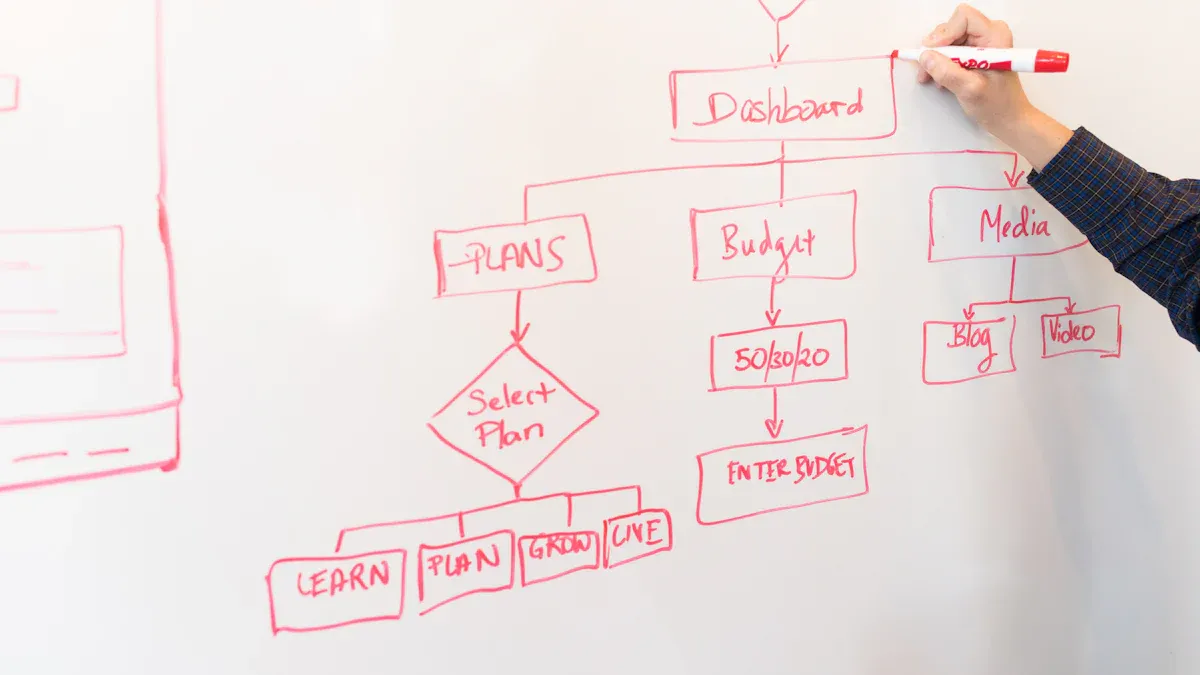
Organizations often struggle to maintain efficient business processes as they grow and adapt. Teams can spot inefficiencies by observing common signs that disrupt workflow and reduce productivity.
Poor cross-team collaboration creates bottlenecks and delays.
Siloed data prevents teams from gaining cross-functional insights for decision-making.
Outdated processes fail to meet the changing needs of the business.
Business process analysis helps teams uncover these issues by examining how tasks move between departments. Leaders use this approach to identify areas where communication breaks down or where steps become redundant. When teams address these inefficiencies, they improve overall performance and reduce frustration.
Tip: Regular reviews of business processes allow organizations to catch inefficiencies early and respond before they impact results.
Analyzing Metrics
Teams rely on metrics to measure the performance of business processes. These metrics provide objective data that guides business process analysis and improvement efforts. The table below lists the most frequently used metrics and their descriptions:
Metric Type | Description |
|---|---|
Process efficiency metrics | Measure the resources used to complete a process. |
Process variance metrics | Measure variation in standard processes over time. |
Process effectiveness metrics | Measure the success of a process in achieving its desired outcome. |
Process control metrics | Evaluate conformance to business rules and regulatory standards. |
Continuous improvement metrics | Measure the impact of process improvements over a longer time period or against agreed objectives. |
Teams select metrics that align with their goals and track them over time. Business process management uses these measurements to compare current performance with desired outcomes. When teams notice negative trends, they investigate further using business process analysis to find root causes.
Prioritizing Changes
After identifying inefficiencies and analyzing metrics, organizations must decide which changes to address first. Several frameworks help teams prioritize improvements and manage change effectively. The table below summarizes popular models:
Framework Name | Description |
|---|---|
Kotter’s 8-Step Change Model | A structured approach to drive enterprise momentum through eight key steps. |
ADKAR Model | Focuses on shifting individual behaviors to facilitate change. |
Prosci 3-Phase Process | A model that outlines a three-phase process for managing change effectively. |
Deloitte’s Transformation Intelligence | Integrates data-driven insights for adaptive change management. |
Bridges’ Transition Model | Emphasizes the human side of change and the transition process. |
McKinsey’s Influence Model | Focuses on influencing organizational behavior to achieve change. |
Lewin’s Change Management Model | A foundational model that outlines a three-step process: unfreeze, change, refreeze. |
Satir Change Model | Addresses the emotional aspects of change and how to manage them. |
The Change Curve | Illustrates the emotional journey individuals go through during change. |
The 5 P’s of Change | A framework that outlines five key elements to consider in change management. |
Teams use these frameworks to evaluate the impact, urgency, and feasibility of proposed changes. They consider challenges such as inefficient workflow management, communication breakdowns, resistance to change, and lack of scalability. By applying a structured approach, organizations ensure that improvements to business processes deliver lasting benefits.
Note: Prioritizing changes helps organizations focus resources on the most critical improvements, reducing costs and increasing the likelihood of success.
Business Process Improvement Strategies
Streamlining Workflows
Organizations achieve greater efficiency by streamlining workflows. Teams use business process modeling to visualize each step and identify inefficiencies. Automation reduces task completion times and helps employees focus on higher-value activities. Continuous improvement encourages teams to adapt and refine their methods, leading to better operational outcomes.
Strategy | Impact on Workflow |
|---|---|
Business Process Modeling | Visualizes processes, identifies inefficiencies |
Automation | Reduces task completion times |
Continuous Improvement | Enhances operational efficiency and adaptability |
Data-Driven Decision Making | Informs strategic choices for growth |
Streamlined processes reduce redundancies and mistakes. Ticketing systems improve inquiry management and response times. Just-in-time inventory systems lower operational costs and boost responsiveness. Teams also benefit from centralized documentation, which minimizes miscommunication and improves access to information.
Regular feedback mechanisms create a culture of continuous improvement and support successful business process transformation.
Automating onboarding processes improves new employee experiences and retention.
Implementing ticketing systems enhances customer service efficiency.
Centralized documentation systems minimize miscommunication and improve access to information.
Regular feedback mechanisms create a culture of continuous improvement.
Standardization Techniques
Standardization plays a vital role in business process improvement. Consistent procedures lead to predictable outcomes and reduce errors. Simplified training helps new employees learn faster. Improved compliance ensures organizations meet regulatory requirements. Enhanced productivity results from efficient resource use, and easier performance measurement allows teams to identify bottlenecks and areas for improvement.
Impact of Process Standardization | Description |
|---|---|
Consistent Procedures | Leads to predictable outcomes and reduces errors. |
Simplified Training | Reduces the learning curve for new employees. |
Improved Compliance | Helps meet regulatory requirements effectively. |
Enhanced Productivity | Increases overall efficiency and reduces wasted resources. |
Easier Performance Measurement | Facilitates identification of bottlenecks and areas for improvement. |
Ocean Mist Farms achieved a 35% time savings by implementing standardized barcodes and data protocols. This example demonstrates how standardization can drive efficiency gains in business processes.
Standardizing operations ensures procedures are followed consistently. This approach leads to high-quality and predictable results. Customer satisfaction increases when organizations deliver reliable outcomes. Teams work more efficiently and effectively, supporting business process transformation.
Training and Change Management
Training is essential for successful business process improvement. Well-prepared staff members implement new processes effectively. Training provides the knowledge and skills needed to navigate changes and enhances overall success.
Step | Description |
|---|---|
1 | Outline the scope of your existing processes |
2 | Teach employees how to spot inefficiencies and opportunities for improvement |
3 | Educate employees about documentation of roles and assigned tasks |
4 | Highlight the need for consistency |
A learning management system (LMS) allows companies to measure and improve employee training success. Built-in analytics help monitor training completion rates. Online exams measure acquired knowledge, and employee satisfaction with the training process can be tracked.
Clear communication about the benefits of changes helps ease resistance. Involving employees in decision-making creates ownership and fosters engagement.
Communicate clearly about the benefits of changes to ease resistance.
Involve employees in decision-making to create ownership.
Lead by example to encourage team adoption of new processes.
Strong leadership commitment and clear communication are essential for effective change. Connecting training opportunities to long-term educational strategies enhances employee skills. Selecting user-friendly process management tools avoids complications and supports business process transformation.
Business Process Automation

Technology Solutions
Many organizations now rely on technology solutions to automate business processes. Adoption rates continue to rise, with nearly 60% of companies using some form of business process automation. Large enterprises lead the way, with 84% reporting active implementation. Hyperautomation has become a strategic priority for 90% of these organizations. They integrate artificial intelligence (AI), machine learning (ML), robotic process automation (RPA), Internet of Things (IoT), and business process mining to streamline operations.
Technology Solution | Description |
|---|---|
Low-Code Platforms | 87% of enterprise developers use these platforms to build and automate workflows efficiently. |
Hyperautomation Tools | Combine AI, ML, RPA, and IoT for advanced automation and analytics. |
Digital Process Automation | Focuses on automating operations, onboarding, and finance/accounting/legal functions. |
Financial services, manufacturing, healthcare, and retail sectors have adopted business process automation at higher rates. Most organizations use these solutions in operations, onboarding, and finance.
Automation Benefits
Business process automation offers several benefits that help organizations improve performance. Automated workflows reduce manual errors and increase productivity. Teams can focus on higher-value tasks instead of repetitive work. Automation also improves compliance by ensuring processes follow established rules.
Increased efficiency: Automated systems complete tasks faster than manual methods.
Enhanced accuracy: Automation reduces human error and improves data quality.
Better scalability: Organizations can handle more work without adding staff.
Improved compliance: Automated processes follow regulations and company policies.
Cost savings: Automation lowers operational expenses over time.
Tip: Automation frees employees to focus on creative and strategic activities, which supports innovation and growth.
Implementation Tips
Successful business process automation requires careful planning and execution. Medium-sized enterprises benefit from following best practices during implementation.
Use business process management technologies to optimize workflows and improve visibility.
Start with small projects that address specific pain points, but keep a long-term vision for broader automation.
Organize business process data before automating, since automation relies on accurate information.
Define scalable automation to support future growth and agility.
Evaluate needs and budget to set clear objectives before starting.
Choose modular and cloud-based solutions for flexibility.
Address change management by involving employees early and providing training.
Conduct pilot programs to test automation before full deployment.
Ensure data security and compliance by selecting platforms with strong encryption.
Measure return on investment and performance using key performance indicators and analytics tools.
Encourage employee buy-in by involving staff in the automation process.
Maintain compliance with regulations to protect sensitive data.
Track improvements after automation to ensure goals are met.
Note: Careful planning and employee involvement help organizations overcome challenges and maximize the benefits of business process automation.
Business Process Optimization and Measurement
Setting KPIs
Teams use key performance indicators (KPIs) to measure the success of business process optimization. KPIs help organizations track progress and identify areas for improvement. Systems and teams often rely on KPIs to guide decision-making and ensure that changes deliver measurable results. The table below shows some of the most effective KPIs for business process monitoring:
KPI | Description |
|---|---|
Cycle time | The total time it takes to complete an end-to-end process |
Defect rate | The percentage of outputs that fail to meet quality standards |
First pass yield | The percentage of units that pass through a process without requiring rework |
Capacity utilization | How much of the total process capacity is being used |
Cost per unit | The average cost incurred to produce one unit of output |
Teams select KPIs that match their goals. For example, a client using systems and teams improved cycle time by tracking each step and removing bottlenecks. Business process monitoring with KPIs helps organizations respond quickly to changes and maintain high standards.
Testing and Piloting
Testing and piloting new improvements allow organizations to reduce risks and improve efficiency. Teams conduct pilot runs to identify problems early and replicate actual production conditions. Quality control measures and thorough documentation support reliable results. Cross-functional teams participate in testing to ensure that all aspects of the process work as intended.
Conduct a pilot run to identify issues before full implementation.
Replicate actual production conditions for accurate results.
Implement quality control measures and document findings.
Involve cross-functional teams for comprehensive testing.
Define clear goals and objectives for the pilot run.
Establish KPIs to monitor performance during the pilot.
Clients at systems and teams have achieved better outcomes by involving employees from different departments in pilot projects. This approach helps organizations refine business processes and avoid costly mistakes.
Tip: Piloting new processes on a small scale allows teams to learn and adjust before rolling out changes company-wide.
Communicating Results
Clear communication of results supports ongoing business process optimization. Teams share findings from business process monitoring with stakeholders to build trust and encourage collaboration. Regular updates help everyone understand the impact of changes and support continuous improvement.
Organizations use dashboards, reports, and meetings to present KPI data. Teams highlight successes and discuss areas for further improvement. For example, a client at systems and teams shared cycle time reductions with their staff, which motivated employees to maintain high performance.
Use visual dashboards to display KPI trends.
Schedule regular meetings to review progress.
Encourage feedback from all team members.
Note: Transparent communication helps organizations celebrate achievements and address challenges together.
Business process optimization relies on measuring results, testing changes, and sharing outcomes. Systems and teams play a key role in helping organizations achieve lasting improvements by focusing on data-driven strategies and open communication.
Continuous Improvement in Business Processes
Review Cycles
Continuous improvement depends on regular review cycles. Teams that evaluate performance frequently can adjust quickly and maintain high standards. Strategies for performance management work best when applied continuously. This approach allows for timely feedback and supports ongoing improvement. Regular feedback helps employees understand their strengths and areas for growth.
Review Frequency | Description |
|---|---|
Annual | Traditional yearly reviews, less frequent feedback. |
Biannual | Reviews conducted twice a year, allowing for more regular feedback. |
Quarterly | Frequent reviews that support ongoing improvement and adaptability. |
Organizations often find that quarterly reviews encourage adaptability and faster progress. Continuous performance management cycles outperform traditional methods. Teams that receive feedback more often can respond to challenges and improve business processes more effectively.
Tip: Frequent reviews help teams stay focused and motivated throughout the year.
Fostering Innovation
Innovation drives progress in business process management. Successful organizations establish clear innovation strategies that align with their goals. Leadership demonstrates commitment by supporting creativity and risk-taking. Employees participate in the innovation process, sharing ideas and experimenting with new approaches.
Step | Strategy Description |
|---|---|
1 | Establish a clear and robust innovation strategy that aligns with business objectives. |
2 | Cultivate a culture of innovation that encourages creativity and risk-taking. |
3 | Implement structured innovation processes to bring ideas to life effectively. |
A culture that supports experimentation and learning from failure is essential. Dedicated innovation teams use agile methods to transform ideas into real improvements. Effective innovation management includes a clear roadmap and structured processes. This approach helps organizations adapt and grow in changing environments.
Leadership should show commitment to innovation.
Employees should contribute to the innovation process.
Teams benefit from an environment that encourages learning and experimentation.
Adapting to Change
Adapting to change is vital for long-term success. In the 21st century, technology advances rapidly and shapes how organizations operate. Companies must recognize shifts in technology and implement new tools to meet market demands. Agile organizations respond quickly and see better financial performance.
Evidence | Description |
|---|---|
Agile Organizations | A study by Deloitte found that agile organizations are 3 times more likely to see positive financial performance. |
Gartner Prediction | Gartner predicts that by 2026, around three-quarters of all new applications will be built using low-code technologies. |
Decision-Making Speed | Organizations with a flat and decentralized structure could make decisions and implement changes 30% faster than hierarchical peers. |
Teams that embrace agility and decentralized decision-making can adapt faster than their competitors. Low-code technologies will play a major role in future business process improvements. Companies that stay flexible and open to change maintain a competitive edge.
Note: Adapting quickly to new technology and market trends helps organizations grow and succeed.
To improve business processes, experts recommend these steps:
Map the current process.
Define business challenges.
Use data to guide decisions.
Focus on efficiency, quality, and agility.
Prioritize areas for improvement.
Ongoing process management helps teams align goals, boost engagement, and support growth. Leaders who value continuous improvement see better results. For those seeking to learn more, many courses offer practical tools and strategies. Reach out to us for guidance on your journey.
FAQ
What is the main goal of business process improvement?
The main goal is to make workflows more efficient and effective. Teams want to reduce waste, save time, and improve quality. This helps organizations deliver better results and stay competitive.
How does business process re-engineering differ from regular process improvement?
Business process re-engineering involves redesigning core processes from the ground up. Teams often use this approach for major changes. Regular process improvement focuses on making small, ongoing adjustments to existing workflows.
Why should organizations use business process software?
Business process software helps teams map, monitor, and automate workflows. It increases visibility, reduces errors, and supports better decision-making. Many organizations use this software to manage complex processes and track progress.
How can teams measure the success of process changes?
Teams use key performance indicators, such as cycle time and defect rate, to measure success. These metrics show if changes lead to better results. Regular tracking helps teams adjust and improve over time.
What role do employees play in process improvement?
Employees provide valuable feedback and ideas. Their involvement helps identify problems and test solutions. When employees take part in process improvement, organizations see better results and higher engagement.
When should a company consider automating a business process?
A company should consider automation when a process is repetitive, time-consuming, or prone to errors. Automation works best for tasks that follow clear rules and do not require complex decision-making.
How often should organizations review their business processes?
Organizations should review processes at least once a year. Many teams find that quarterly reviews help them adapt faster and catch problems early. Regular reviews support continuous improvement.


