3 Easy Steps to Quick Business Optimization Wins

Business Optimization often begins with simple actions that deliver fast results. The three easiest Optimization Steps include setting clear goals, streamlining communication, and automating routine tasks. Many clients and customers see operational costs drop by up to 40% when they reduce unnecessary activities, while over 80% report better performance using AI tools. The table below highlights common strategies and their impact:
Optimization Strategy | Description | Reported Impact |
|---|---|---|
Lean Methods | Reduce costs by eliminating unnecessary activities | 5–40% reduction in operational costs |
AI Tools | Automate routine tasks for improved efficiency | 82% of users report better operational performance |
Cloud Systems | Enhance flexibility and efficiency | 94% of small businesses use at least one cloud service |
Key Takeaways
Set clear objectives to align your team's efforts with the company's long-term vision. This clarity boosts motivation and performance.
Define measurable targets to track progress and empower your staff. Specific goals lead to better accountability and ownership.
Identify quick wins by spotting inefficiencies in workflows. Small changes can lead to significant improvements in productivity.
Streamline communication through daily check-ins and clear messaging guidelines. This enhances collaboration and project completion rates.
Automate repetitive tasks to save time and reduce errors. Automation allows employees to focus on more strategic work.
Choose the right communication tools to reduce email overload. Instant messaging apps can improve response times and team morale.
Conduct regular process reviews to maintain progress and adapt to changes. This ensures continuous improvement and relevance.
Celebrate small wins to keep your team motivated and engaged. Recognizing achievements fosters a positive work environment.
Business Optimization Goals

Setting Clear Objectives
Aligning with Long-Term Vision
Successful companies begin Business Optimization by setting clear objectives that align with their long-term vision. Leaders step away from daily operations and review the company’s strategic direction. They seek feedback from team members and make goals specific, measurable, achievable, relevant, and time-bound. Sharing these objectives with the team ensures everyone understands the purpose and direction.
Clear objectives provide direction and align efforts across the organization. They create a framework for tracking progress and foster collaboration, amplifying impact.
Research from Dominican University of California shows that individuals who write down specific goals achieve about 42% higher success rates. This highlights the importance of clarity and documentation in reaching business targets.
Defining Measurable Targets
Defining measurable targets is essential for Business Optimization. Specific goals clarify what needs to be accomplished and who is responsible. Measurable goals enable tracking of progress and achievement. Setting objectives empowers staff and fosters ownership of performance. Challenging but achievable goals can lead to 90% better performance. Measurable goals help organizations track performance and make informed decisions. They translate industry standards into actionable strategies and drive continuous improvement.
Component | Description | Example |
|---|---|---|
Specific | Clearly defines what you want to accomplish, leaving no room for confusion. | Increase online sales of product X by 15% in Q3. |
Measurable | Allows tracking progress using data and KPIs. | Monitor weekly revenue or customer engagement rates. |
Achievable | Goals should be realistic and consider current resources and team capacity. | Plan incremental growth rather than doubling revenue in a month. |
Relevant | Aligns with overall business vision and strategic priorities. | Focus on increasing sales in core market. |
Time-Bound | Includes a clear deadline to create urgency and maintain focus. | Complete the marketing campaign by October 31st. |
Identifying Quick Wins
Spotting Inefficiencies
Business Optimization often starts by identifying processes that can be improved for immediate results. Teams look for inefficiencies in workflows, such as redundant tasks or outdated procedures. They focus on areas where small changes can deliver rapid improvements. Unclear or unrealistic objectives can demotivate the team. A lack of planning and clear, achievable goals may lead to staff dissatisfaction and unrest, affecting productivity and morale.
Prioritizing Impactful Changes
Companies prioritize impactful changes by using criteria such as implementation speed, visibility, resource efficiency, measurable outcomes, and alignment with strategic goals. Quick wins can be executed within 30-90 days, ensuring rapid value delivery. High-impact quick wins tackle widely recognized issues, leading to immediate positive feedback. Optimal opportunities require minimal investment and staff time, maximizing return on effort. Effective quick wins yield quantifiable results that can be tracked and reported. They support broader organizational objectives in shift planning and workforce management.
Criteria | Description |
|---|---|
Implementation Speed | Quick wins can be executed within 30-90 days, ensuring rapid value delivery. |
Visibility Factor | High-impact quick wins tackle widely recognized issues, leading to immediate positive feedback. |
Resource Efficiency | Optimal opportunities require minimal investment and staff time, maximizing return on effort. |
Measurable Outcomes | Effective quick wins yield quantifiable results that can be tracked and reported. |
Alignment with Strategic Goals | Quick wins should support broader organizational objectives in shift planning and workforce management. |
Tip: Involve the team in the goal-setting process to ensure relevance and feasibility. Set clear, measurable, and achievable goals to avoid obstacles and maintain motivation.
Streamline Communication
Improving Team Collaboration
Daily Check-Ins
Teams that communicate regularly complete projects faster and with higher quality. Daily check-ins help everyone stay aligned and address issues before they grow. These short meetings allow team members to share updates, clarify priorities, and ask for support. Leaders who encourage daily check-ins see improvements in project completion rates, work quality, and overall collaboration.
Project completion rates rise when teams communicate clearly.
Quality of work improves as team members pay more attention to detail.
Team collaboration strengthens, leading to better results.
Daily check-ins also create a routine that keeps everyone focused and motivated.
Clear Messaging Guidelines
Clear messaging guidelines ensure that every team member understands expectations. Teams that use simple language and avoid jargon reduce confusion. Leaders set standards for response times and preferred channels for different types of messages. This structure helps everyone know when to use email, instant messaging, or meetings.
Clear communication aligns all team members and builds a positive work culture.
Setting clear goals gives direction and motivation.
Employee empowerment increases engagement and innovation.
Investing in employee development boosts skills and job satisfaction.
When teams follow clear messaging guidelines, they avoid misunderstandings and work more efficiently.
Choosing Communication Tools
Reducing Email Overload
Many teams struggle with too many emails, which slows down decision-making and causes important messages to get lost. High-performing teams use tools like Microsoft Outlook, Gmail, and Google Workspace to organize messages and filter out distractions. They set rules for when to use email and encourage short, direct messages.
Poor communication can cost businesses up to $1.2 trillion each year in lost productivity. Most business leaders report decreased productivity, higher costs, and lower customer satisfaction due to ineffective communication. Lost deals and damaged brand reputation often result from unclear or delayed messages.
Using Instant Messaging Apps
Instant messaging apps like Slack and Microsoft Teams help teams communicate quickly and share files easily. Zoom provides reliable video conferencing for remote meetings. These tools allow teams to respond in real time, reducing delays and improving collaboration.
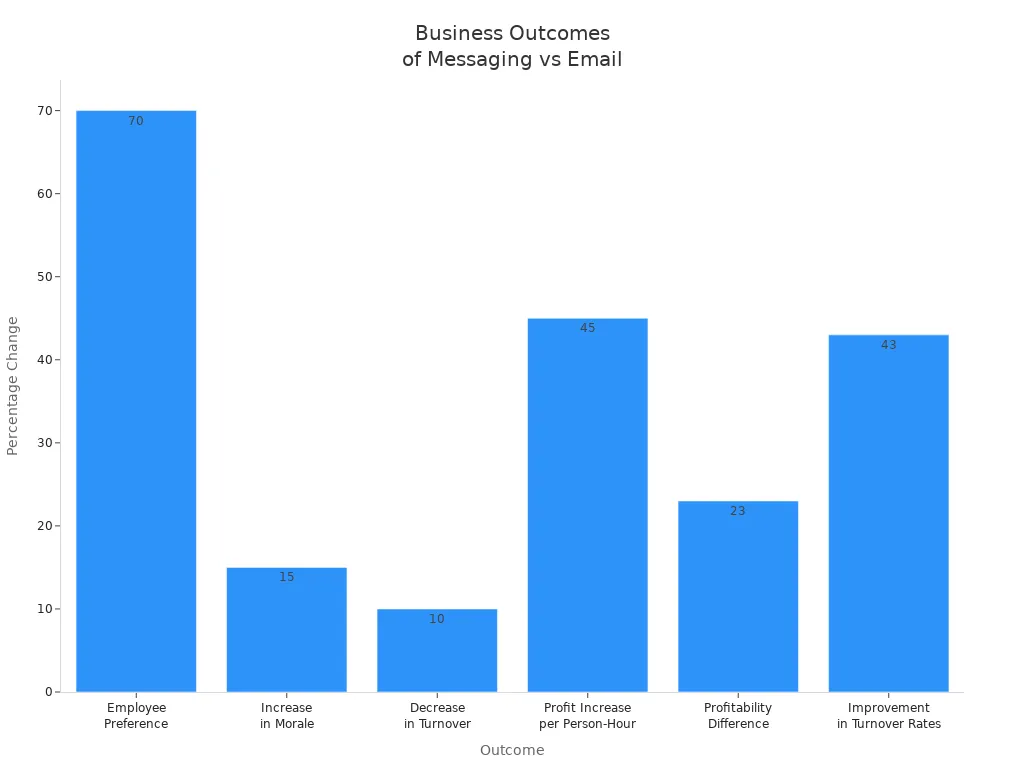
Outcome | Measurement |
|---|---|
Employee Preference | 70% of employees prefer text communication |
Increase in Employee Morale | 15% increase in morale |
Decrease in Turnover | 10% decrease within the first year |
Profit Increase per Person-Hour | 45% increase |
Profitability Difference | 23% difference in profitability |
Improvement in Turnover Rates | 43% improvement |
Switching to instant messaging apps leads to higher employee morale, lower turnover, and increased profitability. Teams that use these tools respond faster and make better decisions, which supports Business Optimization.
Automation for Efficiency

Automation stands out as a quick win for Business Optimization. Many organizations, including clients at systems and teams, have streamlined operations and achieved rapid improvements by automating repetitive tasks. Automation tools help companies save time, reduce errors, and boost productivity.
Easy Automation Tools
Automating Repetitive Tasks
Automating routine tasks allows employees to focus on more strategic work. Workers often spend hours on manual processes, such as data entry or scheduling. By using automation, companies reclaim over 100 hours per employee each year. Nearly 60% of workers believe automation could save them six or more hours every week. Systems and teams have implemented automation to eliminate repetitive tasks, resulting in faster workflows and improved accuracy.
Tip: Start with tasks that require little decision-making, such as invoice processing or appointment reminders. Automation frees up valuable time for creative and high-impact projects.
Integrating Simple Software
Small businesses can choose from a variety of easy-to-use automation tools. These solutions require minimal technical expertise and offer quick setup. Popular options include:
Zapier: User-friendly for non-technical teams, with pre-built templates and flexible pricing.
Microsoft Power Automate: Integrates with over 1,400 apps and provides AI-driven workflow optimization.
UiPath: Automates back-office tasks with AI-powered bots.
HubSpot CRM: Automates sales and customer service workflows.
Nintex: Drag-and-drop interface for designing workflows.
Trello: Built-in automation for task management.
Symphona: No-code platform for advanced automation solutions.
Clients at systems and teams have used these tools to automate processes like onboarding, reporting, and customer follow-ups. This approach delivers quick business optimization wins without requiring large investments.
Measuring Automation Impact
Tracking Time Savings
Measuring the impact of automation helps organizations understand its value. Companies track time savings by comparing hours spent on manual tasks before and after automation. Automation can save over 100 hours annually per employee. Many businesses achieve a return on investment of 240% within a few months and recover their investment in automation within six to nine months.
Evidence Description | Percentage |
|---|---|
Workers reporting increased productivity due to automation | 90% |
Employees stating automation tools accelerate workflow | 70% |
Employees reporting higher job satisfaction from automation | 88% |
Reducing Errors
Automation reduces manual errors and improves reliability. Organizations monitor key performance indicators to evaluate success:
KPI | Description |
|---|---|
Cycle Time Reduction | Measures process speed after automation. |
Error Reductions | Tracks accuracy and fewer manual interventions. |
Quality Output | Assesses reliability and quality of automated tasks. |
Better Productivity | Evaluates task completion rates and resource utilization. |
Motivated Staff | Gauges employee satisfaction and retention. |
ROI / Cost Reduction | Analyzes financial impact and savings. |
Reliability | Estimates system reliability and downtime. |
Customer Satisfaction | Measures improvements in customer experience. |
AI enhances operational efficiency measurement by providing real-time tracking and predictive analytics. This technology helps leaders identify inefficiencies and optimize processes. Clients at systems and teams have used these metrics to track improvements and sustain high performance.
Note: Align operational improvements with customer satisfaction to ensure that efficiency gains translate into better service.
Sustaining Optimization
Continuous Improvement
Regular Process Reviews
Regular process reviews help organizations maintain progress and identify new opportunities for improvement. Most businesses conduct these reviews at least once a year, especially if they follow structured management systems like ISO 9001. Reviews also take place after major changes, such as shifts in personnel or when incidents reveal inefficiencies. For new processes, frequent monitoring allows teams to catch problems early. Emergency reviews may be necessary after unexpected events. This routine ensures that Business Optimization efforts remain effective and relevant.
Tip: Schedule process reviews on a calendar and involve team members from different departments. This approach brings diverse perspectives and uncovers hidden issues.
Adapting to Change
Companies that adapt quickly to change stay competitive. They use proven models to guide their improvement efforts. The table below highlights several effective continuous improvement models for small and medium-sized enterprises:
Description | |
|---|---|
PDCA Cycle | A structured, iterative approach for testing and adjusting improvements. |
Agile Methodology | Focuses on adaptability and teamwork for fast responses to market shifts. |
5S Methodology | Organizes the workspace for better efficiency and safety. |
Kanban Method | Uses visual tools to manage workflow and control tasks in progress. |
Total Quality Management (TQM) | Involves all employees in quality improvement and customer satisfaction. |
Successful organizations also follow best practices for long-term optimization:
Craft an effective strategy statement to guide decisions.
Develop and implement core processes for streamlined operations.
Empower the workforce to create a positive environment.
Use data-driven decisions for better outcomes.
Say "no" to non-essential activities to focus resources.
Build a culture of continuous improvement.
Overcoming Challenges
Addressing Resistance
Many businesses face resistance when introducing new processes. Employees may feel anxious about job security or uncomfortable with changes to their routines. Leaders can overcome these challenges by:
Engaging employees in the change process.
Communicating clearly about what will change and why.
Providing training and support.
Celebrating milestones to boost morale.
Identifying champions of change within the team.
Implementing changes gradually to avoid overwhelming staff.
Celebrating small wins reminds employees that their efforts matter and helps maintain a positive atmosphere.
Keeping Momentum
Maintaining progress requires ongoing effort. Teams should set clear goals, track key performance indicators, and review results regularly. The table below outlines common challenges and solutions for sustaining optimization:
Challenge | Solutions |
|---|---|
Communicate, train, involve stakeholders. | |
Integrating New Technologies | Plan, test, ensure compatibility, seek expert advice. |
Measuring and Sustaining Improvements | Set KPIs, use continuous improvement programs, conduct regular reviews. |
Managing Resource Constraints | Prioritize initiatives, use external expertise, optimize resource allocation. |
Leaders who keep momentum celebrate achievements, address obstacles quickly, and encourage feedback. This approach helps organizations sustain Business Optimization and adapt to future challenges.
Business optimization becomes achievable with three easy steps: setting clear goals, streamlining communication, and automating tasks. These actions deliver improved efficiency, enhanced productivity, and greater customer value:
Benefit | Description |
|---|---|
Improved Efficiency | Streamlined operations remove bottlenecks and redundancies. |
Enhanced Productivity | LEAN tools foster continuous improvement and operational excellence. |
Greater Customer Value | Optimized processes lead to better customer experiences and increased value. |
Simple strategies, such as those in the MOST framework, allow for rapid and effective implementation. Teams who track progress can adjust strategies and stay aligned with market needs. Celebrating quick wins builds confidence, validates investment, and sustains momentum. For more insights on business optimization, readers can reach out to systems and teams.
FAQ
What is Business Optimization?
Business Optimization means improving processes, systems, and workflows. Companies use it to increase efficiency, reduce costs, and deliver better results. Leaders focus on quick wins and measurable improvements.
How can a company set clear objectives?
A company sets clear objectives by defining specific goals. Leaders make targets measurable and achievable. Teams align these goals with the company’s vision and track progress regularly.
Which communication tools help teams work faster?
Teams use instant messaging apps, video conferencing, and organized email platforms. These tools help employees share information quickly and reduce delays. Leaders choose tools that fit their team’s needs.
Why is automation important for Business Optimization?
Automation saves time and reduces errors. Employees use automation tools to handle repetitive tasks. Companies see higher productivity and improved accuracy when they automate routine processes.
How do leaders measure the impact of optimization?
Leaders track key performance indicators. They measure time savings, error reduction, and productivity increases. Companies review these metrics to see if Business Optimization delivers real benefits.
What challenges do teams face during optimization?
Teams face resistance to change, technology integration issues, and resource constraints. Leaders address these challenges by communicating clearly, providing training, and involving employees in the process.
How often should companies review their processes?
Companies review processes at least once a year. Leaders also conduct reviews after major changes or when problems arise. Regular reviews help teams find new ways to improve.
Can small businesses benefit from Business Optimization?
Small businesses benefit by streamlining operations and automating tasks. They use simple tools and focus on quick wins. Business Optimization helps them compete and grow.


