What are Business Process Improvement Methodologies and why care
Business Process Improvement Methodologies describe structured approaches that organizations use to analyze and enhance their workflows. These methods help businesses adapt quickly and deliver better outcomes for clients and customers. Many leaders recognize the value of optimization steps:
83% view process optimization as a tool for driving value and rapid change.
82% stress its importance during economic instability to improve cash flow.
Benefit | Description |
|---|---|
Cost Savings | Organizations reduce operational costs by eliminating inefficiencies and improving resource allocation. |
Quality Improvements | Automation and workflow optimization enhance the quality of outputs and reduce manual errors. |
People in management and professional roles often see these improvements lead to faster results and higher satisfaction. Real-world impact motivates ongoing adoption and refinement.
Key Takeaways
Business Process Improvement Methodologies help organizations analyze and enhance workflows for better results.
Structured approaches lead to measurable improvements in efficiency, quality, and customer satisfaction.
Involving employees at all levels fosters engagement and motivation for successful change.
Using data to identify problems ensures that solutions are based on facts, leading to better decision-making.
Continuous improvement creates a culture that helps organizations adapt and thrive in changing markets.
Choosing the right methodology aligns with business goals and maximizes the impact of improvement efforts.
Regularly reviewing processes and celebrating small wins keeps teams motivated and focused on progress.
Effective change management and leadership support are crucial for overcoming challenges and ensuring success.
What Are Business Process Improvement Methodologies

Definition and Principles
Business Process Improvement Methodologies offer structured systems for organizations to analyze and enhance their workflows. These methods rely on core principles that guide teams toward better results. The following table highlights these principles and their impact on business outcomes:
Contribution to Business Results | |
|---|---|
Defining Value | Aligns products and services with customer needs. |
Mapping Value Stream | Reveals inefficiencies and waste in processes. |
Creating Flow | Reduces delays and interruptions for smoother operations. |
Establishing Pull | Matches production to customer demand, improving responsiveness. |
Pursuing Perfection | Drives continuous improvement for long-term excellence. |
Teams focus on the customer, use data to measure progress, and map processes to find areas for improvement. They also work to reduce variation and pursue ongoing enhancements. These principles help organizations deliver quality and efficiency.
Purpose and Objectives
Organizations use Business Process Improvement Methodologies to reach several important goals. The main objectives include:
Streamlining workflows to remove redundancies and bottlenecks.
Reducing operational costs while improving quality.
Enhancing customer satisfaction by improving product or service delivery.
Increasing overall productivity and efficiency across the organization.
Fostering a culture of continuous improvement for lasting success.
These objectives help businesses stay competitive and responsive in changing markets.
Methodologies vs. Simple Process Changes
Business Process Improvement Methodologies differ from simple process changes in several ways. The table below compares these two approaches:
Aspect | Business Process Improvement Methodologies | Simple Process Changes |
|---|---|---|
Approach | Structured frameworks | Ad-hoc changes |
Outcomes | Sustainable and measurable improvements | Inconsistent outcomes |
Implementation Strategy | Comprehensive strategy | Often lacks systematic approach |
Teams that use structured methodologies follow a clear plan and measure their results. This leads to sustainable improvements. Simple process changes often lack a systematic approach and may not deliver consistent results. Organizations that choose structured methods can achieve long-term gains and avoid repeated mistakes.
Why Business Process Improvement Matters
Efficiency and Cost Savings
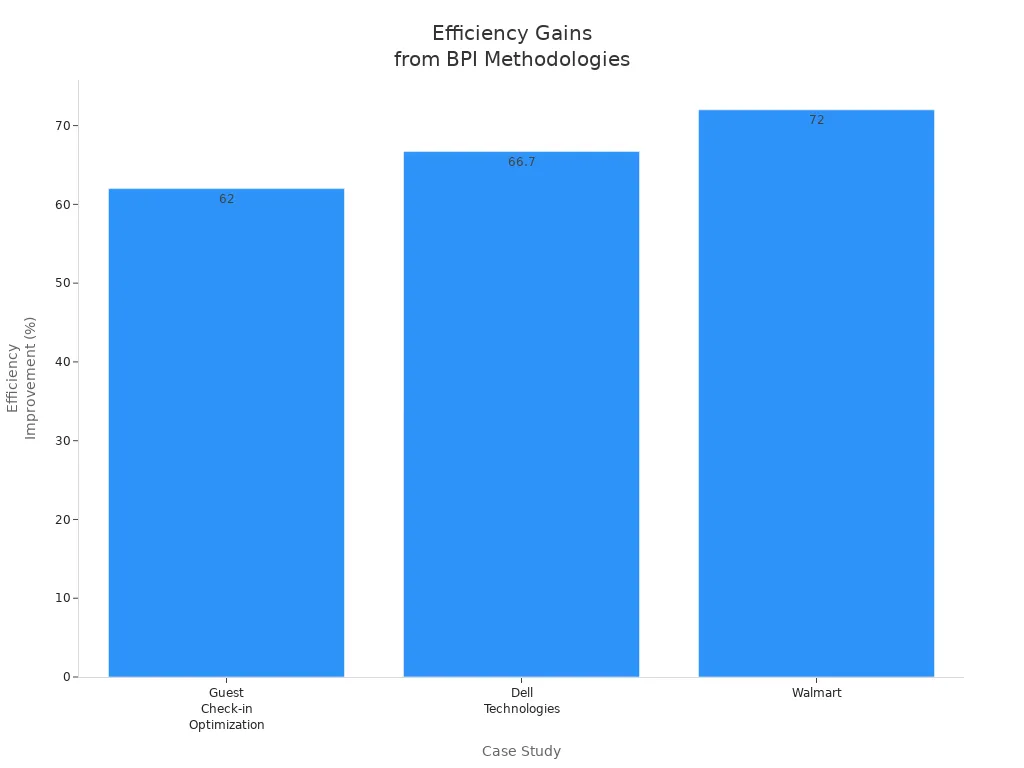
Organizations often seek ways to operate more efficiently and reduce expenses. Business Process Improvement Methodologies help teams identify bottlenecks and eliminate unnecessary steps. These methods lead to measurable gains in speed and resource utilization. For example, companies in hospitality, technology manufacturing, and retail have achieved significant improvements:
Case Study | Industry | Problem | Results | Impact |
|---|---|---|---|---|
Guest Check-in Optimization | Hospitality | Long check-in times | Reduced from 8.5 to 3.2 minutes (62% improvement) | Increased guest satisfaction scores by 28% |
Dell Technologies | Technology Manufacturing | Long lead times and high inventory costs | Reduced order-to-delivery time from 21 to 7 days, $47M annual savings | Improved supplier performance ratings by 34% |
Walmart | Retail | Stock-outs and overstock | Stock-out rate decreased from 6.8% to 1.9% (72% improvement) | Released $125M in working capital |
Teams also benefit from cost savings in several ways:
Reduced risk of project delays and associated costs.
Improved scheduling and decreased cycle time on equipment maintenance.
Consistent on-time completion of projects, which reduces fines and waste.
Fewer errors and less rework, resulting in lower labor costs.
Improved resource utilization, reducing overtime costs.
Reduced waste by eliminating inefficiencies, allowing better resource allocation.
Faster time-to-market due to shortened lead times.
Reduced inventory costs, freeing up cash and space.
Quality and Customer Value
Quality improvement remains a central goal for many organizations. Business Process Improvement Methodologies support higher standards by reducing errors and streamlining workflows. Teams use these methods to deliver products and services that meet customer expectations. The following table shows how different approaches impact quality in healthcare and other industries:
Methodology | Impact on Quality | Example |
|---|---|---|
Six Sigma | Reduced patient wait times and improved care | Healthcare |
Lean | Optimized patient flow and minimized delays | Healthcare |
TQM | Raised care standards and reduced errors | Healthcare |
Kaizen | Encouraged small, ongoing changes for quality gains | General |
Improved processes lead to faster turnaround times, higher quality products or services, and more reliable delivery schedules. These changes contribute to customer satisfaction. Teams often create clear standards for service quality, respond faster to customer requests, and personalize services based on feedback. Customers find it easier to interact with companies and receive timely solutions.
Methodology | Impact on Customer Satisfaction |
|---|---|
Lean | Faster service, fewer mistakes |
Six Sigma | Consistent quality, reliable outcomes |
Kaizen | Ongoing improvements, better experiences |
TQM | Organization-wide focus on customer needs |
Identifying and fixing problems that frustrate customers.
Making it easier for customers to get help when they need it.
Competitive Advantage
Companies that invest in process improvement gain a strong position in the market. They operate more efficiently, deliver higher quality, and respond quickly to customer needs. Statistical data shows that businesses prioritizing process improvement experience:
An average of 20% increase in operational efficiency within the first year.
A 40% reduction in production defects over five years.
A 30% decrease in operational costs.
A 25% increase in customer satisfaction.
These results help organizations outperform competitors and adapt to changing demands. Teams that use Business Process Improvement Methodologies build lasting advantages and maintain leadership in their industries.
Risks of Not Improving
Organizations that ignore business process improvement face serious challenges. These risks can affect performance, employee morale, and long-term success. Leaders who do not address process weaknesses may see their teams struggle with daily tasks.
One major risk involves misalignment within the organization. When teams do not share the same goals or strategies, projects often fail. Employees may work in different directions, which leads to confusion and wasted effort. This misalignment can prevent companies from reaching their targets.
Another common problem is the lack of executive support. Without strong leadership, improvement projects may not receive the resources or attention they need. Leaders set the tone for change. If they do not support new initiatives, teams may lose motivation. Projects can stall or fail before they deliver results.
A culture that does not value continuous improvement also creates problems. Employees may resist change if they do not see its benefits. Teams that avoid new ideas often fall behind competitors. Over time, this attitude can make it difficult for organizations to adapt to market changes or customer needs.
Poor change management adds another layer of risk. When leaders do not manage transitions well, employees may feel uncertain or frustrated. This resistance can slow down progress and increase the chance of project setbacks. Teams need clear communication and training to adjust to new processes.
The table below summarizes these risks and their impact:
Risk Description | Explanation |
|---|---|
Misalignment within the organization | Internal misalignment can lead to ineffective process improvements and project failures. |
Lack of executive support | Without buy-in from top management, projects may lack necessary resources and direction. |
Absence of a continuous improvement culture | A culture that does not support ongoing improvement can hinder the success of initiatives. |
Inadequate change management | Poor management of changes can result in employee resistance and project setbacks. |
Note: Ignoring process improvement does not just slow growth. It can also increase costs, lower quality, and reduce customer satisfaction. Over time, these issues can damage a company’s reputation and make it harder to compete.
Types of Business Process Improvement Methodologies
Lean
Lean stands as one of the most popular approaches for improving business processes. Organizations use Lean to remove waste, increase value, and create efficient workflows. Lean focuses on delivering what customers want while using the fewest resources possible.
Waste Reduction
Lean identifies and removes activities that do not add value. These activities are called "waste." By reducing waste, companies save money and time. The following tools help teams find and eliminate waste:
5S: Organizes the workplace for efficiency.
Value Stream Mapping: Shows the flow of materials and information.
Just-In-Time (JIT): Produces only what is needed, when it is needed.
Kanban: Uses visual signals to control work in progress.
Poka-Yoke: Prevents mistakes before they happen.
Total Productive Maintenance (TPM): Keeps equipment running smoothly.
The table below shows how Lean practices improve operational efficiency:
Lean Principle/Practice | Impact on Operational Efficiency |
|---|---|
Elimination of Waste | Reduces resource use and costs by removing non-value activities. |
Value Stream Mapping | Finds bottlenecks and inefficiencies in processes. |
Standardization | Ensures consistent quality and reduces variation. |
Pull System | Matches production to demand, preventing overproduction. |
Shorter Lead Times | Delivers products faster, increasing customer satisfaction. |
Higher Quality | Reduces defects and complaints through error prevention. |
Continuous Improvement | Encourages ongoing changes to meet customer needs. |
Value Creation
Lean does not just remove waste. It also helps teams focus on what customers value most. By mapping the value stream, organizations see every step in a process. They can then improve steps that add value and remove those that do not. This approach leads to better products, happier customers, and lower costs.
Six Sigma
Six Sigma is another widely used method for process improvement. It uses data and statistics to find and fix problems. Six Sigma aims to reduce defects and make processes more reliable.
Data-Driven Quality
Six Sigma uses a structured approach called DMAIC. This stands for Define, Measure, Analyze, Improve, and Control. Each phase helps teams solve problems and improve quality:
Define the problem and set goals.
Analyze data to find root causes.
Improve the process by implementing solutions.
Control the process to maintain improvements.
Teams use data at every step. This ensures that changes are based on facts, not guesses. Six Sigma helps organizations achieve higher quality and greater customer satisfaction by reducing variation.
Defect Reduction
Six Sigma focuses on finding and removing the causes of defects. In healthcare, for example, Six Sigma has helped improve patient flow, increase diagnostic accuracy, and reduce infection rates. The table below shows some results from Six Sigma projects in healthcare:
Area of Improvement | Result Description |
|---|---|
Patient Flow | Improved movement of patients in emergency departments. |
Diagnostic Accuracy | Increased accuracy in clinical labs. |
Perioperative Pathways | Streamlined surgical care processes. |
Infection Rates | Lowered infection rates. |
Pharmacy Operations | Made pharmacy work more efficient. |
Insurance Claims | Reduced claim rejections. |
Six Sigma projects often lead to shorter hospital stays, better use of resources, and more precise cost control. These results show how data-driven methods can make a real difference in quality and efficiency.
Kaizen
Kaizen is a Japanese word that means "change for the better." It is both a philosophy and a method for continuous improvement. Kaizen encourages everyone in an organization to look for small ways to improve their work every day.
Continuous Improvement
Kaizen focuses on making small, steady changes instead of waiting for big breakthroughs. The core ideas include:
Make incremental changes to improve efficiency and quality.
Involve employees at all levels in the improvement process.
Aim for ongoing enhancements, not just one-time fixes.
Kaizen promotes a culture where teams always look for ways to do things better. This mindset leads to lasting improvements over time.
Employee Involvement
Kaizen values the knowledge and experience of employees. Teams identify problems, analyze current processes, create practical solutions, test those solutions, measure results, and standardize what works. This approach builds teamwork and ownership.
Kaizen is one of the two foundational pillars of the Lean management system, emphasizing participation by everyone at all levels, every day. It is about changing the way things are and engaging employees in the improvement process.
Kaizen helps organizations build a culture of continuous improvement. Employees feel empowered to suggest changes and take part in making their workplace better.
PDCA Cycle
The PDCA Cycle stands for Plan-Do-Check-Act. Many organizations use this method to drive continuous improvement. The cycle provides a clear structure for teams to plan changes, test them, and evaluate results before making them permanent.
Iterative Steps
The PDCA Cycle supports iterative process improvement. Teams follow four main steps:
Plan: Identify a problem or opportunity. Develop a plan to improve the process.
Do: Implement the plan on a small scale. Test the change in a controlled setting.
Check: Measure and analyze the results. Compare outcomes to the original goals.
Act: Decide whether to adopt, adjust, or abandon the change. Standardize successful improvements.
The PDCA cycle offers a framework for planning, testing, and evaluating changes in a systematic manner. This approach helps teams test improvements on a small scale before wider implementation. It reinforces the idea of making gradual, data-driven enhancements.
Many businesses rely on the PDCA Cycle to test improvements in their processes. This method encourages teams to learn from each cycle and make further adjustments. Over time, organizations achieve better results through repeated use of the cycle.
5 Whys
The 5 Whys technique helps teams find the root cause of problems. This method uses a simple but powerful approach. By asking "Why?" multiple times, teams move beyond surface-level issues and uncover the real reason behind a problem.
Root Cause Analysis
To use the 5 Whys, teams follow these steps:
Define the problem clearly.
Ask "Why?" to identify the immediate cause.
Continue asking "Why?" four more times, each time digging deeper into the previous answer.
Address the root cause by developing and implementing a targeted solution.
For example, consider a company facing late shipments:
Why? Shipments are often late.
Why? The warehouse struggles to process orders on time.
Why? There’s a backlog of unscanned items.
Why? Scanning equipment frequently malfunctions.
Why? Preventive maintenance schedules are not followed.
By reaching the fifth "Why," the team discovers that missed maintenance causes the problem. They can then focus on improving maintenance schedules to prevent future delays.
The 5 Whys technique helps organizations solve problems at their source. Teams avoid treating only the symptoms and instead create lasting solutions.
Total Quality Management (TQM)
Total Quality Management (TQM) represents a comprehensive approach to long-term success. TQM involves everyone in the organization and focuses on meeting customer needs. This method shapes company culture and drives continuous improvement.
Organization-Wide Quality
TQM relies on several key principles that influence how organizations operate:
Principle | Description |
|---|---|
Customer Focus | Meeting and exceeding customer expectations remains the top priority. |
Total Employee Involvement | All employees participate in quality initiatives and feel engaged. |
Process-Centered Approach | Improving processes leads to better quality and efficiency. |
Integrated System | Every part of the organization works together toward quality goals. |
Strategic and Systematic Approach | TQM practices align with the organization's strategic objectives. |
Continual Improvement | Ongoing efforts enhance products, services, or processes. |
Fact-Based Decision Making | Data and analysis guide decisions. |
Communications | Effective communication supports TQM efforts at every level. |
Organizations that support employee development and empowerment see greater success with TQM. Consensus on quality practices helps teams work together. When everyone shares the goal of quality, the company builds a culture of continuous improvement.
Emphasizing quality as a shared goal creates a strong foundation for lasting organizational success.
Business Process Management (BPM)
End-to-End Optimization
Business Process Management (BPM) offers a comprehensive approach to improving how organizations operate. BPM stands out because it looks at the entire workflow, not just individual steps. This method ensures that every part of a process aligns with the company’s overall goals.
BPM provides several key benefits:
It emphasizes a holistic view of processes, making sure all steps support organizational objectives.
Teams gain visibility into the full process, which helps them spot bottlenecks and areas for improvement.
BPM focuses on the entire workflow, unlike other methods that may only target specific tasks.
This broad perspective leads to better efficiency and adaptability across the organization.
Stakeholders can make informed decisions because they see how each step connects to the bigger picture.
The approach allows for better alignment with strategic goals, helping companies stay competitive.
BPM helps organizations adapt quickly to changes in the market. By optimizing processes from start to finish, companies can deliver better results and respond to customer needs more effectively.
Theory of Constraints (TOC)
Bottleneck Focus
The Theory of Constraints (TOC) gives organizations a powerful way to improve their processes. Instead of trying to fix everything at once, TOC teaches teams to focus on the single most critical constraint. This targeted strategy ensures that resources go where they will have the greatest impact.
TOC operates on a clear principle: every system has at least one constraint that limits its performance. By identifying and improving this bottleneck, organizations can boost their overall results. The process follows a series of steps:
Identify the constraint.
Exploit the constraint by making the most of its capacity.
Subordinate other processes to support the constraint.
Elevate the constraint if more improvement is needed.
Repeat the process to find and address new constraints.
TOC helps teams maximize throughput and efficiency. By focusing on the weakest link, organizations can achieve significant improvements without wasting resources on less critical areas.
TOC’s step-by-step approach makes it easier for businesses to see where problems occur and take action. This method supports continuous improvement and helps companies reach their goals faster.
Choosing the Right Methodology
Assessing Business Needs
Organizations must first understand their unique needs before selecting a process improvement methodology. Leaders should clarify the main goal, whether it involves reducing defects, cutting waste, or encouraging ongoing change. The scale of the improvement project also matters. Large initiatives may require robust frameworks like Six Sigma or Business Process Management (BPM), while smaller projects can benefit from Kaizen or the PDCA Cycle.
A clear assessment helps teams choose the right approach. The table below outlines key criteria for evaluating business needs:
Criteria | Description |
|---|---|
Primary objective | Identify if the goal is to reduce defects, eliminate waste, or drive change. |
Scale of improvement | Decide if the project is large (Six Sigma/BPM) or small (Kaizen/PDCA). |
Team experience | Check if the team has skills for complex methods or needs simpler tools. |
Other important factors include:
Risk factors: Consider the risks and complexity of the project.
Project planning: Review the timeline, capacity, and change management needs.
Process maturity: Evaluate how well processes are documented and followed.
Fit for automation: Decide if automation is possible based on process complexity.
Value identification: Analyze how the process supports strategic goals and adds value.
Careful assessment ensures that organizations select a methodology that fits their goals and resources.
Organizational Readiness
Before starting a process improvement initiative, organizations should check if they are ready for change. Readiness depends on several factors, such as company culture, available resources, and the complexity of current processes. The following table highlights key factors to consider:
Key Factor | Explanation |
|---|---|
Match goals | Align business goals with the right methodology. |
Check culture | Understand if the culture supports involvement and change. |
Evaluate complexity | Assess if processes are simple or complex. |
Review resources | Ensure the team has the skills and tools needed. |
Consider timelines | Determine how quickly results are needed. |
Organizations of different sizes may benefit from different approaches:
Small teams (under 25 people) often start with Kaizen or PDCA for quick results.
Mid-size organizations (25–200 people) may use Lean, Agile, or Theory of Constraints (TOC).
Large enterprises (200+ people) often choose Six Sigma, Lean Six Sigma, or Total Quality Management (TQM).
A readiness check helps organizations avoid common pitfalls and prepares teams for successful improvement.
Matching Methodology to Goals
Each process improvement methodology offers unique strengths. Organizations should match their choice to their strategic goals and industry needs. For example, Lean works well for rapid waste reduction, while Six Sigma targets measurable quality improvements. Kaizen supports a culture of daily enhancements.
Some examples include:
Lean: Effective for eliminating waste. A small manufacturer saved 20% in costs by redesigning workflows.
Kaizen: Encourages continuous improvement. Employees at Toyota saved hundreds of hours by suggesting simple changes.
Six Sigma: Reduces errors. General Electric saved billions by using Six Sigma to improve processes.
Organizations should evaluate their main objectives, the scale of change, and team capabilities. By aligning methodology with goals, they ensure that improvement efforts deliver real value.
Selecting the right methodology helps organizations achieve their goals efficiently and build a culture of ongoing improvement.
Resource Considerations
Selecting the right business process improvement methodology depends on more than just goals and readiness. Teams must also consider the resources available for the project. These resources shape how well a methodology can be implemented and sustained. The following table outlines key resource considerations that influence the success of process improvement efforts:
Resource Consideration | Description |
|---|---|
BPR Team Composition | The makeup of the team involved in the BPR process is crucial for its success. |
Business Needs Analysis | Understanding the specific needs of the business is essential for effective process improvement. |
Adequate IT Infrastructure | A robust IT infrastructure is necessary to support the BPR initiatives. |
Effective Change Management | Managing change effectively is vital to overcome resistance and ensure smooth implementation. |
Ongoing Continuous Improvement | Continuous improvement practices should be integrated into the BPR methodology for lasting success. |
A strong team forms the foundation of any improvement project. The team should include members with different skills and backgrounds. For example, process experts, IT specialists, and frontline employees each bring unique perspectives. When teams have the right mix of skills, they can solve problems faster and make better decisions.
Business needs analysis helps teams focus on what matters most. By understanding the company’s goals and challenges, teams can choose a methodology that fits. This step prevents wasted effort and ensures that improvements align with business priorities.
Modern process improvement often relies on technology. Adequate IT infrastructure supports data collection, process mapping, and automation. Without the right tools, teams may struggle to track progress or implement changes. Investing in technology can make improvement projects more efficient and accurate.
Effective change management plays a key role in success. Teams must communicate clearly, train staff, and address concerns early. When employees understand the reasons for change, they are more likely to support new processes.
Continuous improvement should not end after the first project. Teams need to build habits that encourage ongoing evaluation and adjustment. This approach helps organizations stay flexible and competitive over time.
Key points to remember when considering resources:
Build a diverse team with the right expertise.
Analyze business needs before choosing a methodology.
Ensure IT systems can support process changes.
Plan for change management to reduce resistance.
Foster a culture of continuous improvement.
By addressing these resource considerations, organizations can set the stage for successful and lasting process improvements.
Implementing Business Process Improvement Methodologies
Identifying Processes
Organizations begin by identifying which processes need improvement. Teams look for workflows that show high error rates, frequent delays, or excessive resource use. They also pay attention to areas with many customer complaints or those that have not been reviewed in a long time. The following table outlines best practices for selecting processes to improve:
Best Practice | Description |
|---|---|
Align with Your Business Goals | Ensure changes support the main objectives of the company. |
Be Specific | Clearly define the process and establish measurable goals. |
Be Data-Driven, Objective, & Critical | Use data to identify issues and inform decisions. |
Involve All Stakeholders | Engage all affected parties to gather insights and foster support. |
Teams often focus on:
Processes with high error rates or quality issues
Processes with long cycle times or frequent delays
Activities that consume excessive resources
Areas with frequent customer complaints
Processes that have not been reviewed or updated recently
By following these steps, organizations ensure that improvement efforts target the most critical areas.
Mapping and Analysis
After identifying key processes, teams map and analyze them to uncover inefficiencies. Process mapping creates a visual representation of each step, making it easier to spot bottlenecks and waste. Value stream analysis helps teams see which activities add value and which do not. Root cause analysis, using tools like the 5 Whys or Ishikawa diagrams, digs deeper to find the underlying reasons for problems.
Teams follow these steps:
Define business processes to understand how work is done and identify areas for improvement.
Engage stakeholders to gather input and ensure alignment with organizational goals.
Continuously monitor processes to identify inefficiencies and make necessary adjustments.
Mapping and analysis give teams a clear picture of current workflows. This approach helps them make informed decisions about where to focus their efforts.
Setting Goals and Metrics
Setting clear goals and metrics guides the improvement process. Teams establish what they want to achieve, such as reducing cycle time or lowering error rates. They select key performance indicators (KPIs) to measure progress. These metrics must align with organizational objectives and provide a way to track success.
Effective goal setting includes:
Defining specific, measurable outcomes
Choosing relevant KPIs for each process
Setting realistic timelines for achieving improvements
Teams use data to monitor progress and adjust their strategies as needed. This structured approach ensures that Business Process Improvement Methodologies deliver measurable and lasting results.
Solution Design and Testing
Teams move to solution design after they set goals and analyze processes. They brainstorm ideas to address the root causes of problems. Each solution aims to improve efficiency, quality, or customer satisfaction. Teams use creativity and data to develop practical options.
The solution design phase includes several steps:
Idea Generation: Teams gather to discuss possible changes. They use tools like brainstorming sessions, mind maps, and process diagrams. Each member shares ideas based on their experience.
Evaluation of Options: Teams compare each idea. They look at cost, impact, and feasibility. They use a simple table to organize their findings:
Solution Option | Cost | Impact | Feasibility |
|---|---|---|---|
Automation | High | Large | Medium |
Standardization | Low | Medium | High |
Training | Medium | Small | High |
Selection of Best Solution: Teams choose the option that fits their goals and resources. They consider how easy it is to implement and how much it will help.
Once teams select a solution, they move to testing. Testing helps them see if the change works as expected. Teams use pilot projects or small-scale trials. They collect data before and after the test.
Teams should always test solutions before full implementation. Testing reduces risk and helps teams avoid costly mistakes.
During testing, teams follow these steps:
Set up a controlled environment for the trial.
Measure key performance indicators (KPIs) such as cycle time, error rate, or customer satisfaction.
Compare results to baseline data.
Adjust the solution if needed.
Teams use feedback from testing to refine their approach. They may repeat the test with changes until they see positive results. This process ensures that the final solution delivers real improvements.
Some teams use simulation tools to predict outcomes. Others rely on manual tracking and observation. Both methods help teams make informed decisions.
Testing is not just about finding success. It also helps teams learn from failures and improve their solutions.
After successful testing, teams document the new process. They create clear instructions and share them with everyone involved. This step prepares the organization for the next phase: training and change management.
Real-World Examples and Results

Lean in Manufacturing
Lean principles have transformed manufacturing systems and teams across the globe. Toyota stands as a classic example. In the 1950s, Toyota faced production efficiency challenges and quality control issues. Their teams adopted Lean Manufacturing, focusing on waste reduction and continuous improvement. This approach helped Toyota minimize unnecessary steps and streamline workflows. As a result, production costs dropped, and product quality improved. The company’s systems became more responsive, allowing teams to adapt quickly to changes in demand. Toyota’s success with Lean revolutionized the automotive industry and inspired other manufacturers to follow similar practices.
Company | Industry | Problem | Results | Impact |
|---|---|---|---|---|
Toyota | Automotive | Production efficiency | Reduced costs, improved quality | |
Dell Technologies | Technology Manufacturing | Long lead times, high inventory costs | Order-to-delivery time reduced from 21 to 7 days, $47M annual savings | Improved supplier performance ratings by 34% |
Teams at Dell Technologies also used Lean to address long lead times and high inventory costs. Their systems focused on streamlining order fulfillment. By redesigning workflows, Dell reduced delivery times and saved millions annually. Supplier performance improved, showing how Lean can drive measurable results.
Lean Manufacturing empowers systems and teams to eliminate waste and create value. Companies that use Lean often see faster production, lower costs, and higher customer satisfaction.
Six Sigma in Healthcare
Healthcare systems and teams have adopted Six Sigma to improve patient care and reduce errors. Six Sigma uses data-driven methods to find root causes of problems. Teams define issues, measure performance, analyze data, implement solutions, and control results. This structured approach helps healthcare organizations deliver safer and more efficient care.
Company | Industry | Problem | Results | Impact |
|---|---|---|---|---|
Healthcare Systems | Healthcare | Errors in patient care | Erroneous result rates decreased from 1.2% to under 0.4% | Safer and more efficient care |
Teams at healthcare systems identified errors in patient care as a major concern. By applying Six Sigma, they reduced erroneous result rates significantly. Their systems became more reliable, and teams could focus on delivering high-quality care. Six Sigma helped create a culture of continuous improvement, leading to safer outcomes for patients.
Six Sigma gives healthcare teams tools to analyze processes and make data-based decisions. Systems that use Six Sigma often achieve higher accuracy and better patient experiences.
BPM in Financial Services
Business Process Management (BPM) has helped financial services systems and teams optimize workflows. Bank of America faced long cycle times in mortgage processing. Their teams mapped processes, identified bottlenecks, and redesigned steps to improve efficiency. BPM allowed them to monitor progress and adjust quickly.
Company | Industry | Problem | Results | Impact |
|---|---|---|---|---|
Bank of America | Financial Services | Long cycle times in mortgage processing | Processing time reduced from 45 to 18 days | Net Promoter Score improved by 35 points |
Teams at Bank of America reduced mortgage processing time from 45 to 18 days. Their systems became more agile, and customer satisfaction increased. BPM helped align processes with business goals, making it easier for teams to deliver consistent results.
BPM enables systems and teams to optimize end-to-end workflows. Financial services organizations that use BPM often see faster processing, improved customer experiences, and stronger performance.
Business Process Improvement Methodologies have enabled systems and teams in manufacturing, healthcare, and financial services to achieve remarkable results. These examples show how structured approaches can drive efficiency, quality, and customer value.
Lessons Learned
Business Process Improvement Methodologies offer valuable insights for organizations in every industry. The real-world examples above reveal several important lessons that leaders and teams can apply to their own improvement efforts.
Key Takeaways
Clear Goals Lead to Success: Teams that set specific, measurable goals achieve better results. They know what to improve and how to measure progress.
Employee Involvement Matters: Successful organizations involve employees at all levels. Workers who help design solutions feel more engaged and motivated.
Data Drives Improvement: Teams that use data to analyze problems make better decisions. Data helps them find root causes and track results.
Continuous Improvement Builds Strength: Companies that improve processes regularly stay ahead of competitors. Small changes add up to big gains over time.
Leadership Support Is Essential: Leaders who support improvement projects provide resources and guidance. Their involvement helps teams overcome obstacles.
Common Challenges
Challenge | Description | How to Overcome |
|---|---|---|
Resistance to Change | Employees may fear new processes or tools. | Provide training and clear benefits. |
Lack of Clear Metrics | Teams may not know how to measure success. | Set specific KPIs for each project. |
Siloed Communication | Departments may not share information. | Encourage cross-team collaboration. |
Limited Resources | Teams may lack time or tools for improvement. | Start small and scale up gradually. |
Tip: Teams should celebrate small wins. Recognizing progress keeps everyone motivated and builds momentum for future improvements.
Best Practices for Lasting Results
Start with a pilot project to test new ideas.
Use visual tools like process maps to spot problems.
Review progress often and adjust strategies as needed.
Share lessons learned across the organization.
Build a culture that values feedback and innovation.
These lessons show that process improvement is not a one-time event. It requires ongoing effort, teamwork, and a willingness to learn. Organizations that follow these practices can achieve lasting success and adapt to future challenges.
Business Process Improvement Methodologies help organizations work smarter and deliver better results. Teams see gains in efficiency, quality, and customer satisfaction. They can start by reviewing current processes and choosing a method that fits their needs. Anyone interested in learning more can reach out for guidance or support.
Continuous improvement leads to long-term success. Every step forward counts.
FAQ
What is a business process improvement methodology?
A business process improvement methodology provides a structured way for organizations to analyze and enhance workflows. Teams use these methods to boost efficiency, reduce errors, and deliver better results.
How do teams choose the right methodology?
Teams assess their goals, resources, and process complexity. They match the methodology to their needs. For example, Lean suits waste reduction, while Six Sigma targets quality improvement.
Can small businesses use process improvement methodologies?
Small businesses can apply these methods. Kaizen and PDCA work well for smaller teams. These approaches help organizations make quick changes and see fast results.
What are common challenges in process improvement?
Teams often face resistance to change, unclear goals, and limited resources. Training, clear communication, and pilot projects help overcome these challenges.
How long does process improvement take?
The timeline depends on the project size and complexity. Small changes may take weeks. Larger initiatives can last several months. Teams monitor progress and adjust as needed.
Do process improvement methodologies require special software?
Some methodologies use software for mapping, tracking, and analysis. However, teams can start with simple tools like spreadsheets or diagrams.
How do organizations measure success?
Organizations set clear goals and use key performance indicators (KPIs) to track progress. Metrics include cycle time, error rates, and customer satisfaction.
Why is employee involvement important?
Employee involvement ensures practical solutions and builds support for change. Teams that include workers at all levels achieve better results and foster a culture of improvement.


