Business Consulting Services help your business grow fast

Business consulting services help companies grow fast by offering expert guidance and proven Systems. Consultants use a unique Methodology to analyze challenges and deliver actionable solutions. The range of consulting services includes strategy, technology, and financial consulting. Companies benefit from tailored Resources that boost efficiency and drive results.
Category | Description |
|---|---|
Strategy and corporate consulting | Market analysis, portfolio decisions, pricing, growth planning, corporate restructuring. |
Operations and performance consulting | Cost efficiency, supply chain, procurement, process redesign. |
Digital and technology consulting | Technology strategy, data platforms, automation, IT delivery. |
People, organization, and change consulting | Organization design, leadership, culture, change management. |
Deal, turnaround, and restructuring consulting | Mergers, acquisitions, divestitures, restructuring. |
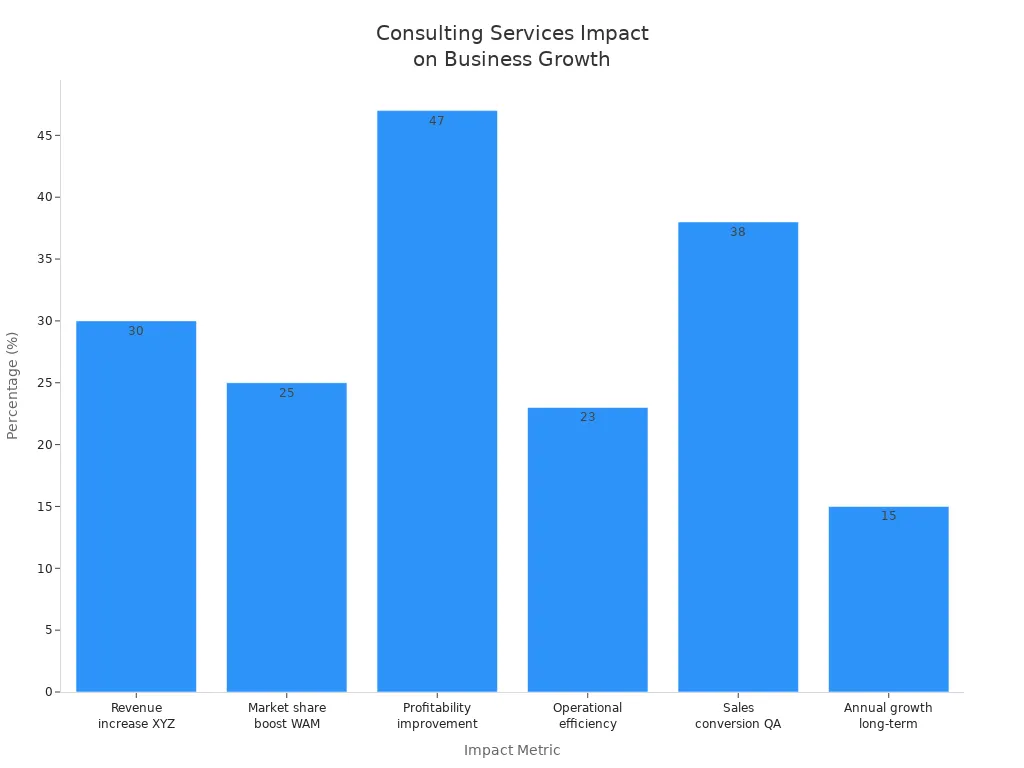
Consulting helps businesses unlock new opportunities and maximize growth potential.
Key Takeaways
Business consulting services provide expert guidance to help companies grow quickly and efficiently.
Consultants analyze challenges and deliver tailored solutions that improve operations and drive results.
Key areas of consulting include strategy, technology, financial management, and change management.
Consultants help businesses identify new opportunities through market analysis and innovative strategies.
Effective consulting leads to measurable outcomes, such as increased revenue and improved operational efficiency.
Consulting firms use objective analysis to uncover blind spots and optimize business processes.
Choosing the right consulting partner involves assessing their experience, alignment with goals, and communication style.
Investing in consulting services can empower organizations to adapt to market changes and achieve sustainable growth.
What Are Business Consulting Services?
Business consulting services support organizations by offering expert advice and practical solutions for growth. These services cover a wide range of functions, from planning and strategic consulting to marketing, permitting, and bookkeeping. Consultants help businesses identify challenges, create strategies, and implement changes that lead to measurable improvements.
Core Functions
Advisory Roles
Consultants act as trusted advisors. They guide leaders through complex decisions and help them set clear goals. Their advice often shapes the direction of a company’s future.
Service Areas
Business consulting covers many service areas. The table below shows the main functions and their descriptions:
Function | Description |
|---|---|
Business analysis and assessment | Consultants examine operations, finances, and strategies to identify inefficiencies and areas for improvement. |
Strategy development | Strategic plans are created to guide organizations toward long-term objectives and growth. |
Process optimization | Identifying bottlenecks and proposing improvements to enhance efficiency and productivity. |
Digital transformation consulting | Focus on adopting digital technologies to modernize processes and infrastructure. |
Financial management | Involves financial analysis and optimization to improve profitability and stability. |
Change management | Guidance on managing transitions during restructurings or technology implementations. |
Human resources consulting | Optimizing talent management, including recruitment and training programs. |
Compliance and regulation | Tools to ensure adherence to legal and regulatory standards. |
Solving specific problems | Providing practical solutions to unique challenges faced by the organization. |
Evaluation and follow-up | Assessing results post-implementation and making necessary adjustments. |
Sectors Served
Business consulting services apply to many sectors. Each sector has unique needs and goals.
Public Sector
Consultants in the public sector focus on public service and societal welfare. They help government agencies improve efficiency and meet community needs. Public sector consulting often involves accountability to citizens and elected officials.
Private Sector
Private sector consulting aims to increase profit and market share. Consultants work with businesses to boost competitiveness and drive innovation. Decision-making in this sector depends on market conditions and shareholder interests.
Social Sector
Consultants also serve non-profit organizations. They help these groups achieve their missions, manage resources, and measure impact. Social sector consulting often balances efficiency with equity and access.
Note: Consulting adapts to the unique challenges of each sector, ensuring solutions fit the organization’s goals.
Consulting Process
The consulting process follows several key steps. Each step builds on the last to ensure lasting results.
Analysis
Consultants start with discovery and problem identification. They gather data and assess business performance to find root causes of issues.
Strategy Development
Consultants use their findings to create a tailored action plan. Strategic planning sets clear objectives and outlines the steps needed for growth.
Implementation
Consultants help organizations put the plan into action. They support teams during execution and allocate resources where needed.
Ongoing Optimization
Consultants monitor progress and measure results. They make adjustments to ensure the business continues to improve and reach its goals.
Business consulting, including management consulting and strategic consulting, gives organizations the tools and guidance needed for sustainable growth. By following a structured process, consultants help businesses achieve their objectives and adapt to changing environments.
Accelerating Growth with Consulting Services

Identifying Opportunities
Market Analysis
Consulting firms help businesses discover new growth paths by using a variety of research methods. They collect and analyze data to understand market trends, customer needs, and competitor actions. This process allows leaders to make informed decisions and spot opportunities that might otherwise go unnoticed.
Description | |
|---|---|
Expert Interviews | One-on-one conversations with industry specialists to gain qualitative insights. |
Mobile Surveys | Structured questionnaires distributed via mobile platforms for quick quantitative data collection. |
Focus Groups | Moderated discussions to explore attitudes and perceptions in detail. |
Mystery Shopping | Observational research evaluating customer service and operational standards from a consumer perspective. |
Databases | Pre-existing sources providing foundational insights and specialized information. |
Official Governmental Sources | Trusted sources for macroeconomic and demographic data. |
Industry Reports | Outlines market trends and growth forecasts for specific industries. |
News Publications | Covers current developments and market trends, requiring careful vetting for reliability. |
Consulting services use these methods to deliver actionable insights. Businesses gain a clearer picture of their environment and can respond quickly to changes. A hands-on approach in delivering business advice often leads to better outcomes. Strong advisor-client relationships help businesses achieve favorable results, especially in sales and turnover.
Business advice positively influenced at least one business outcome in 14 out of 23 evaluations.
The impact on sales and turnover was generally more favorable compared to employment and productivity.
A hands-on approach in delivering business advice is associated with better outcomes, highlighting the importance of strong advisor-client relationships.
New Revenue Streams
Business consulting helps organizations create new revenue streams by identifying areas for innovation and efficiency. Consultants analyze workflows and recommend improvements that eliminate delays and reduce redundant tasks. For example, the British Institute of Innkeeping implemented automated purchase order workflows, which streamlined approvals and removed bottlenecks. 360 Destination Group integrated CRM and accounting systems, boosting efficiency and eliminating duplicate data entry.
Description | |
|---|---|
British Institute of Innkeeping | Implemented automated purchase order workflows to streamline approvals and eliminate delays. |
360 Destination Group | Integrated CRM and accounting systems to boost efficiency and eliminate redundant data entry. |
Consulting enables businesses to adapt quickly and seize new opportunities. By focusing on innovation and operational improvements, organizations can increase profitability and expand their market reach.
Streamlining Operations
Process Optimization
Consulting firms play a key role in optimizing business processes. They use data analysis and statistical process controls to monitor performance and detect variations that may cause quality issues. Consultants identify and eliminate sources of waste, which reduces costs and improves quality.
Evidence Type | Description |
|---|---|
Data Analysis | Crucial for understanding current process performance and identifying improvement opportunities. |
Statistical Process Controls (SPC) | Essential for monitoring process performance in real-time and detecting variations leading to quality issues. |
Reduction of Waste | Identifying and eliminating sources of waste optimizes processes, reduces costs, and improves quality. |
Reducing unnecessary steps and silos in processes minimizes wasted time and resources.
Improving efficiency ensures quality and consistency and fosters innovation.
Business consulting helps organizations streamline operations, making them more agile and responsive to market demands.
Technology Integration
Consulting firms accelerate business growth by integrating advanced technology. Expert consultants reduce project timelines and ensure that technology initiatives align with business objectives. For instance, Coca-Cola used AI-driven marketing tools to optimize resource allocation and prevent costly mistakes.
AI helps organizations redeploy consultants towards higher-value work, enhancing efficiency.
Firms that embrace AI can scale engagements and broaden service offerings, leading to increased business opportunities.
AI assists in streamlining project initiation by quickly surfacing relevant information, allowing firms to add value more rapidly.
AI copilots provide immediate guidance during client interactions, improving productivity and client confidence.
Clients expect consulting partners to demonstrate fluency in AI, which can enhance client relationships and loyalty.
Firms that integrate AI effectively gain a competitive edge by delivering results faster and more reliably.
Training consultants to use AI leads to more effective teams, improving retention and engagement.
Business consulting leverages technology to transform operations and drive rapid growth. Management consulting ensures that technology solutions fit the business strategy and support long-term objectives.
Implementing Strategies
Strategic Planning
Consulting firms guide businesses through strategic planning, helping them define clear goals and create actionable plans. Effective approaches include starting with the end in mind, staying grounded in core business, and optimizing for different goals based on maturity. Consultants balance aspiration and achievability, involve key leaders, and connect individual work to the strategic plan.
Start with the end in mind: Define the future state or goal of the business you are working towards over the 3-5 year-planning period.
Stay grounded: Ensure the strategy is rooted in the core business and market opportunity.
Figure out what you’re optimizing for: Optimize for different goals based on business maturity.
Balance aspiration & achievability: Find the right balance to drive engagement.
Bring the right people to the table: Involve key leaders at appropriate times.
Have a 'designated dissenter': Identify someone to constructively challenge ideas.
Connect the dots: Ensure everyone sees the link between their work and the strategic plan.
Be clear what you’re NOT doing: Create focus and clarity.
Put the business in context: Avoid developing a plan in isolation.
Try to break it: Prepare for potential issues with contingency plans.
Consulting creates a collaborative process, examines potential biases, and schedules check-ins strategically. Strategic planning skills give businesses a competitive advantage by enhancing focus, revealing blind spots, and aligning efforts toward shared goals.
Sales and Marketing
Consulting helps businesses align sales and marketing efforts with long-term objectives. Many firms confuse sales with business development, which can dilute the effectiveness of marketing strategies. Structured consulting ensures that sales and marketing work together to drive growth.
A client in the aerospace & defense sector identified and prioritized market segments for long-term growth, demonstrating how targeted consulting can lead to strategic advantages.
A mid-cap private equity client gained confidence in a €300m e-commerce retailer's growth potential, showcasing the importance of thorough commercial due diligence in driving business decisions.
A global client achieved a 1% increase in net sales and a 1.5% increase in gross margin through the development of a global pricing architecture, highlighting the direct impact of consulting on financial performance.
Consulting services help businesses develop cohesive strategies that support sustainable growth and increase profitability.
Financial Management
Business consulting provides guidance on financial management strategies that support growth. Consultants recommend financial forecasting, cash flow management, and data leveraging to maximize information for decision-making.
Strategy | Description |
|---|---|
Financial Forecasting | Provides guidance in decision-making for the rate of growth that is right for your business. |
Cash Flow Management | Ensures there is a positive cash flow to support planned growth and daily operations. |
Data Leveraging | Maximizes information for informed decision-making regarding business operations and growth. |
Financial Planning | Involves working closely with accountants to monitor cash flow and budget for tax payments. |
Helps track website traffic, sales trends, and customer behavior for better decision-making. |
Consulting helps businesses monitor cash flow, plan for tax payments, and track sales trends. These strategies ensure that organizations have the resources needed to grow and adapt to changing market conditions.
Navigating Challenges
Businesses face many obstacles as they grow. Consulting services help organizations overcome these challenges by providing expert guidance and proven strategies. Two major areas where consultants add value are risk management and competition analysis.
Risk Management
Risk management protects a business from unexpected events and disruptions. Consultants teach companies how to build resilience and adapt to changing conditions. They use several techniques to manage risks and ensure sustainable growth:
Diversify sources: Companies expand their supplier and client networks. This reduces dependency and buffers against disruptions.
Monitor and adapt: Consultants encourage regular assessments of risks, such as climate impacts and regulatory changes. Businesses update mitigation plans to stay prepared.
Build resilience: Investing in sustainable practices and maintaining transparent communication strengthens operations. This builds trust with stakeholders.
Consultants help leaders identify risks early and develop strategies to minimize their impact. Effective risk management supports long-term stability and growth.
Competition Analysis
Staying ahead of competitors is essential for business success. Consulting firms use competitive analysis to help organizations outperform rivals. This process gives companies a clear view of their market position and reveals opportunities for improvement.
Competitive analysis allows businesses to benchmark their performance against competitors. It provides critical insights into strengths and weaknesses relative to rivals. Consultants use this information to refine sales and marketing strategies for a competitive edge.
Key steps in competition analysis:
Identify key competitors.
Analyze their offerings, pricing strategies, and marketing tactics.
Evaluate customer experiences to uncover market gaps.
Consultants follow these steps to gain a comprehensive understanding of the competitive environment.
They use the gathered information to inform strategic decision-making.
Businesses improve their competitive positioning in the market.
Competitive analysis is especially important for startups. It helps them identify market gaps and develop superior strategies. By systematically evaluating competitors, businesses gain actionable insights that set them apart.
Common Challenges and Consulting Solutions
Challenge | Description |
|---|---|
Profitability | Consulting firms must manage overhead and track billable hours to maintain financial health. |
Client Acquisition | Attracting new clients is essential but challenging due to market competitiveness and lead generation. |
Pricing | Firms struggle to set competitive prices without compromising profitability. |
Staying Ahead of Trends | Keeping up with rapid industry changes and relevant trends is crucial for maintaining competitiveness. |
Demonstrating ROI | Quantifying the impact of consulting services and communicating value to clients is often difficult. |
Internal Knowledge Management | Preserving and accessing collective knowledge is vital for long-term success. |
Talent Retention | High turnover rates and the need for career development opportunities challenge talent retention. |
Consulting services help businesses navigate these challenges by offering tailored solutions and ongoing support. They empower organizations to manage risks, analyze competitors, and adapt to changing markets.
Benefits of Business Consulting
Business consulting services deliver a range of advantages that help organizations grow and increase profitability. These benefits stem from specialized expertise, objective analysis, and rapid execution. Companies gain access to industry knowledge, strategic insights, and measurable outcomes that drive sustainable success.
Expertise and Insights
Industry Knowledge
Consulting firms possess deep knowledge of industry trends, regulations, and best practices. They tailor solutions to fit the unique needs of each business, addressing specific challenges and optimizing operations. This expertise enables organizations to maintain competitiveness and adapt to changing environments.
Business consultants understand the complexities of different sectors.
They help companies analyze regulatory requirements and develop entry strategies for new regions.
Their guidance supports forecasting demand and setting realistic goals.
Market Trends
Consultants use market trends to inform business strategy and identify growth opportunities. They analyze emerging markets and products, enabling proactive decisions. By monitoring shifting customer demands, consultants help businesses adapt quickly and mitigate risks.
Consultants spot untapped customer segments and anticipate evolving preferences.
They prepare businesses for potential disruptions by tracking industry changes.
Strategic insights from market analysis support continuous optimization.
Objective Problem Solving
Unbiased Analysis
Consulting firms provide an objective perspective, free from internal biases. They offer specialized expertise in niche areas, which is crucial for addressing complex challenges. Their role in resource augmentation allows organizations to manage workloads effectively during critical projects.
Description | |
|---|---|
Top-down | Defines the process, structures key insights, outlines the story, and develops a ghost deck. |
Bottom-up | Focuses on data analysis, conducts interviews, organizes information, and creates individual documents. |
Consultants introduce best practices based on extensive experience across industries. Their solutions remain innovative and forward-thinking, which is vital for strategic transformations.
Identifying Blind Spots
Consultants help businesses uncover inefficiencies and risks through objective analysis. Their specialized expertise enables them to identify gaps that internal teams may miss. They align current strategies with long-term goals, suggesting actionable steps for improvement.
Consultants perform thorough operations audits to assess workflows.
They engage the entire organization to gather insights from all levels.
A culture of continuous improvement encourages idea sharing.
External expertise brings fresh perspectives.
Data-driven decision-making ensures actions are based on evidence.
Change management guidance supports businesses as they implement improvements based on identified blind spots.
Fast Execution
Quick Implementation
Consulting services bridge the gap between strategy and execution. Consultants translate high-level goals into actionable plans, which facilitates faster implementation. Their industry experience helps identify best practices, ensuring strategies are executed efficiently.
Project management tools speed up strategy execution.
AI and automation accelerate data analysis and decision-making.
Cloud solutions enable scalable and flexible operations.
Change management reduces resistance and fosters adoption.
Consultants align stakeholders with strategic objectives, which accelerates the execution process.
Measurable Results
Business consulting delivers measurable outcomes and clear ROI. Companies track financial metrics such as revenue growth, profit margin improvements, and cost reductions. Operational efficiency indicators include process optimization results, reduced cycle times, and enhanced productivity.
Employee satisfaction metrics show improvements in staff retention and communication.
Short-term and long-term measurement frameworks assess sustainability.
Qualitative assessments include stakeholder feedback and customer satisfaction scores.
Comparative analysis and benchmarking help businesses evaluate consulting contributions.
Technology and data analytics provide real-time performance tracking.
Implementation and adoption rates measure the execution of recommendations.
Business consulting services empower organizations to achieve fast, sustainable growth through expertise, objective problem solving, and rapid execution.
Real-World Results and Case Studies
Business leaders often look for proof that consulting delivers measurable results. Real-world examples show how organizations from different sectors have achieved rapid growth by improving systems and teams. The following case studies highlight how consulting has helped clients reach their goals.
Revenue Growth
Small Business Example
Small businesses can see significant revenue growth with the right support. Consultants work with leadership to improve systems and teams, which leads to better performance. The table below shows how companies in various industries have benefited from consulting engagements:
Industry | Engagement Duration | Key Focus Areas | Results Achieved |
|---|---|---|---|
Aerospace Systems Manufacturer | 12 months | Operational transformation, lean manufacturing | Enhanced competitiveness |
Aerospace Electronics Manufacturer | 4 months | Overhaul operational processes | Improved key performance metrics |
Global Food Manufacturer | 9 months | Addressing production inefficiencies | Reduced waste, increased output |
Leading Technology Company | 6 months | Optimizing business processes | Elevated financial performance |
High-Growth Tech Company | N/A | Streamlining operations, optimizing costs | Scaled efficiently |
Consultants help businesses redesign workflows and train teams. These changes create a foundation for sustainable revenue growth.
Operational Turnaround
Process Improvement Example
Operational turnaround often requires a focus on both systems and teams. Consultants analyze current processes, identify bottlenecks, and guide organizations through change. The following examples show how consulting has led to measurable improvements:
Example | Type of Turnaround | Outcome Metrics |
|---|---|---|
Retail Chain | Financial Restructuring | 20% increase in cash flow within six months |
Logistics Provider | Operational Efficiency Improvements | 15% reduction in operational costs and improved delivery times |
Healthcare Provider | Strategic Repositioning | 25% increase in revenue from telemedicine services |
Tech Startup | Leadership Overhaul | 30% boost in investor confidence |
Financial Services Firm | Crisis Management | Restored client trust within weeks after a data breach |
Consultants support teams as they implement new systems. This hands-on approach helps organizations recover quickly and build resilience.
Market Entry Success
New Product Launch Example
Entering a new market can be risky. Consultants guide businesses through market research, strategy development, and launch execution. The table below shows how companies have succeeded or struggled with market entry:
Company | Market Entry Strategy | Outcome |
|---|---|---|
Apple | Used IStyle as a distributor to enter the Romanian market | |
Starbucks | Failed to penetrate the Australian market due to high prices and local preferences | Unsuccessful entry into the market |
Consultants help businesses understand local preferences and adapt their systems and teams for new environments. Success often depends on careful planning and execution.
These real-world examples show that consulting can drive rapid business growth by improving systems and teams. Organizations that invest in expert guidance often achieve better results and long-term success.
Choosing the Right Business Consulting Partner

Experience and Track Record
Selecting a consulting partner with proven experience and a strong track record is essential for business success. Companies should evaluate the experience level and critical thinking skills of the consulting team. Industry knowledge and professionalism play a major role in delivering efficient solutions and valuable insights.
A thorough review of credentials helps organizations match expertise to their specific needs. Educational background and years in consulting practice indicate depth of knowledge. Examining case studies and past client results provides evidence of successful outcomes. The following checklist can guide businesses in assessing a potential partner:
Evaluate the consulting team's experience and critical thinking skills.
Assess industry knowledge and professionalism.
Review credentials and match expertise to business needs.
Examine educational background and industry experience.
Look at case studies and past client results.
Consider the number of years in consulting practice.
A consulting partner with a strong track record brings efficiency and insight to every engagement. Companies benefit from the lessons learned through previous projects.
Alignment with Goals
A consulting partner must align with the organization’s goals to drive meaningful results. Building unique capabilities allows businesses to execute strategies and outperform competitors. Prioritizing strategic tasks over routine work ensures that efforts focus on competitive advantage.
Flexible and adaptable structures help organizations respond to evolving markets. Effective resource allocation empowers decision-making at the level closest to relevant information. Overcoming cultural and process barriers supports the adoption of new strategies. Leadership teams must operate within a unified framework to avoid disjointed execution.
To ensure alignment, companies should:
Prioritize strategic tasks that contribute to competitive advantage.
Design flexible structures to address changing markets.
Allocate resources and decision rights effectively.
Remove obsolete systems and align culture with new strategies.
Synchronize leadership teams for unified execution.
Clarifying enterprise-level objectives and resolving conflicting interpretations of strategic goals help organizations stay on track. Aligning teams and initiatives across all layers ensures consistent progress.
Communication Style
Effective communication is a cornerstone of successful business consulting partnerships. A consulting partner must demonstrate clear and open communication with all stakeholders. Compatibility with the organization’s team fosters collaboration and trust.
Companies should assess the communication style of potential partners. This includes evaluating responsiveness, clarity, and willingness to listen. A consulting partner who communicates well can explain complex concepts in simple terms. They encourage feedback and adapt their approach based on client needs.
Communication Trait | Description |
|---|---|
Responsiveness | Answers questions promptly |
Clarity | Explains ideas in understandable ways |
Listening Skills | Values input from all stakeholders |
Adaptability | Adjusts communication as needed |
A consulting partner with strong communication skills helps organizations navigate challenges and achieve goals efficiently.
Pricing Models
Choosing the right pricing model is important for both consulting firms and their clients. Pricing affects the value clients receive and the return on investment (ROI) they achieve. Consultants use several pricing models, each with unique benefits and challenges.
Many consulting firms now use value-based pricing. This model adapts to market demands and focuses on resilience and risk mitigation. Value-based pricing raises consulting fees and enhances the perceived value of services. Clients often see better ROI because they receive tailored and impactful solutions. Consultants align their fees with the results they deliver, which encourages high-quality work.
The table below shows the most common pricing models and their usage rates:
Pricing Model | Percentage Usage | Description |
|---|---|---|
Project-based rates | 30% | Offers cost certainty while pricing based on value rather than time. |
Hourly rates | 29% | Common among newer consultants, but limits earning potential. |
Monthly retainers | 16% | Provides recurring revenue and predictability for both parties. |
Value pricing | 15% | Less common but leads to higher fees and better client outcomes. |
Daily rates | 10% | Popular for short-term engagements and certain specialties. |
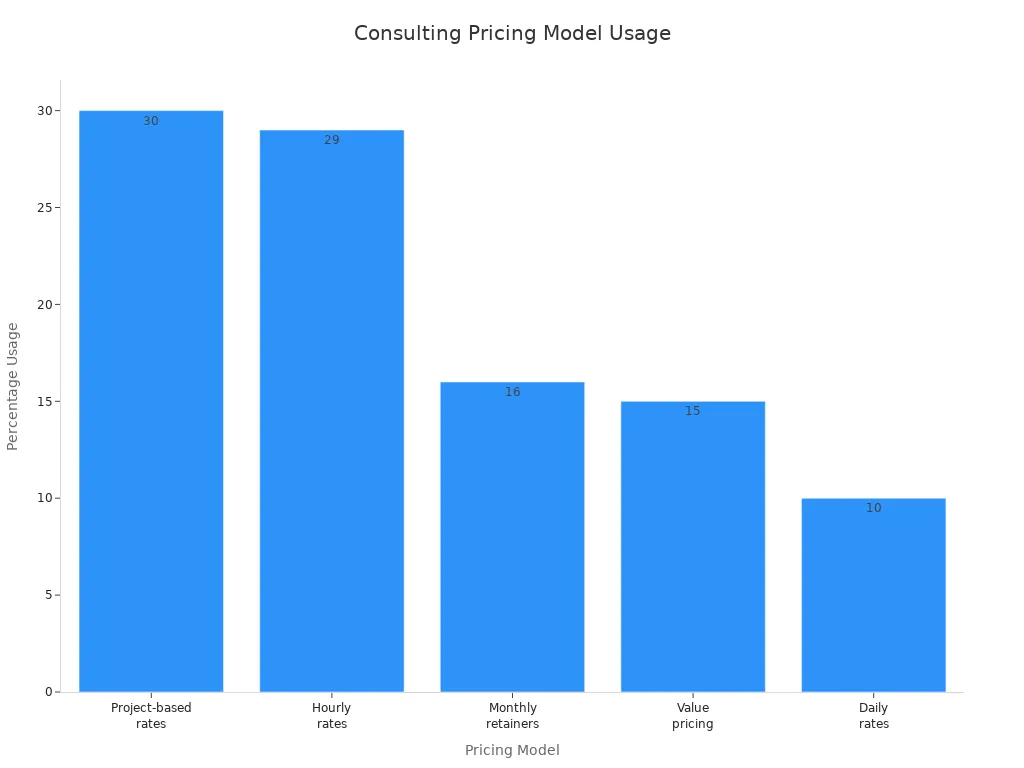
Project-based rates offer cost certainty. Clients know the total price before the project begins. This model works well for defined projects with clear goals. Hourly rates are common among newer consultants. They provide flexibility but can limit earning potential. Monthly retainers create recurring revenue and predictability. Both consultants and clients benefit from ongoing support and stable costs.
Value pricing aligns with client expectations and demonstrates tangible benefits. Consultants charge based on the value they create, not just the hours worked. This model often leads to higher earnings and better outcomes. Monthly retainers and value pricing are associated with higher earnings compared to lower pricing models. Daily rates are popular for short-term projects and certain specialties. They allow consultants to focus on specific tasks without long-term commitments.
Selecting the right pricing model depends on the project scope, desired outcomes, and the level of ongoing support needed. Clients should consider how each model affects their budget and the value they receive.
Consulting firms and clients must discuss pricing openly. Clear agreements help avoid misunderstandings and ensure both parties benefit. Pricing models shape the consulting relationship and influence the results achieved. By understanding these options, businesses can make informed decisions and maximize their investment in consulting services.
Business consulting gives companies expert guidance, proven strategies, and ongoing support. These services help business leaders solve problems, improve operations, and achieve rapid growth. Real-world examples show that consulting delivers measurable results. Readers should review their business needs and consider consulting as a smart investment.
To learn more about how business consulting can help your business grow fast, reach out to us today.
FAQ
What does a business consultant do?
A business consultant analyzes company operations, identifies challenges, and recommends solutions. They guide leaders in strategy, process improvement, and technology adoption. Consultants help businesses achieve growth and efficiency.
How long does a consulting engagement usually last?
Consulting engagements vary in length. Some projects take a few weeks, while others may last several months. The timeline depends on the scope and complexity of the business goals.
Which industries benefit most from consulting services?
Consulting services support many industries, including manufacturing, technology, healthcare, retail, and finance. Each sector gains tailored strategies that address unique challenges and opportunities.
How do consultants measure success?
Consultants use key performance indicators (KPIs) such as revenue growth, cost reduction, and improved productivity. They track progress with data analytics and client feedback.
Can small businesses afford consulting services?
Many consulting firms offer flexible pricing models. Small businesses can choose project-based rates or monthly retainers. Consultants design solutions that fit different budgets.
What is the difference between management and business consulting?
Management consulting focuses on organizational structure and leadership. Business consulting covers broader areas, including strategy, operations, marketing, and finance.
How do consultants ensure confidentiality?
Consultants sign agreements to protect sensitive information. They follow strict ethical standards and keep client data secure.
Do consulting services guarantee results?
Consulting services provide expert guidance and proven strategies. While consultants aim for measurable improvements, results depend on implementation and market conditions.


