Lean Methodology Explained with Step-by-Step Implementation
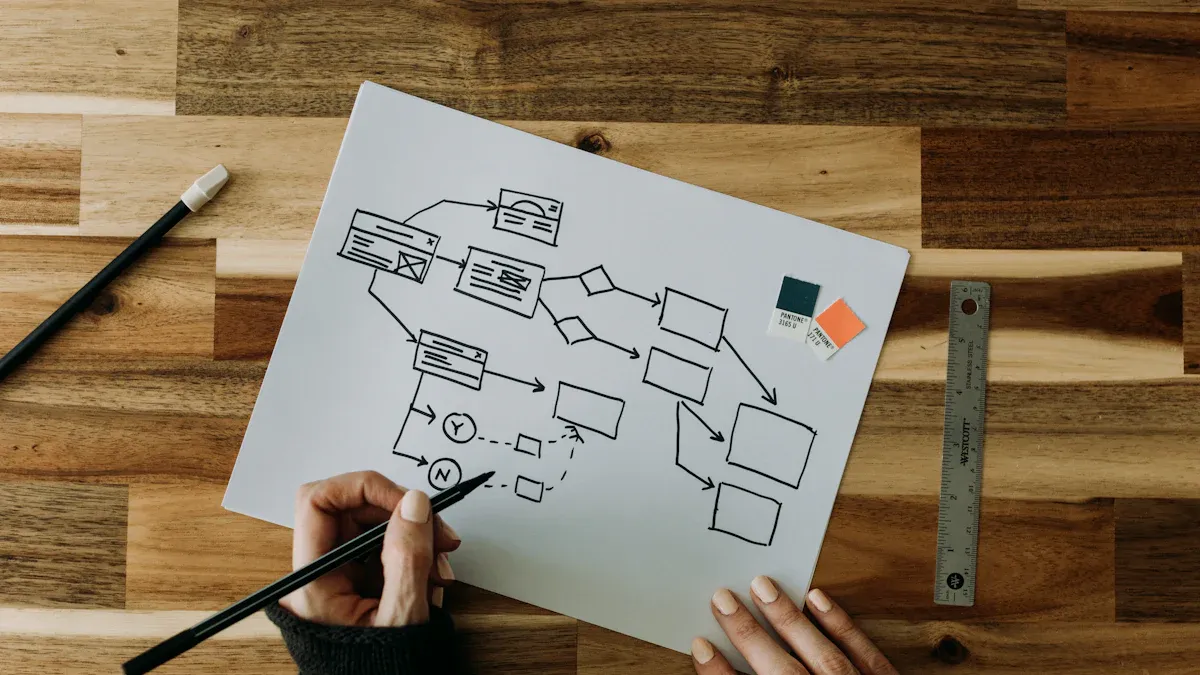
Lean Methodology focuses on maximizing value for clients and customers while minimizing wasted resources. This approach encourages organizations to adopt Lean as both a mindset and a management philosophy. Many companies experience impressive results after implementing Lean Methodology:
Savings of up to 30% on development expenses
Output increases between 20% and 40%
Faster delivery of value and quicker testing of ideas
Lean Methodology guides teams through practical steps to improve efficiency and reduce waste.
Key Takeaways
Lean Methodology maximizes customer value while minimizing waste, leading to significant savings and increased efficiency.
Understanding customer needs is crucial. Teams should define value from the customer's perspective to ensure products meet expectations.
Value Stream Mapping (VSM) helps teams visualize workflows, identify bottlenecks, and eliminate non-value-adding activities.
Continuous improvement is essential. Organizations should foster a culture where teams regularly assess and enhance processes.
Lean practices, like Just-in-Time production, help avoid overproduction and reduce inventory costs, improving responsiveness.
Engaging employees at all levels in Lean initiatives builds trust and encourages ownership of improvement efforts.
Leadership support is vital for Lean success. Leaders must embody Lean principles and communicate a clear vision.
Using Lean tools, such as DMAIC and 5S, empowers teams to solve problems, streamline processes, and deliver greater value.
Lean Methodology Overview
What Is Lean Methodology
Lean Methodology helps organizations maximize customer value and minimize waste. This approach originated from the Toyota Production System and now applies across many industries. Teams use Lean Methodology to catch defects early and foster a culture of continuous improvement. Lean organizations view problems as opportunities and value customer experience. They empower employees to create value and remove waste from processes.
Lean Principles
Lean Methodology includes principles and tools that focus on waste removal. Teams define value from the customer's perspective, map activities that contribute to value, and create smooth workflows. Lean practices emphasize built-in quality and encourage open communication. The approach aims for structural efficiency and supports problem-solving at every level.
Lean methodology seeks to maximize customer value while minimizing waste.
It promotes continuous improvement and respects team members.
Lean organizations foster a culture of problem-solving and open communication.
Lean Thinking
Lean thinking represents a mindset and management philosophy. It encourages evolutionary change and ongoing enhancement of processes. Teams simplify workflows and deliver value to customers. Lean thinking values employees as essential contributors to improvement. Organizations commit to continuous improvement, eliminate waste, and respect people.
Lean thinking is not just a set of tools. It guides teams to embrace change and improve every day.
Continuous improvement: Teams enhance processes and practices regularly.
Eliminating waste: They identify and remove activities that do not add value.
Respect for people: Employees play a key role in improvement.
Lean vs. Traditional Management
Lean Methodology differs from traditional management in several ways. The table below highlights core differences:
Aspect | Traditional Project Management | Lean Project Management |
|---|---|---|
Planning Approach | Comprehensive upfront planning | Just-in-time progressive planning |
Success Metrics | On time, on budget, to specification | Customer value delivered, waste eliminated |
Change Management | Formal change control processes | Embraces change as opportunity for improvement |
Work Organization | Work breakdown structure, Gantt charts | Value stream maps, Kanban boards |
Quality Focus | Inspection at completion | Built-in quality, prevent defects |
Team Structure | Specialized roles, hierarchical | Cross-functional teams, collaborative |
Risk Approach | Risk register, mitigation plans | Fail fast, learn quickly |
Documentation | Extensive, formal documentation | Minimal, just enough documentation |
Decision Making | Centralized with project manager | Decentralized to appropriate level |
Improvement | Post-project lessons learned | Continuous improvement throughout |
Lean Methodology uses just-in-time planning and values customer feedback. Teams organize work with value stream maps and Kanban boards. They build quality into processes and prevent defects. Lean teams collaborate across functions and learn quickly from mistakes. Organizations focus on continuous improvement rather than waiting until a project ends.
Lean Principles and Core Concepts
Five Lean Principles
Lean Methodology relies on five core principles that guide organizations toward efficiency and value creation. These principles help teams identify waste and improve processes.
Value
Teams define value from the customer's perspective. They focus on what the customer wants and needs. By understanding value, organizations deliver products and services that meet expectations.
Value Stream
A value stream includes all steps required to deliver a product or service. Teams map the value stream to diagnose issues and highlight areas for improvement. Value Stream Mapping (VSM) helps organizations visualize workflows and pinpoint bottlenecks.
Flow
Flow means that work moves smoothly through each step without interruptions. Teams optimize processes to reduce delays and create a stable environment. The 5S method establishes order and cleanliness, supporting efficient flow.
Pull
Pull systems ensure that work starts only when there is demand. Teams use Kanban boards to manage workflow and avoid overproduction. This approach prevents unnecessary inventory and keeps processes responsive.
Perfection
Perfection encourages continuous improvement. Teams strive to eliminate waste and enhance quality. Kaizen drives ongoing changes, while Poka-Yoke (mistake-proofing) ensures safety and reliability.
Empirical studies show that applying these principles can reduce patient wait times by 20% to 50%. Organizations see improvements in efficiency and customer satisfaction.
Value Stream Mapping diagnoses process issues.
5S creates a stable work environment.
Kaizen drives continuous improvement.
Pull systems and Kanban manage workflow.
Poka-Yoke ensures safety and quality.
TIMWOODS: Types of Waste
Lean Methodology identifies waste using the TIMWOODS framework. Waste includes activities that do not add value. Organizations remove waste to improve efficiency and deliver better results.
Type of Waste | Description | Example from Organizations |
|---|---|---|
Time | Lost time due to delays or inefficiencies. | Just-in-time production |
Inventory | Excess stock that wastes space and resources. | Lean inventory management |
Movement | Unnecessary motion in tasks or processes. | Toyota's factory layout |
Waiting | Idle time when work stops or slows down. | Just-in-time production |
Overproduction | Producing more than needed, leading to waste. | Streamlined assembly lines |
Overprocessing | Extra steps that do not add value. | Simplified workflows |
Defects | Errors or mistakes that require correction. | Quality control at Toyota |
Teams use this framework to spot waste in daily operations. For example, Toyota optimized factory layouts to reduce movement. Organizations streamline assembly lines to prevent overproduction. Lean inventory management avoids excess stock and saves resources.
Removing waste helps organizations focus on value and improve performance. Lean Methodology supports ongoing efforts to identify and eliminate waste.
Benefits of Lean Methodology
Efficiency and Waste Reduction
Lean Methodology helps organizations achieve remarkable gains in efficiency. Teams identify and remove waste, such as overproduction, excess inventory, defects, waiting, and unnecessary motion. This approach leads to financial savings and improved productivity. Employees focus on essential tasks, which boosts output and quality. Streamlined workflows reduce delays, allowing faster delivery without extra resources. Quality becomes part of every process, so defects and rework decrease. Production aligns with actual demand, lowering inventory levels and freeing cash.
Outcome | Description |
|---|---|
Eliminating overproduction, excess inventory, defects, waiting, and unnecessary motion leads to financial gains. | |
Improved Process Efficiency | Streamlined workflows reduce delays, resulting in faster output without additional resources. |
Increased Productivity | Removing non-value work allows employees to focus on essential tasks, boosting productivity. |
Enhanced Quality | Embedding quality into processes reduces defects and rework, improving consistency and performance. |
Inventory Reduction | Aligning production with actual demand lowers inventory levels, freeing cash and reducing costs. |
Cost Savings | Efficiency improvements and waste reduction contribute directly to measurable financial results. |
Customer Satisfaction | Focusing on customer value enhances satisfaction and loyalty. |
Cultural Change | Engaging teams in improvement fosters ownership and motivation, leading to a continuous improvement mindset. |
Adaptability to Change | Lean practices enable smoother adaptations to changing conditions. |
Data-Driven Decision Making | Utilizing metrics and data helps leaders identify issues early and make informed decisions. |
Sustained Competitive Advantage | Cumulative lean outcomes strengthen market position, making organizations faster and more resilient. |
Teams that embrace Lean Methodology often see faster output, higher quality, and lower costs.
Customer Value
Organizations that use Lean Methodology place customer needs at the center of every process. Teams define value from the customer's perspective, which ensures products and services meet or exceed expectations. Value includes quality, convenience, and reliability. Tools like Voice of the Customer (VOC) help gather feedback and insights. Efforts focus on creating maximum benefit for customers, which increases loyalty and satisfaction.
Understanding customer needs is crucial for delivering products that meet or exceed expectations.
Focusing on what customers value ensures that efforts are directed towards creating maximum benefit.
This customer-centric approach enhances customer loyalty and satisfaction.
Defining value from the customer's perspective is essential for aligning processes.
Value encompasses quality, convenience, and reliability, not just price.
Tools like the Voice of the Customer (VOC) help gather insights through feedback mechanisms.
Teams that listen to customers and adapt processes deliver greater value and build lasting relationships.
Continuous Improvement
Continuous improvement forms the foundation of Lean Methodology. Teams evaluate and enhance processes regularly. A culture of innovation helps organizations adapt to changing customer needs. This commitment to perfection drives long-term success and sustainability. Lean organizations measure progress using clear metrics, such as defect rates, lead times, and productivity.
Metric Category | Specific Metrics |
|---|---|
Quality Metrics | Defect Rate, Customer Complaints/Returns, Rework Percentage |
Delivery/Flow Metrics | Lead Time, Cycle Time, On-Time Delivery Rate, Takt Time, Throughput |
Cost Metrics | Cost of Poor Quality (COPQ), Labor Cost per Unit, Scrap Rate/Waste Reduction |
Inventory Metrics | Work in Progress (WIP), Days of Inventory on Hand (DOH), Stockouts/Backorders |
Capacity & Utilization | Capacity Utilization Rate, Machine Downtime, Setup Time (Changeover Time) |
Productivity Metrics | Overall Equipment Effectiveness (OEE), Units Produced per Hour/Shift |
Safety and Morale | Number of Incidents, Employee Suggestion Rate for CI, Employee Turnover |
Continuous improvement helps teams respond to new challenges and maintain high performance over time.
Lean Methodology Implementation Steps

Identify Value
Customer Needs
Teams and systems begin Lean Methodology by identifying what customers truly value. They focus on quality, convenience, and reliability, not just price. Leaders listen to clients through surveys, interviews, and focus groups. The Voice of the Customer (VOC) tool helps collect direct feedback. This approach ensures that every process aligns with customer expectations.
Teams that understand customer needs deliver products and services that meet or exceed expectations. Systems that prioritize customer value achieve higher satisfaction and loyalty.
Tools for Value Identification
Organizations use several tools to pinpoint value. Value Stream Mapping (VSM) stands out as a practical method. It helps teams visualize every step in a workflow, showing how value moves from start to finish. VSM reveals which activities add value and which create waste. Teams also use VOC to gather insights from clients. These tools guide systems and teams to focus efforts where they matter most.
Value Stream Mapping highlights process flows and identifies non-value-adding activities.
Voice of the Customer collects feedback through surveys, interviews, and focus groups.
Teams prioritize processes that add value to the customer.
Map Value Stream
Waste Detection
Mapping the value stream allows teams to detect waste. They examine each step to see where delays, excess inventory, or unnecessary movement occur. For example, a medium-sized service firm used VSM to discover that approval queues caused most delays, not actual processing time. After redesigning the approval process, the firm reduced mandatory approvals by over 50% and improved efficiency. A small family-owned business found that internal confirmation delays slowed order fulfillment. By shifting to continuous flow, the business reduced lead times and increased customer satisfaction.
Systems and teams that map their value streams can pinpoint hidden sources of waste and take targeted action.
Value Stream Mapping
Value Stream Mapping follows a series of best practices:
Select the process: Choose a critical workflow for mapping.
Gather data: Collect information about activities, time, and material flow.
Create a current state map: Visualize how work moves through the system.
Identify waste: Analyze the map to find delays, excess inventory, and other waste types.
Create a future state map: Envision an improved process with less waste.
Implement improvements: Develop a plan to transition to the future state.
Continuously improve: Monitor progress and make ongoing enhancements.
Teams use VSM to visualize the flow of value in a company's workflow. This method includes all actions and personnel involved in delivering the final product. Systems that follow these steps achieve smoother operations and higher efficiency.
Create Flow
Process Optimization
Creating flow means work moves smoothly from one step to the next. Teams break down complex processes into simpler steps. They reconfigure production sequences and balance workloads. Cross-functional collaboration helps optimize resources. Employees receive training to become multi-skilled, which supports flexibility. Systems organize equipment to match the natural flow of value, making efficiency part of the process.
Reduce changeover times to switch between products quickly.
Avoid batch operations that create bottlenecks and excess inventory.
Align equipment with the value stream for inherent flow.
Bottleneck Removal
Teams and systems remove bottlenecks by analyzing where forced downtime occurs. They use tools like Value Stream Mapping, root cause analysis, and visual management. Cross-functional teams reduce handoffs and speed up decision-making. Continuous workflow prevents interruptions. Pull systems start new work only when there is demand, optimizing resources. Kaizen involves all employees in improvement efforts. The PDCA (Plan-Do-Check-Act) method ensures changes lead to lasting results.
Strategy | Description |
|---|---|
Bottleneck Analysis | Identifies where downtime happens and how to fix it. |
Value Stream Mapping | Visualizes every step to find waste and boost efficiency. |
Continuous Workflow | Keeps work moving smoothly, preventing bottlenecks. |
Pull System | Starts new work only when needed, optimizing resources. |
Kaizen | Engages all employees in ongoing improvement. |
PDCA | Implements changes and checks for continuous improvement. |
Root Cause Analysis | Finds the underlying causes of bottlenecks. |
Cross-Functional Teams | Includes all skills needed, reducing handoffs and speeding decisions. |
Visual Management | Makes work status visible, improving communication and workflow. |
Systems and teams that remove bottlenecks achieve faster delivery, higher quality, and improved customer satisfaction.
Establish Pull
Establishing pull means producing goods or services only when there is actual customer demand. This approach helps organizations avoid building up excess inventory and reduces the risk of overproduction. Teams align production schedules with real customer requirements, which increases resource efficiency and responsiveness.
Just-in-Time
Just-in-Time (JIT) is a core practice for establishing pull. Teams produce items only as needed, which keeps inventory levels low and ensures quick response to customer orders. JIT requires clear communication and coordination across all steps in the process. Kanban cards or digital signals often help teams manage workflow and trigger production based on demand.
The benefits of Just-in-Time are significant. Organizations that use JIT see dramatic improvements in lead times, cycle times, and inventory costs. The table below shows the typical range of improvements:
Metric | Improvement Range |
|---|---|
Lead-time reduction | 60-80% |
Cycle-time reduction | 10-30% |
Set-up time reduction | 60-80% |
Savings in materials purchases | 10-30% |
Raw materials inventory | 20-40% |
Work-in-process inventory | 30-55% |
Finished goods inventory | 20-45% |
Direct labor productivity | 10-35% |
Administration personnel | 15-30% |
Improved quality savings | 10-40% |
Storage space reduction | 20-40% |
Facility space reduction | 10-30% |
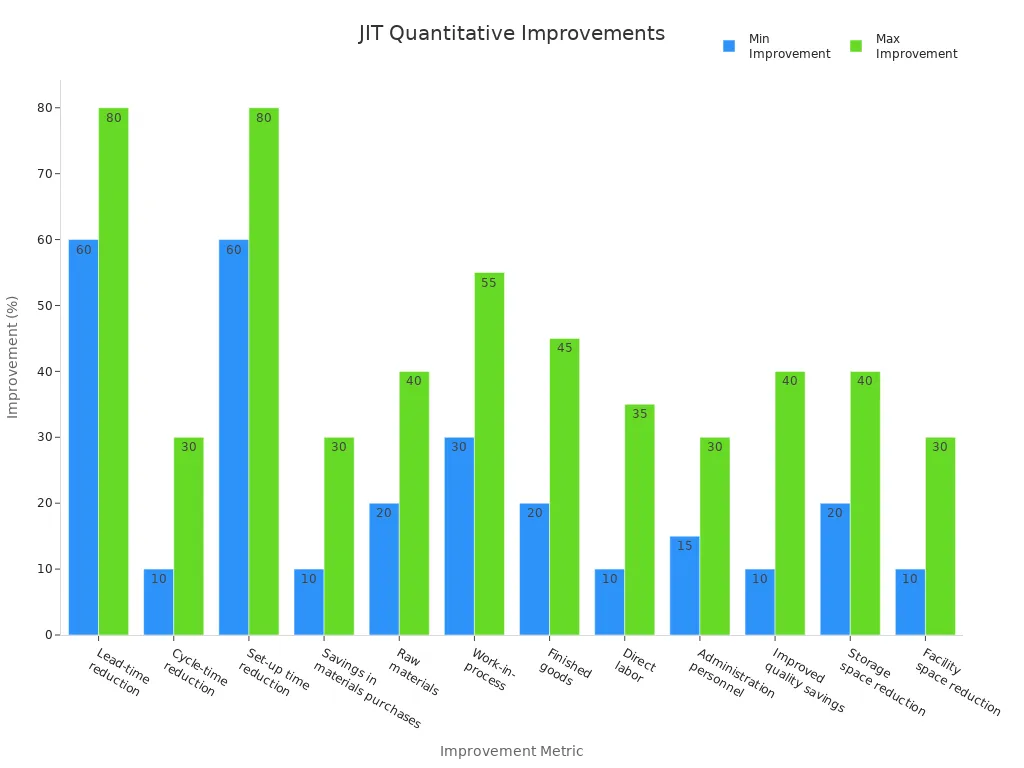
Teams that implement Just-in-Time often experience faster delivery, lower costs, and better use of space.
Overproduction Control
Controlling overproduction is essential for a successful pull system. Teams use visual tools, such as Kanban boards, to signal when to start new work. This method ensures that production matches actual demand and prevents unnecessary buildup of products. Mapping the entire production process helps teams spot bottlenecks and areas where overproduction might occur. Regular monitoring allows teams to adjust quickly and keep operations efficient.
Key steps for establishing pull include:
Producing based on real customer demand, not forecasts.
Visualizing the production process to identify bottlenecks.
Using pull signals, like Kanban cards, to communicate demand.
Monitoring performance and making adjustments as needed.
A pull system leads to higher productivity and efficiency. Teams that monitor their systems regularly can identify problems early and make improvements that keep operations running smoothly.
Seek Perfection
Lean Methodology encourages organizations to seek perfection through continuous improvement. Teams commit to regularly assessing their performance and making small, ongoing changes. This approach helps organizations stay competitive and deliver high-quality products.
Kaizen
Kaizen means "change for the better." Teams use Kaizen to make incremental improvements in their processes. Everyone in the organization, from leaders to front-line workers, participates in finding ways to reduce waste and improve quality. Regular evaluation of processes helps teams adapt to market changes and new technologies. A culture of innovation supports ongoing improvement and helps meet changing customer needs.
By fostering a culture of continuous improvement, organizations can enhance their processes, reduce waste, and consistently deliver value to customers.
Some effective approaches to seeking perfection include:
Adapting to new technologies and market trends.
Evaluating processes regularly to find areas for improvement.
Encouraging innovation at all levels of the organization.
Progress Measurement
Measuring progress is vital for continuous improvement. Teams use clear metrics to track their performance and validate the effectiveness of their efforts. Common metrics include defect rate, lead time, cost of poor quality, work in progress, capacity utilization rate, overall equipment effectiveness, and number of incidents.
Metric | Purpose |
|---|---|
Defect Rate | Measures the number of units that did not meet quality standards. |
Lead Time | Total time from when an order is placed until it is delivered. |
Cost of Poor Quality (COPQ) | Measures the cost of defective products and rework. |
Work in Progress (WIP) | Refers to work that has begun but is not yet completed. |
Capacity Utilization Rate | Measures how effectively resources are used to create products. |
Overall Equipment Effectiveness (OEE) | Combines availability, performance, and quality into a vital KPI. |
Number of Incidents | Reflects safety in the workplace. |
Tracking these metrics provides several benefits:
Quantifiable proof of improvement.
Validation of the resources used for Lean initiatives.
Motivation for teams through visible results.
Data-driven decision making for leaders.
Accountability and transparency for all stakeholders.
Continuous measurement and improvement help organizations maintain high standards and achieve long-term success.
Challenges and Solutions
Change Resistance
Many organizations encounter resistance when introducing Lean Methodology. Employees often feel uncertain about new processes. They worry that changes will disrupt their routines or make their jobs harder. Leaders must address these concerns directly. Clear communication helps teams understand the reasons for change and the benefits Lean brings. Training sessions and workshops give employees the skills they need to adapt. Leaders can involve staff in improvement projects, which builds trust and ownership.
Teams that participate in Lean initiatives feel more confident and motivated. Open dialogue reduces anxiety and helps everyone embrace new ways of working.
Common challenges during Lean adoption include:
Lack of leadership support.
Inadequate training and resources.
Difficulty in data collection and analysis.
Absence of a continuous improvement culture.
Leadership Support
Leadership plays a vital role in Lean Methodology success. Effective Lean leaders understand Lean principles and embody them in daily actions. They foster communication and encourage team problem-solving. Leaders empower employees to make decisions and contribute ideas. Respect for employees builds a positive environment where everyone feels valued.
Lean leaders offer clear and supportive guidance.
Leadership maintains focus on delivering customer value.
Leaders drive cultural shifts, guiding teams toward continuous improvement and waste elimination.
Strong leadership ensures Lean initiatives stay on track. Leaders who support Lean create a culture of improvement and help teams overcome obstacles.
Lean Misconceptions
Misunderstandings about Lean Methodology can hinder progress. Some people believe Lean is only a set of tools or a way to cut costs. Others think Lean requires hiring new staff or reducing the workforce. These misconceptions prevent organizations from realizing Lean's full potential.
Misconception | Reality |
|---|---|
Lean is a cultural and strategic approach focused on continuous improvement and value creation. | |
Success requires hiring different people | Existing teams can achieve breakthrough results with the right environment and development. |
Lean means fewer employees | Lean frees capacity for greater value creation, not necessarily job cuts. |
People should be cautious about speaking up | Psychological safety is essential for Lean to thrive, encouraging open communication. |
Lean is not about eliminating jobs. It focuses on efficiency and value creation. Lean principles apply in many sectors, including offices, hospitals, and schools. Psychological safety encourages open communication, which is essential for Lean to succeed.
Organizations that address misconceptions build stronger Lean cultures. Teams achieve better results when everyone understands Lean's true purpose.
Sustaining Improvements
Many organizations find it difficult to maintain Lean improvements over time. Teams often see early success, but old habits can return if they do not have a plan for sustainability. Sustaining improvements means making Lean practices a permanent part of daily work. This requires more than just following steps or using tools. Teams need a strong foundation and ongoing support.
A key factor in sustaining Lean improvements is building a culture that values continuous progress. Employees should see improvement as part of their job, not just a special project. Leaders play a major role in setting this expectation. They must show commitment to Lean principles and encourage everyone to participate. When leaders support Lean, teams feel motivated to keep improving.
Organizations use several strategies to make improvements last. The table below highlights some of the most effective methods:
Strategy | Description |
|---|---|
Continuous Improvement Software | Centralizes and streamlines improvement initiatives, providing a structured platform for tracking and managing lean activities. |
Leadership Commitment | Active championing of lean principles by leadership to drive engagement and support continuous training. |
Cultural Alignment | Embedding lean principles into the organizational culture to ensure long-term sustainability of improvements. |
Ongoing Training | Providing continuous training to employees to confidently apply lean methods in their daily work. |
Continuous improvement software helps teams track progress and manage Lean activities. This software gives everyone access to the same information and makes it easier to share ideas. Leadership commitment ensures that Lean stays a priority. Leaders who talk about Lean and recognize team efforts help keep momentum strong.
Cultural alignment means that Lean principles become part of how people think and act. Teams that value Lean will look for ways to improve, even without outside pressure. Ongoing training gives employees the skills they need to use Lean tools every day. Training sessions, workshops, and coaching help reinforce good habits.
Sustaining improvements requires effort from everyone. Teams that use these strategies can keep Lean practices alive and continue to see positive results.
Regular reviews and feedback sessions also help teams stay on track. By measuring progress and celebrating small wins, organizations can build confidence and keep moving forward. When Lean becomes part of the culture, improvements last longer and deliver greater value.
Lean Success Tips
Building Lean Culture
Organizations that succeed with Lean create a strong culture around continuous improvement. Leaders play a key role by modeling Lean behaviors and communicating a clear vision. They set the tone for the entire organization. Teams thrive when leaders show commitment and align systems with Lean values.
Key elements for building a Lean culture include:
Recognize achievements and encourage ongoing engagement.
Promote team collaboration through cross-department efforts.
Train and educate employees regularly with hands-on sessions.
Ensure active leadership involvement and clear communication.
A step-by-step approach helps organizations build and sustain Lean culture:
Secure unwavering leadership commitment. Senior leaders must lead by example and communicate the Lean vision.
Form a cross-functional guiding team. Members from different departments champion and facilitate change.
Define the organization’s “True North” and set clear goals. Everyone understands the shared vision and key performance indicators.
Train, empower, and foster a learning environment. Employees receive Lean training and feel safe to experiment.
Begin with value stream pilots. Pilot projects help teams practice skills and build momentum.
Standardize success and scale the effort. Document best practices and expand them across the organization.
Relentlessly pursue continuous improvement (Kaizen). Teams make improvement a daily habit.
A strong Lean culture values respect, teamwork, and learning. Everyone participates in improvement, not just managers.
Training and Engagement
Training and engagement keep Lean initiatives effective. Employees need regular education to stay updated on Lean principles and best practices. Hands-on training sessions help teams apply Lean methods in real situations. When employees understand their roles and feel empowered, they lead improvements and drive better results.
Benefit | Description |
|---|---|
Knowledge | Employees stay engaged in continuous improvement. |
Updates | Teams learn the latest Lean methodologies. |
Best Practices | Ongoing education shares proven methods. |
Practical Understanding | Hands-on training builds real-world Lean skills. |
Organizations that involve employees in decision-making see stronger business outcomes. Empowered teams adapt quickly and solve problems faster. Practical training and clear roles help everyone contribute to Lean success.
Teams that view challenges as learning opportunities become more resilient and adaptable.
Measuring Success
Measuring Lean success requires clear metrics. Organizations track progress using several types of measurements:
Metric Type | Metric Description |
|---|---|
Cost Metrics | Measures financial impact, such as Cost of Poor Quality or Labor Cost. |
Inventory Metrics | Tracks inventory flow, like Work in Progress or Days on Hand. |
Capacity & Utilization Metrics | Assesses resource effectiveness, such as machine downtime. |
Productivity Metrics | Evaluates efficiency, like Overall Equipment Effectiveness. |
Safety and Morale Metrics | Reflects workplace safety and employee engagement. |
Teams use these metrics to identify strengths and areas for improvement. Regular measurement keeps everyone focused on goals and supports continuous progress.
Consistent tracking of Lean metrics helps organizations sustain improvements and celebrate success.
Using Lean Tools
Lean organizations rely on practical tools to drive improvement and eliminate waste. These tools help teams visualize processes, identify problems, and implement solutions. Each tool serves a specific purpose and supports Lean principles.
Common Lean Tools:
DMAIC (Define, Measure, Analyze, Improve, Control): Teams use DMAIC to solve problems step by step. They define the issue, measure current performance, analyze root causes, improve the process, and control results to sustain gains.
Value Stream Mapping (VSM): VSM allows teams to map every step in a workflow. They spot delays, bottlenecks, and waste. This tool helps teams redesign processes for smoother flow.
SIPOC (Suppliers, Inputs, Process, Outputs, Customers): SIPOC diagrams show the relationship between suppliers, inputs, processes, outputs, and customers. Teams use SIPOC to understand how each part affects the whole system.
Ishikawa Diagram (Fishbone Diagram): Teams use this diagram to find root causes of problems. They organize possible causes into categories, making it easier to target solutions.
5S (Sort, Set in order, Shine, Standardize, Sustain): 5S creates a clean and organized workspace. Teams sort items, set them in order, shine the area, standardize procedures, and sustain improvements.
Lean tools help teams reduce processing time, waiting time, and cycle time. They also lower costs and improve workload balance.
Healthcare organizations have seen positive results from Lean tools. DMAIC has increased time for direct patient care and reduced unnecessary procedures. Hospitals using Lean tools report fewer nosocomial infections and better patient outcomes. Teams in other industries also benefit from these tools, achieving faster delivery and higher quality.
Lean Tool Effectiveness Table
Tool | Purpose | Typical Outcome |
|---|---|---|
DMAIC | Structured problem-solving | Improved process reliability |
VSM | Workflow visualization | Reduced delays and bottlenecks |
SIPOC | System overview | Clear process understanding |
Ishikawa | Root cause analysis | Targeted solutions |
5S | Workplace organization | Cleaner, safer environment |
Teams select tools based on their goals. For example, a team may use VSM to map a patient care process, then apply DMAIC to fix delays. Another team may use 5S to organize a supply room, making it easier to find equipment.
Lean tools support continuous improvement. Teams track progress and adjust methods as needed. Leaders encourage everyone to use these tools daily. When teams master Lean tools, they build a foundation for lasting success.
Lean tools empower teams to solve problems, streamline work, and deliver greater value to customers.
Lean Methodology offers organizations a clear path to efficiency and customer value. Industry experts highlight several important steps:
Engage employees at all levels.
Focus on incremental changes.
Use visual tools for transparency.
Commit to continuous learning.
Measure progress with key indicators.
Teams that embrace Lean Methodology see lasting improvements. Anyone can start today. For more guidance, reach out to learn how systems and teams can help achieve similar results.
FAQ
What is Lean Methodology?
Lean Methodology helps organizations reduce waste and improve efficiency. Teams focus on delivering value to customers. This approach uses principles like continuous improvement and respect for people.
How does Lean differ from Six Sigma?
Lean targets waste and process flow. Six Sigma aims to reduce defects and variation. Many organizations combine both methods for stronger results.
Which industries use Lean Methodology?
Manufacturing, healthcare, education, and service industries use Lean. Teams in offices and hospitals apply Lean principles to improve workflows and quality.
What are common Lean tools?
Teams use Value Stream Mapping, Kanban boards, 5S, and DMAIC. These tools help visualize processes, organize workspaces, and solve problems.
How can teams start Lean implementation?
Teams begin by identifying customer value. They map workflows, remove waste, and use Lean tools. Leaders support training and encourage continuous improvement.
Is Lean only for large organizations?
Lean works for any size. Small businesses, startups, and large companies benefit from Lean principles. Teams adapt Lean to fit their needs.
What challenges do teams face with Lean?
Teams often face resistance to change, lack of leadership support, and difficulty sustaining improvements. Training and clear communication help overcome these challenges.
How do teams measure Lean success?
Teams track metrics like defect rates, lead times, and productivity. Regular measurement shows progress and highlights areas for improvement.


