Knowledge Process Outsourcing helps your business grow fast

Knowledge Process Outsourcing gives companies a powerful edge in today’s market. By turning over knowledge-intensive, analytical, and information-driven tasks to external experts, organizations gain access to specialized talent and advanced tools. This approach leads to cost savings of up to 60% compared to in-house teams and drives a strong return on investment, often reaching 20–40%. As global demand rises, the KPO market is expected to surpass $100 billion by 2026, with analytics and research leading growth. Companies in Sales and Business Management use KPO to manage data volumes and regulatory complexity, fueling faster expansion.
Key Takeaways
Knowledge Process Outsourcing (KPO) allows businesses to delegate complex tasks to external experts, enhancing efficiency and access to specialized skills.
Companies can save up to 60% on costs by using KPO, making it a financially smart choice for accessing high-level expertise.
KPO supports faster decision-making by providing real-time insights, helping businesses respond quickly to market changes.
Outsourcing knowledge-intensive tasks frees internal teams to focus on core activities, driving innovation and growth.
KPO enhances scalability, allowing businesses to adjust resources based on project needs without the hassle of hiring full-time staff.
Choosing the right KPO partner is crucial; look for expertise, a strong track record, and cultural fit to ensure successful collaboration.
Regular performance reviews and clear communication with KPO partners help maintain alignment and optimize outcomes.
KPO is beneficial across various industries, including finance, healthcare, and IT, providing tailored solutions that meet specific business needs.
What is Knowledge Process Outsourcing?
KPO Definition and Scope
Knowledge Process Outsourcing refers to the practice of delegating complex, information-driven business activities to external experts. These activities often require advanced skills, deep domain knowledge, and strong analytical abilities. Companies use this approach to handle tasks that go beyond simple data entry or routine processing. Instead, they focus on work that involves research, analysis, and decision-making.
Knowledge Process Outsourcing (KPO) is characterized by the delegation of high-skill, information-intensive business functions to external providers with domain expertise. Unlike standard outsourcing, KPO emphasizes judgment, synthesis, and interpretation over routine tasks. Typical services within KPO include market research, financial analysis, legal support, and data analytics.
The scope of KPO covers a wide range of industries. Businesses often outsource functions such as market research, financial modeling, legal research, and advanced data analytics. These services help organizations gain insights, make informed decisions, and stay competitive in their markets.
KPO vs. Traditional Outsourcing
Knowledge Process Outsourcing stands apart from traditional Business Process Outsourcing (BPO) in several ways. The main differences include the type of work, the skill level required, and the value delivered to the business.
KPO involves specialized, analytical, and decision-oriented functions, while BPO focuses on repetitive and standardized tasks.
KPO drives innovation and allows for data-driven policies, contrasting with BPO's emphasis on cost savings.
KPO requires advanced knowledge in areas like finance, engineering, and healthcare, whereas BPO typically handles routine operations.
Nature of work: Analysis-focused (KPO) vs. Process-focused (BPO)
Skill level: Experienced specialists (KPO) vs. Generalist teams (BPO)
Outcomes: Insights and recommendations (KPO) vs. Completed actions (BPO)
Customization: High degree of tailoring (KPO) vs. Limited flexibility (BPO)
This distinction means that KPO providers deliver more than just efficiency. They offer expertise and strategic value that can shape a company’s direction.
Why KPO Matters for Growth
Knowledge Process Outsourcing plays a key role in helping businesses grow quickly. Companies gain access to specialized expertise in fields such as finance, healthcare, and IT. This access allows them to solve complex problems and respond to market changes faster than competitors.
KPO provides specialized expertise in fields like finance, healthcare, and IT, unlike BPO which focuses on routine tasks.
Cost savings are significant as KPO allows access to skilled professionals in lower-cost regions.
KPO enhances data analytics capabilities, leveraging AI and ML for better business insights, which is less emphasized in BPO.
By outsourcing knowledge-intensive processes, companies can focus on core competencies and drive innovation.
Firms that use Knowledge Process Outsourcing can scale their operations, improve decision-making, and stay agile in a fast-changing business environment. This approach supports rapid expansion and long-term success.
How KPO Accelerates Business Growth

Access to Expert Talent
Global Knowledge Pools
Companies that use Knowledge Process Outsourcing tap into a worldwide network of skilled professionals. These experts bring specialized knowledge from different industries and regions. Businesses can access talent that may not be available locally. This approach helps organizations stay competitive and adapt to new trends quickly.
KPO allows businesses to delegate knowledge-intensive tasks to external experts, enhancing operational efficiency and enabling faster response times.
Organizations using KPO can respond to market demands more effectively, ensuring scalability and faster decision-making, which improves customer experiences.
Global knowledge pools also promote innovation. Teams from different backgrounds offer fresh perspectives and creative solutions. This diversity leads to better problem-solving and improved business outcomes.
Filling Skill Gaps
Many organizations face challenges when they lack certain skills in-house. Knowledge Process Outsourcing helps fill these gaps by providing access to professionals with advanced expertise. Companies can quickly bring in specialists for complex projects or emerging technologies.
This flexibility means businesses do not need to spend time and resources on lengthy recruitment processes. They can scale their teams up or down based on project needs. As a result, organizations maintain high performance and meet deadlines more easily.
Faster Decision-Making
Real-Time Insights
Timely information is critical for making smart business decisions. KPO providers use advanced analytics and reporting tools to deliver real-time insights. These insights help leaders understand market trends, customer behavior, and operational performance.
Access to real-time insights through KPO enhances decision-making processes, allowing organizations to react quickly to market changes and improve customer satisfaction.
With up-to-date data, companies can adjust their strategies and respond to opportunities or threats without delay. This speed gives them a strong advantage in fast-moving industries.
Speeding Up Projects
Knowledge Process Outsourcing accelerates project timelines by providing immediate access to expert teams. These teams work efficiently and bring proven methods to each assignment. Organizations avoid common delays caused by skill shortages or lack of experience.
The following table highlights real-world examples of how KPO speeds up decision-making and project delivery:
Industry | Problem | KPO Solution | Outcome |
|---|---|---|---|
Technology Company | Limited internal analytics capability slowed product decisions | Offshore data analytics team providing predictive insights | Faster roadmap decisions and improved product performance. |
Financial Services Firm | High cost of in-house financial research and compliance analysis | Dedicated financial and legal KPO team | Reduced operational costs and stronger regulatory compliance. |
These examples show that KPO enables organizations to make faster decisions and complete projects on time, leading to better results.
Cost Efficiency
Lower Overhead
Reducing operational costs remains a top priority for many businesses. Knowledge Process Outsourcing offers a cost-effective way to access high-level expertise without the expense of hiring full-time staff. Companies save on salaries, benefits, and training costs.
KPO industries in Asian countries have grown by over 45% in the last five to six years.
Businesses can benefit significantly if they correctly understand and utilize Knowledge Process Outsourcing.
In Europe, an intensive automobile design costs USD 800 per person-hour, whereas, in India, it costs USD 60 per person-hour.
This significant difference in labor costs allows organizations to allocate resources more efficiently and invest in other areas of growth.
Resource Optimization
KPO helps businesses use their resources wisely. By outsourcing complex tasks, internal teams can focus on core activities that drive value. This approach leads to better productivity and higher returns on investment.
The worldwide Knowledge Process Outsourcing market, valued at approximately US$84.7 Billion in 2022, is projected to expand to around US$374.3 Billion by 2030, with a CAGR of 20.4% during the analysis period from 2022 to 2030. This rapid growth shows that more companies recognize the benefits of optimizing resources through KPO.
Focus on Core Activities
Freeing Internal Teams
Companies often struggle to balance routine tasks with strategic projects. Knowledge Process Outsourcing helps organizations delegate knowledge-intensive functions to external specialists. Internal teams gain more time and energy to focus on core business activities. This shift improves performance and drives growth. When businesses outsource non-core functions, they concentrate on areas that directly impact success.
By outsourcing specialized processes, organizations allow their employees to dedicate efforts to innovation and growth. Teams respond to market demands more effectively and make decisions faster. Resources focused on core competencies strengthen the competitive edge.
Strategic Initiatives
Businesses that use Knowledge Process Outsourcing can pursue strategic initiatives with greater confidence. Internal teams work on projects that shape the future of the company. They develop new products, improve customer experiences, and explore new markets. Outsourcing non-essential tasks frees up resources for these important activities.
Organizations that focus on core activities:
Launch new products faster.
Improve customer satisfaction.
Adapt to industry changes with agility.
This approach ensures that every team member contributes to the company’s long-term vision.
Scalability and Flexibility
Adapting to Change
Growing companies face constant change. Knowledge Process Outsourcing provides the flexibility to scale operations quickly. Businesses adjust their workforce and resources based on project needs. This adaptability helps organizations stay competitive in dynamic markets.
KPO enables companies to respond to new opportunities and challenges without delay. Teams expand or contract as needed, ensuring efficient use of resources.
Supporting Expansion
Many successful companies use Knowledge Process Outsourcing to support rapid expansion. They hire external experts to handle specialized tasks during growth phases. This strategy reduces costs and increases productivity. The following table shows examples of businesses that achieved scalability and flexibility through outsourcing:
Company | Description | Outcome |
|---|---|---|
CuriosityStream | Hired six programmers to develop a video feature. | Increased productivity and reduced software development costs. |
StudyTube | Collaborated with Ukrainian developers for growth. | Secured €1,500,000 investment and continued scaling. |
Slack | Hired Canadian design team MetaLab for product development. | Valuation reached $5 billion in July 2017, with ongoing growth. |
GitHub | Outsourced its MVP development. | Became a leading platform for software development version control. |
Alibaba | Initially outsourced software development to the US to hire skilled professionals. | Captured 60% of the Chinese e-commerce market. |
These examples highlight how outsourcing knowledge-intensive tasks supports business expansion and strengthens market position.
Key Business Functions for KPO

Research and Analytics
Knowledge Process Outsourcing plays a vital role in research and analytics. Companies rely on external experts to gather, analyze, and interpret data. This approach helps organizations make informed decisions and stay ahead in competitive markets.
Market Research
Market research stands as the largest segment in KPO. Businesses outsource this function to gain insights into customer preferences, market trends, and competitor strategies. External specialists use advanced tools to collect and analyze data, providing actionable intelligence. Companies benefit from faster access to information and improved decision-making.
Outsourcing market research enables organizations to adapt quickly to changing market demands. They avoid the costs of hiring and training in-house experts. This process streamlines operations and enhances productivity.
Competitive Intelligence
Competitive intelligence helps businesses monitor rivals and anticipate industry shifts. KPO providers deliver detailed reports on competitor activities, pricing strategies, and product launches. These insights support strategic planning and help companies maintain their market position.
The following table highlights the most frequently outsourced business functions through KPO:
Business Function | Percentage of KPO Revenue | Description |
|---|---|---|
Analytics and Market Research | Largest segment, driven by demand for decision intelligence and customer insights. | |
Financial Process Outsourcing | 28.4% | BFSI sector's demand for credit risk modeling and regulatory compliance analysis. |
Legal Process Outsourcing | N/A | Fastest-growing segment, projected to reach $75.42 billion by 2030. |
Outsourcing research and analytics delivers measurable benefits:
Benefit | Description |
|---|---|
Outsourcing reduces expenses related to hiring, training, and retaining in-house experts. | |
Scalability | KPO allows businesses to adapt quickly to changing market demands without fixed costs. |
Enhanced Decision-Making | Access to specialized expertise and advanced tools improves data interpretation and strategic planning. |
Increased Efficiency | Streamlining operations reduces the burden on internal teams, enhancing productivity. |
Legal and Compliance
Legal and compliance functions require specialized knowledge and attention to detail. KPO providers support businesses by managing complex legal tasks and ensuring regulatory adherence.
Contract Management
Contract management involves drafting, reviewing, and maintaining agreements. External experts handle these tasks efficiently, reducing risks and improving accuracy. Companies avoid costly errors and maintain compliance with industry standards.
Regulatory Research
Regulatory research helps organizations stay updated with changing laws and regulations. KPO teams conduct thorough analysis and provide guidance on compliance requirements. This support enables businesses to operate confidently in regulated environments.
A case study examined nine KPO vendors serving financial services clients. These firms outsourced financial and legal research to offshore teams. The results included enhanced regulatory compliance, improved risk assessment, and significant operational cost reductions. Companies achieved these benefits without expanding their internal teams.
IT and Software
IT and software development drive innovation and efficiency. KPO providers offer expertise in application development and data management.
Application Development
External specialists develop custom software solutions and maintain existing applications. Businesses access advanced capabilities and adopt the latest technologies. This approach reduces infrastructure costs and accelerates project timelines.
Data Management
Data management ensures secure storage, processing, and analysis of information. KPO teams implement robust systems and maintain data integrity. Companies benefit from improved operational efficiency and reliable IT performance.
Knowledge Process Outsourcing integrates external expertise with internal insights. This synergy fosters innovation and strategic growth. Employees contribute to strategy development, helping businesses stay ahead of competitors and become industry leaders.
Finance and Accounting
Finance and accounting departments play a critical role in every organization. These teams handle sensitive data, manage budgets, and ensure compliance with regulations. Many companies now turn to Knowledge Process Outsourcing (KPO) to improve their financial operations. KPO providers offer specialized skills and advanced tools that help businesses achieve greater accuracy and efficiency.
Financial Analysis
Financial analysis involves examining financial data to support business decisions. KPO firms employ experts who understand complex financial models and industry trends. These professionals deliver detailed reports that help leaders plan budgets, forecast revenue, and evaluate investments.
Outsourcing financial analysis brings several advantages:
Access to skilled professionals without internal hiring.
Supports better decision-making through expert insights.
Reduces errors and improves output quality.
KPO teams use advanced software to analyze large volumes of data quickly. They identify patterns and highlight risks or opportunities. This process allows companies to respond faster to market changes. Internal teams can focus on strategic planning while external experts handle the technical details.
KPO not only improves service quality but also provides flexibility for businesses. By managing complex tasks through KPO, finance and accounting departments can reduce errors and enhance the accuracy of their financial processes, ultimately leading to significant cost savings.
Risk Management
Risk management protects organizations from financial loss and regulatory penalties. KPO providers help companies identify, assess, and control risks. They monitor changes in laws and market conditions, ensuring that businesses stay compliant.
Outsourcing risk management offers several benefits:
Benefit | Description |
|---|---|
Cost Savings | Reduces operational costs by outsourcing specialized tasks. |
Improved Quality | Enhances service quality through access to skilled professionals. |
Operational Efficiencies | Streamlines processes, allowing internal teams to focus on core operations. |
Speedy Access | Provides quick access to a talented workforce without the need for hiring. |
KPO teams use their expertise to create risk assessment models and compliance checklists. They help companies avoid costly mistakes and maintain strong financial health. Businesses can adapt to new regulations and market shifts with confidence.
Finance and accounting departments that use KPO gain a competitive edge. They improve accuracy, reduce costs, and streamline operations. This approach supports growth and helps organizations achieve their financial goals.
Implementing Knowledge Process Outsourcing
Choosing a KPO Partner
Selecting the right Knowledge Process Outsourcing partner shapes the success of any outsourcing initiative. Companies should look for providers with proven expertise and a strong track record in their industry.
Expertise and Track Record
A reliable KPO partner demonstrates deep domain knowledge and a history of delivering quality results. Businesses often conduct thorough due diligence before making a decision. They review case studies, client portfolios, and industry certifications. This process helps identify partners who can handle complex tasks and adapt to changing requirements.
Key criteria for evaluating a KPO partner include:
Specialized skills in the required domain
Positive references and client testimonials
Experience with similar projects or industries
Transparent processes and clear communication
A partner with a strong track record reduces risk and ensures smoother project execution.
Cultural Fit
Cultural alignment between the business and the KPO provider supports effective collaboration. Companies benefit when both teams share similar values, work ethics, and communication styles. Investing in training and establishing communication protocols helps bridge cultural gaps.
Tip: Establishing clear communication channels and regular feedback sessions fosters trust and understanding between teams.
Setting Goals and Metrics
Defining clear goals and measurable outcomes guides the success of KPO initiatives. Companies should align objectives with their overall business strategy.
Success Metrics
Success metrics help track progress and measure the impact of outsourcing. Businesses often use the SMART framework—Specific, Measurable, Achievable, Relevant, and Time-bound—to set these goals. Common metrics include:
Quality of deliverables
Speed of project completion
Cost savings achieved
Customer satisfaction scores
Compliance with industry standards
Regular performance reviews and benchmarking against industry standards ensure continuous improvement.
Aligning Objectives
Alignment between the company and the KPO partner is essential. Both parties should agree on expectations, timelines, and desired outcomes. Collaboration on goal-setting enhances communication and accountability.
A simple table can help clarify objectives:
Objective | Company Responsibility | KPO Partner Responsibility |
|---|---|---|
Define project scope | Provide requirements | Offer technical expertise |
Set performance metrics | Approve KPIs | Track and report progress |
Ensure compliance | Share regulations | Implement best practices |
Managing Transition
A smooth transition to KPO minimizes disruption and sets the stage for long-term success.
Change Management
Change management involves preparing teams for new workflows and responsibilities. Companies develop transition plans that outline knowledge transfer, role clarification, and risk management. Training programs and clear documentation support employees during this period.
Communication
Effective communication keeps everyone informed and engaged. Establishing robust channels—such as regular meetings, status updates, and feedback loops—ensures transparency. Open dialogue helps resolve issues quickly and maintains alignment throughout the transition.
Note: Ongoing communication and feedback are vital for building strong partnerships and achieving desired results.
Measuring and Optimizing
Once a business starts working with a Knowledge Process Outsourcing partner, measuring and optimizing performance becomes essential. This process helps companies ensure that outsourcing delivers the expected value and supports long-term growth.
Tracking KPIs
Key Performance Indicators (KPIs) provide a clear way to measure the success of KPO partnerships. Companies set these metrics at the start of the relationship. KPIs often include quality of deliverables, turnaround time, cost savings, and customer satisfaction. By tracking these indicators, businesses can see if the KPO provider meets expectations.
A simple table can help organize common KPIs for KPO:
KPI | Description | Example Target |
|---|---|---|
Quality of Output | Accuracy and completeness of work | 98% error-free reports |
Turnaround Time | Speed of task completion | 24-hour delivery |
Cost Savings | Reduction in operational expenses | 30% lower costs |
Customer Satisfaction | Feedback from internal or external clients | 90% satisfaction rate |
Businesses use technology and reporting tools to collect and analyze KPI data. Automated dashboards and regular reports make it easy to spot trends and identify issues quickly. This approach supports informed decision-making and helps leaders respond to problems before they grow.
Regular performance reviews allow both the company and the KPO partner to discuss results and set new goals. These meetings keep everyone aligned and focused on improvement.
Continuous Improvement
Continuous improvement ensures that KPO partnerships remain effective over time. Companies and their outsourcing partners work together to find ways to do things better. They review processes, update goals, and adopt new technologies as needed.
Some steps for continuous improvement include:
Reviewing performance data after each project or quarter
Identifying areas where results fall short of targets
Brainstorming solutions with the KPO team
Implementing changes and tracking their impact
This cycle repeats as the partnership grows. Both sides learn from experience and adjust their approach. Over time, this leads to higher efficiency, better quality, and stronger business outcomes.
Tip: Leveraging technology for data analysis helps companies spot opportunities for improvement faster and more accurately.
Measuring and optimizing KPO performance gives businesses confidence in their outsourcing strategy. By tracking KPIs and focusing on continuous improvement, organizations can maximize the benefits of Knowledge Process Outsourcing and support rapid business growth.
KPO Challenges and Solutions
Data Security
Data security stands as a major concern in Knowledge Process Outsourcing. Companies must protect sensitive information when sharing it with external partners. Encryption acts as a vault for safeguarding valuable data. Secure File Transfer Protocol (SFTP) and Virtual Private Networks (VPNs) ensure safe transmission. Access controls limit data access to authorized personnel. Strong user authentication, such as two-factor authentication and role-based access, keeps information safe.
Require data encryption for all sensitive files.
Implement strict access controls to prevent unauthorized entry.
Conduct regular security audits to identify vulnerabilities.
Establish clear processes for reporting potential breaches.
Include explicit data responsibilities in contracts.
Demand proof of ongoing security audits from partners.
A healthcare company faced legal action after its outsourced vendor mishandled patient data, violating HIPAA regulations.
Companies must stay vigilant. Regular audits and clear contracts help prevent costly mistakes and legal issues.
Communication Barriers
Communication barriers can slow progress in KPO relationships. Teams often work across different countries and cultures. Misunderstandings may arise from language differences or unclear expectations. Effective strategies help overcome these challenges.
Strategy | Description |
|---|---|
Establishing effective channels | Clear protocols outline expectations for frequency, channels, and language. |
Understanding cultural differences | Cross-cultural training helps team members grasp different communication styles. |
Hiring bilingual staff | Bilingual employees bridge gaps and assist with translation and adaptation. |
Building strong relationships | Regular communication fosters trust and clarifies expectations. |
Leveraging technology | Tools like video conferencing and instant messaging enhance real-time communication. |
Ensuring cultural competency | Training avoids stereotypes and fosters effective strategies among team members. |
Teams that use these strategies build stronger connections. Technology tools and regular meetings keep everyone informed. Cross-cultural training improves clarity and reduces misunderstandings.
Integration with Teams
Integrating KPO teams with internal staff maximizes collaboration. Companies that view outsourcing as a strategic partnership report higher satisfaction rates. This mindset encourages both sides to invest in success and align with long-term goals.
Invest in cultural training programs to enhance mutual understanding.
Establish clear communication protocols to facilitate seamless interactions.
Foster collaboration through regular meetings and updates.
Create efficient communication protocols for smooth information exchange.
Choose the right tools, such as project management software.
Set the frequency of updates to maintain clarity.
Conduct regular check-ins and feedback sessions to foster transparency and trust.
Successful integration creates a sense of shared responsibility. Both internal and external teams work toward common objectives. Regular check-ins and feedback sessions build trust and keep projects on track. Companies that invest in these practices achieve better results and stronger partnerships.
KPO Success Stories
Market Entry Acceleration
Companies often face challenges when entering new markets. Knowledge Process Outsourcing helps organizations overcome these barriers by providing access to specialized systems and expert teams. These teams handle complex research and analysis, allowing businesses to make informed decisions quickly.
In 2008, nine KPO vendors worked with financial services clients, mainly banks. Offshore KPO teams managed standardized financial and legal research. These systems reduced operational costs and improved regulatory compliance. Banks expanded their market presence without increasing internal staff.
Nektar Therapeutics, a US life sciences company, outsourced R&D knowledge processes to Indian KPO partners in 2016. The centralized KPO support integrated clinical trial data and competitor analysis. This improved decision accuracy by 25%. The company accelerated its market entry timing and responded faster to industry changes.
KPO systems and teams streamline market intelligence and regulatory research. Organizations gain a competitive edge by acting quickly and efficiently.
Cost Reduction and Innovation
Businesses seek ways to reduce costs and drive innovation. Knowledge Process Outsourcing delivers both by connecting companies with skilled teams and advanced systems. These partnerships optimize operations and support creative solutions.
Outsourcing improves efficiency by up to 25%.
57% of companies identify cost reduction as their main outsourcing goal.
Organizations save between 20% and 70% on operational costs through KPO.
60% of businesses report that outsourcing enables quick scaling of operations.
A 2008 case study examined nine KPO vendors serving financial services clients. These banks faced high costs for investment research and compliance analysis. Dedicated offshore KPO teams helped them achieve significant operational cost reductions. The banks also enhanced regulatory compliance and retained valuable knowledge.
Benefit | Description |
|---|---|
Cost Savings | Lower operational expenses through outsourcing |
Efficiency | Improved workflow and faster project completion |
Innovation | Access to new ideas and specialized expertise |
Scalability | Quick expansion of systems and teams |
KPO systems and teams empower organizations to innovate and grow. Companies use these resources to launch new products, adapt to market demands, and maintain strong financial health.
Is KPO Right for Your Business?
Assessing Readiness
Every organization should evaluate its readiness before adopting Knowledge Process Outsourcing. Leaders need to understand if their company has the right foundation for a successful KPO partnership. They should look at both internal capabilities and the qualities of potential providers.
A business can start by reviewing its own resources and goals. Teams should ask if they have enough capacity to manage outsourced projects. They should also check if KPO aligns with long-term plans. This step helps avoid surprises and ensures that outsourcing supports growth.
Assess internal capacity and operational demands.
Ensure alignment with long-term business goals.
Next, companies should examine the strengths of possible KPO partners. The following table outlines important factors to consider when evaluating a provider:
Factor | Description |
|---|---|
Domain Expertise | Evaluate the provider’s knowledge and skills in the relevant field. |
Track Record | Assess the provider’s history of successful projects and client satisfaction. |
Scalability | Determine if the provider can grow with your business needs. |
Quality Control Measures | Ensure the provider has systems in place to maintain high standards. |
Data Security Protocols | Check the measures taken to protect sensitive information. |
A company that reviews these factors can make a more informed decision. This process reduces risk and increases the chance of a strong partnership.
Tip: A readiness assessment helps identify gaps and prepares teams for a smooth transition to KPO.
Key Considerations
Several key considerations influence the decision to implement Knowledge Process Outsourcing. Each business faces unique challenges, so leaders must weigh these factors carefully.
The table below highlights important considerations for any industry:
Consideration | Description |
|---|---|
Data security and confidentiality | Concerns about sharing sensitive information with third-party providers. |
Quality control | Challenges in maintaining consistent quality standards across outsourced processes. |
Communication and cultural barriers | Issues arising from working with teams in different countries, leading to misunderstandings. |
Integration with existing processes | Complexity in integrating outsourced processes with in-house operations. |
Loss of control | Perceived loss of control over key business functions when outsourcing. |
Dependency on service providers | Risks associated with over-reliance on KPO providers, which can create vulnerabilities. |
Regulatory compliance | Challenges in ensuring compliance with international regulations when working with global KPOs. |
A business should address these considerations before moving forward. For example, strong data security protocols protect sensitive information. Clear communication plans help teams work together across borders. Leaders should also plan how to integrate new processes with existing systems.
Note: Careful planning and open communication help companies overcome common challenges in KPO adoption.
A thoughtful approach ensures that Knowledge Process Outsourcing delivers real value and supports business growth.
Knowledge Process Outsourcing drives business growth by providing expert talent, cost savings, and flexibility. Many global enterprises now outsource complex analytics and financial modeling, as shown below:
Key Findings | Statistics |
|---|---|
Global enterprises outsourcing complex analytics | |
Enterprises shifting financial modeling tasks to KPO firms | 46% |
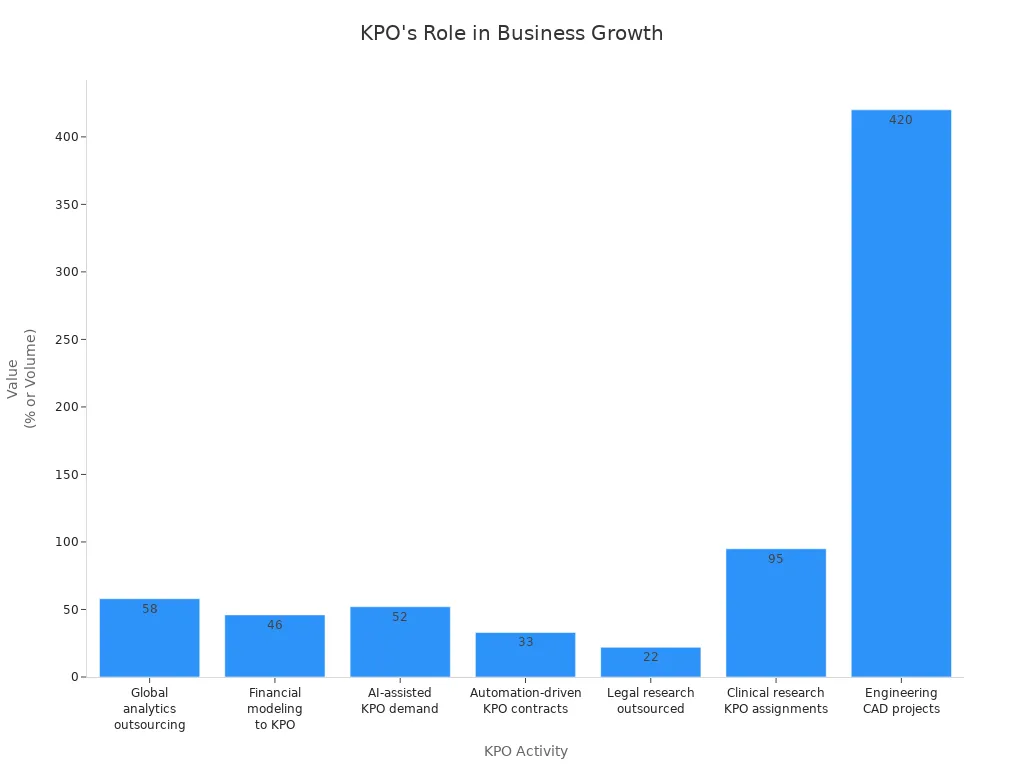
Strategic outsourcing enables businesses to scale efficiently and focus on core competencies, which is essential for adapting to growth opportunities such as mergers and acquisitions.
Companies should assess their needs, choose partners with strong compliance, and set clear goals. Those interested in learning more about KPO and its impact can reach out for further information.
FAQ
What types of tasks does Knowledge Process Outsourcing cover?
KPO covers tasks like market research, financial analysis, legal research, data analytics, and software development. These tasks require specialized knowledge and advanced skills.
How does KPO differ from BPO?
KPO focuses on complex, knowledge-based work. BPO handles routine, repetitive tasks. KPO providers offer expertise and strategic insights, while BPO providers deliver efficiency for standard processes.
Is KPO safe for sensitive business data?
KPO providers use strong security measures. They use encryption, access controls, and regular audits. Companies should check a provider’s data protection policies before sharing information.
What industries benefit most from KPO?
Industries like finance, healthcare, IT, legal, and engineering benefit most. These fields need advanced analysis, research, and compliance support.
How can a company choose the right KPO partner?
A company should check the provider’s expertise, track record, and security practices. They should also look for cultural fit and clear communication.
Can small businesses use KPO?
Small businesses can use KPO to access expert skills without hiring full-time staff. This helps them save money and stay competitive.
What are the main risks of KPO?
Main risks include data security, communication barriers, and integration challenges. Companies can reduce these risks by setting clear rules and choosing reliable partners.
How does KPO support business growth?
KPO gives companies access to expert talent, reduces costs, and increases flexibility. This support helps businesses scale quickly and focus on their main goals.


