Steps to Build a Strong Succession Strategy for Your Business

Business Succession Planning protects leadership continuity and business stability. Many owners wonder how to build a strong succession strategy. When leaders leave unexpectedly, companies face disruption. Nearly 70% of small businesses fail to sell or transition because they lack planning. Median close rates sit at just 6.46%. Proactive planning reduces risk and secures long-term success. By using proven methodology, owners create systems that identify critical roles and future needs. Ongoing review and access to resources help sustain the process.
Key Takeaways
Business Succession Planning ensures leadership continuity and minimizes disruptions during transitions.
Identify critical roles within your organization to prioritize succession planning efforts effectively.
Engage stakeholders in the succession planning process to enhance credibility and acceptance.
Choose a succession model that aligns with your company’s culture and goals, whether internal, external, or hybrid.
Regularly review and update your succession plan to keep it relevant and effective in changing business environments.
Invest in training and mentoring programs to prepare high-potential employees for future leadership roles.
Measure the readiness of potential successors to ensure they can step into key positions when needed.
Embed succession planning into your company culture to foster growth and employee engagement.
Business Succession Planning Overview

Business Succession Planning gives companies a structured way to prepare for leadership changes. This process helps organizations identify future leaders, set clear roles, and create plans for smooth transitions. Many industry standards highlight the need for leadership identification, professional advisors, and strong documentation. Companies also benefit from clear governance structures and defined duties. These elements work together to keep the business stable during times of change.
Why Succession Planning Matters
Every business faces the risk of sudden leadership changes. Illness, retirement, or unexpected departures can disrupt daily operations. Succession planning prepares organizations for these moments. It ensures continuity and minimizes disruption when leaders leave. Companies that plan ahead preserve important knowledge and keep operations running smoothly. A well-prepared successor can protect the organization from negative impacts during transitions. Emergency succession plans provide immediate replacements, which helps maintain stability during crises. This proactive approach supports productivity and keeps morale high.
Note: Organizations without a succession plan often experience costly turnover and loss of institutional knowledge. They may also face breaks in continuity and missed business opportunities.
Key Benefits for Businesses
Business Succession Planning offers many advantages. Companies that invest in this process see greater stability and growth. Some key benefits include:
Ensures organizational continuity by preventing disruptions in operations.
Aligns with strategic business goals by preparing future leaders with necessary skills.
Preserves institutional knowledge by transferring valuable experience from senior employees.
Reduces reliance on external recruitment by developing internal talent.
Lowers turnover and improves productivity by providing clear career paths.
Improves competitive advantage by investing in people who can innovate and adapt to new technologies.
Optimizes employee development investments by directing training resources effectively.
Organizations that provide clear opportunities for internal career growth often see higher profits. Employees feel more satisfied and stay longer when they know their company invests in their future. A good succession plan benefits owners, employees, customers, and stakeholders by supporting a smooth transition with minimal disruption.
Business Succession Planning stands as a critical tool for long-term business health. It helps companies face the future with confidence and resilience.
Identify Key Roles
Critical Leadership Positions
Every organization depends on certain roles that drive its success. Leaders must identify which positions are most critical to daily operations and long-term goals. They can start by evaluating each role’s impact on customer experience, revenue, compliance, strategic initiatives, and organizational culture. A scoring system helps measure direct effects on revenue, customer satisfaction, regulatory risk, and the difficulty of finding replacements.
Tip: Companies often use a matrix to prioritize roles based on business impact and how hard it is to replace someone in that position.
A leadership workshop can help pinpoint roles that would disrupt operations, revenue, or compliance if left vacant for 60-90 days. By focusing on 5-10 key positions, organizations make Business Succession Planning more manageable. Leaders ask clear questions about customer impact, cash flow, and compliance. Positions that score high in two or more areas become top priorities for succession planning.
Key criteria for identifying critical roles:
Impact on customer experience and brand reputation
Direct effect on revenue or cost
Influence on compliance, safety, or cyber risk
Difficulty of replacement
Role in strategic initiatives
Influence on organizational culture
Assess Future Needs
Organizations must look beyond current needs and consider future leadership requirements. Market trends, technology changes, and company growth shape what skills will be necessary. Leadership assessments turn opinions into objective data. These tools reveal skill gaps, emotional resilience, and team-building abilities among current leaders.
Evidence Type | Description |
|---|---|
Skill Gap Identification | Assessments help identify skill gaps among current leaders, which is essential for planning future leadership needs. |
Benchmarking | Organizations can benchmark their leadership capabilities against industry standards to ensure competitiveness. |
Predictive Analysis | Assessments can predict future leadership potential, aiding in succession planning and ensuring readiness for market changes. |
Understanding these gaps prepares high-potential employees for future roles. Benchmarking against industry standards ensures the company stays competitive. Predictive analysis helps leaders plan for market changes and organizational growth.
Stakeholder Involvement
Stakeholder involvement strengthens the succession planning process. Leaders engage all stakeholders who will feel the impact of leadership changes. They use interviews and surveys to gather input from different groups. Senior leadership plays a key role by lending credibility and authority to the process.
Method | Description |
|---|---|
Helps maintain momentum and address challenges, ensuring stakeholder engagement throughout the process. | |
Collaborative Approach | Involves stakeholders in the planning, enhancing credibility and acceptance across the organization. |
Active participation from senior leaders signals that succession planning is a strategic priority. Regular meetings and updates keep everyone informed and involved. A collaborative approach increases acceptance and support across the organization.
Choose a Succession Model
Selecting the right succession model shapes the future of any organization. Leaders must decide whether to develop talent from within, seek new perspectives from outside, or blend both approaches. Each model offers unique benefits and challenges. The choice depends on company goals, culture, and the availability of qualified candidates.
Internal vs. External Options
Organizations often start by considering internal candidates for leadership roles. Internal succession builds loyalty and motivates employees. Workers see clear career paths and feel valued when they know the company invests in their growth. However, relying only on internal talent can limit innovation. Sometimes, the current team may not have the skills needed for future challenges.
External succession brings in new ideas and expertise. This approach helps when the company needs skills not found inside the organization. External hires can drive change and introduce best practices from other industries. Yet, bringing in outsiders may disrupt team dynamics. New leaders need time to adjust and learn the company’s culture.
The table below compares the advantages and disadvantages of each model:
Succession Model | Advantages | Disadvantages |
|---|---|---|
Internal | - Promotes employee loyalty and engagement. | - May lack fresh perspectives. |
External | - Brings in fresh perspectives and necessary expertise. | - May disrupt internal structure. |
Tip: Companies should assess their current talent pool before deciding to look outside for leadership.
Family Business Considerations
Family-owned businesses face unique succession challenges. Owners often want to keep leadership within the family. This approach can protect the company’s values and traditions. However, family members may not always have the right skills or interest in running the business. Clear criteria for selecting successors help avoid conflict and ensure the best choice for the company’s future.
Family businesses benefit from open discussions about roles and expectations. Outside advisors can guide the process and provide objective feedback. Written agreements and training plans prepare family members for leadership and reduce misunderstandings.
Hybrid Approaches
Many organizations use hybrid succession models. These models combine internal development with external hiring. Leaders may develop high-potential employees for some roles and recruit outside experts for others. This flexible approach fills skill gaps and brings in fresh perspectives when needed.
Hybrid models work well when internal assessments show that some positions require outside expertise. Regular reviews help leaders decide when to promote from within or hire externally. This strategy supports long-term growth and adapts to changing business needs.
Business Succession Planning succeeds when leaders choose the model that fits their goals, culture, and talent needs. A thoughtful approach ensures the right people lead the company into the future.
Business Valuation and Financial Planning
A strong succession plan starts with understanding the true value of the business. Accurate valuation and careful financial planning help owners make informed decisions. These steps protect the company’s future and support a smooth leadership transition.
Objective Business Valuation
Objective business valuation gives owners a clear picture of what their company is worth. This process uses several reliable methods. Financial statements show the company’s health and performance. Market conditions reveal how outside factors affect value. Growth potential looks at future profits and market size. Both tangible and intangible assets add to the total value. The management team’s skills and industry analysis also play important roles.
Factor | Description |
|---|---|
Financial Statements | Essential information about the business's financial health and performance. |
Market Conditions | Current market trends and economic outlook that impact business value. |
Growth Potential | Assessment of future growth and profitability based on market size and competitive advantage. |
Tangible and Intangible Assets | Evaluation of both physical and non-physical assets contributing to overall business value. |
Management and Team | Consideration of the management team's competence and its impact on business success. |
Industry Analysis | Understanding industry dynamics and competition to assess business position and potential. |
Professional appraisers and financial advisors help ensure accuracy. They use these factors to set a fair price. This step supports legal compliance and builds trust among stakeholders.
Financial and Estate Planning
Financial and estate planning keeps the transition process smooth. A practical plan reassures employees and stakeholders. It includes a clear process for business valuation and funding. Owners must identify key roles and possible successors. A strong estate plan prepares for challenges and matches the owner’s vision.
Promotes continuity and stability for the business.
Includes a process for business valuation and funding transactions.
Identifies key roles and potential successors.
Anticipates challenges and aligns with the owner’s goals.
Ensures accurate estate tax calculation and compliance.
Prevents financial burdens on beneficiaries.
Supports informed decision-making with a clear understanding of business worth.
A skilled financial advisor guides owners through these steps. They help with tax strategies, asset identification, and beneficiary planning. Defining roles in the plan reduces conflict and brings clarity to management.
Setting a Transition Timeline
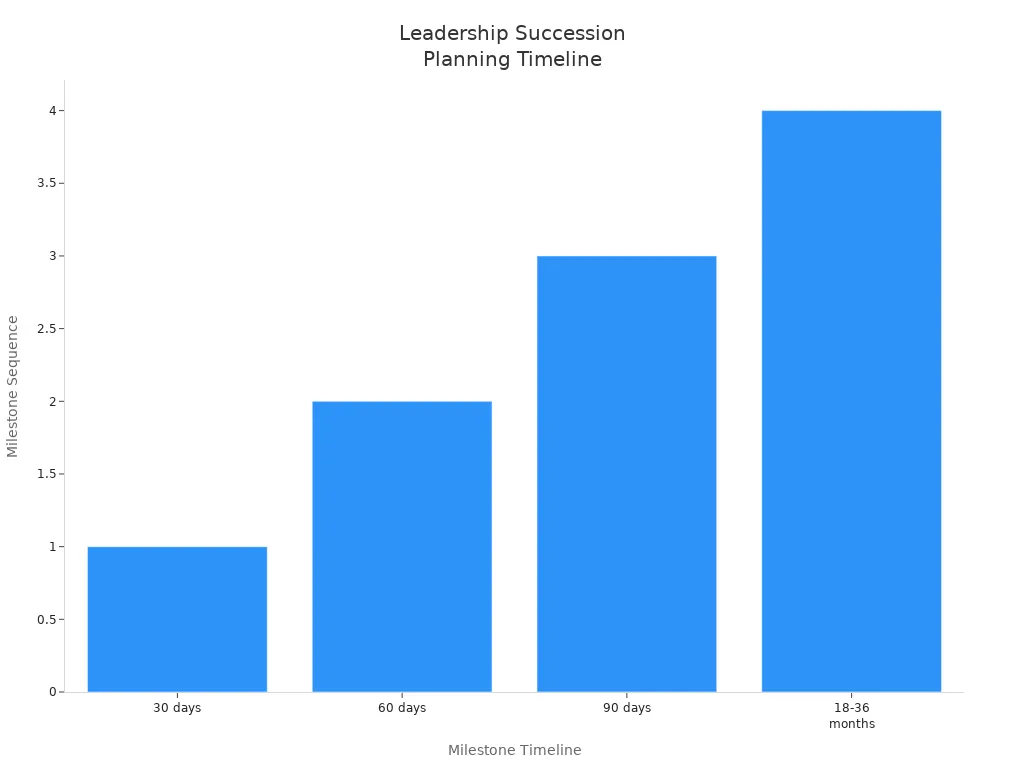
A clear timeline helps everyone know what to expect during leadership changes. The process starts with identifying critical roles and forming committees. Next, the company completes competency profiles and assessments. Development plans and training programs follow. Over 18 to 36 months, candidates build skills and prepare for new roles.
Milestone | Timeline | Description |
|---|---|---|
30 days | Initial | Critical roles identified and committees formed |
60 days | Intermediate | Competency profiles completed and initial assessments conducted |
90 days | Final | Development plans finalized and training programs launched |
18-36 months | Long-term | Gradual pipeline strengthening as candidates complete development programs |
Business Succession Planning works best when owners value their company accurately, plan finances carefully, and set a clear timeline. These steps protect the business and support a successful transition.
Align Talent Strategy
Identify High-Potential Employees
Organizations need to spot employees who show promise for future leadership. They can start early by preparing several candidates for key positions. Managers look for high-potential employees at all levels, not just in senior roles. They keep detailed records of skills and update them often. Regular assessments help find skill gaps and guide development plans. Managers also talk with employees about their career goals to match personal ambitions with company needs.
A table below shows common criteria for identifying high-potential employees:
Criteria | Description |
|---|---|
Learning Agility | Ability to learn quickly and adapt to new situations. |
Adaptability | Flexibility in responding to change and challenges. |
Strategic Perspective | Capability to think critically about business challenges and opportunities. |
Commitment to Organizational Success | Dedication to the goals and success of the organization, beyond personal achievements. |
Growth Trajectory | Evidence of expanding capabilities and seeking challenging assignments over time. |
Resilience | Ability to recover from setbacks and maintain performance under pressure. |
Leadership Behaviors | Displaying leadership qualities even before formal roles, such as influencing and rallying teams. |
Managers use these criteria to find employees who can grow into leadership roles. They also use temporary leadership assignments to test readiness.
Successor Selection Criteria
Selecting the right successor requires clear standards. Leadership teams evaluate candidates based on their impact on business continuity and strategic importance. They use comprehensive evaluations to measure progress and alignment with company goals. Targeted development initiatives help build a strong talent pipeline. Readiness assessments show strengths and areas for improvement. Some organizations use AI-driven analytics to gain deeper insights into employee potential.
Strategy | Description |
|---|---|
Comprehensive Evaluations | Assess employee progress and alignment with organizational goals. |
Targeted Development Initiatives | Build a talent pipeline for critical roles. |
Readiness Assessments | Evaluate strengths and development needs of potential successors. |
AI-driven Analytics | Provide insights into employee strengths and areas for improvement. |
Organizations with strong succession programs experience fewer disruptions and lower recruitment costs. They also maintain stronger leadership continuity over time.
Integrate with HR Processes
Business Succession Planning works best when it connects with other HR processes. Managers link succession planning with performance management, learning, and development. They also tie it to recruitment, hiring, compensation, and retention strategies. This integration ensures that succession planning is not a separate program but part of a larger talent management system.
Note: Only 20% of HR leaders have leaders ready to fill critical roles. Organizations should focus on preparing leaders for new responsibilities, not just replacing them.
Best practices include starting early, involving senior leadership, and developing formal plans. Managers identify key roles, assess current talent, and forecast future needs. They also promote diversity and inclusion to create a broad pool of candidates. Succession planning software can help streamline the process. Regular reviews keep the plan up to date and relevant.
Business Succession Planning aligns talent strategy with long-term goals. This approach prepares organizations for future challenges and supports ongoing growth.
Develop and Test Future Leaders

Training and Mentoring Programs
Organizations invest in training and mentoring to prepare future leaders. They use cohort development programs, which group employees together for shared learning. This approach improves promotion outcomes and builds teamwork. Sequential leadership learning helps employees gain skills step by step. Frequent coaching from managers supports ongoing growth and confidence.
Structured training programs give employees the tools they need for advancement. Mentorship opportunities connect potential leaders with experienced professionals. Regular feedback and performance assessments guide each person’s development. Pairing future leaders with mentors provides valuable advice and support.
Companies also use cross-functional rotation. Employees work in different departments to understand the whole organization. Stretch assignments challenge them to solve new problems and develop new skills. Strategic exposure to senior leadership helps future leaders learn how decisions are made at the top.
Tip: Regular feedback and mentorship help employees see their progress and stay motivated.
Assign Real Responsibilities
Testing future leaders means giving them real work. Companies allow successors to make decisions, starting with small ones. They might lead strategic projects or manage business units. These experiences show how well they handle pressure and solve problems.
Some organizations let potential leaders represent the company in external partnerships. This builds confidence and teaches them about the business world. Acting or interim roles give employees a chance to try leadership before a permanent move. Managers watch how they perform and give feedback.
Assign small decision-making tasks first.
Let them lead important projects.
Provide opportunities to manage teams or business units.
Allow them to represent the company with partners.
Use acting roles to test fit and readiness.
These steps help identify who is ready for more responsibility.
Measure Readiness
Measuring readiness ensures that future leaders can step into key roles. Companies use several metrics to track progress and success.
Metric | Description |
|---|---|
Critical Positions Filled Internally | Tracks the number of key roles filled by internal candidates. |
Ready-Now Successor Rate | Proportion of leadership roles with successors who are ready now. |
Critical Positions with 3+ Successors | Number of key roles with at least three prepared candidates. |
Time to Readiness | Average time required before a successor is ready for a key role. |
Succession Coverage Ratio | Percentage of key positions with at least one identified successor. |
Managers also use assessments, performance reviews, and mentor feedback to check readiness. They look at the health of the talent pipeline, including the number of high-potential employees and the diversity of the group. Business performance, such as revenue growth and efficiency, shows the impact of strong leadership development.
Business Succession Planning includes these steps to ensure the right people are ready to lead. This process builds a strong foundation for the company’s future.
Review and Sustain the Succession Plan
Regular Plan Reviews
Companies must keep their succession plans current to stay effective. Regular reviews help leaders track progress and adjust for new challenges. Most organizations revisit their plans every 6 to 12 months. Some choose annual, biannual, or even quarterly reviews, depending on their size and complexity. These check-ins often align with performance reviews or budget planning periods. Leaders should also update the plan when a succession occurs or when new talent joins the management team.
A well-built succession plan is not something to file away and forget. Businesses grow, goals shift, and people move on. Regular reviews ensure the plan reflects the owner’s wishes, the company’s value, and the readiness of all involved.
A regular review schedule helps companies measure the progress of employees in development programs. This process keeps the plan up-to-date and relevant.
Adapting to Change
Market conditions and business goals can change quickly. Companies need strategies to keep their succession plans flexible. Research shows that organizations with long-range planning adapt better to new needs and goals. Leaders use several strategies to stay prepared:
Strategy | Description |
|---|---|
Communicating the plan | Informing stakeholders and potential successors about transition expectations fosters confidence. |
Training and development | Preparing successors through mentorship and structured training minimizes disruptions. |
Testing the plan | Running trial transitions helps identify weaknesses before a full transition. |
Regular reviews | Updating plans annually ensures alignment with changing business objectives and conditions. |
Proactive planning strengthens the talent pipeline and reduces risk. Continuous maintenance, such as quarterly talent reviews and regular updates, keeps the plan aligned with business needs.
Embedding Succession in Culture
Companies that treat succession planning as an ongoing process see better results. Leaders start small and build gradually to make steady progress. Modern tools and resources help streamline the process. A culture of growth and development encourages employees to engage and stay with the company. Professional guidance can help address challenges and apply best practices.
Organizations with structured succession plans see revenue increase by 58% and profitability improve by 72%. Employee engagement becomes almost three times more likely.
Business Succession Planning works best when it becomes part of the company’s culture. Leaders who focus on growth and development create a strong foundation for the future.
A structured Business Succession Planning process supports business continuity by preparing leaders, aligning strategy, and preserving value. Regular reviews and updates keep plans relevant and flexible, which strengthens organizational resilience. Practical steps like setting reminders, involving leadership, and creating clear pathways help sustain momentum. Clients at systems and teams achieve these results through intentional planning and teamwork. They can reach out to learn more or ask, “Is your business ready for the next leadership transition?”
FAQ
What is succession planning?
Succession planning prepares a business for leadership changes. It identifies key roles and develops future leaders. This process protects business continuity and supports growth.
How often should a company review its succession plan?
Most companies review their succession plan every 6 to 12 months. Regular updates keep the plan relevant and effective.
Who should participate in succession planning?
Senior leaders, HR professionals, and key stakeholders should participate. Their involvement ensures the plan aligns with business goals and culture.
What are common mistakes in succession planning?
Common mistakes include ignoring critical roles, failing to update plans, and not developing internal talent. Companies also risk problems by lacking clear criteria for successor selection.
How does succession planning benefit employees?
Succession planning creates clear career paths. Employees feel valued and motivated. They see opportunities for growth and advancement.
Can small businesses use succession planning?
Small businesses benefit from succession planning. They protect operations and prepare for unexpected changes. Owners can use simple tools and involve trusted advisors.
What tools help with succession planning?
Companies use talent management software, assessment tools, and leadership development programs. These tools track progress and support decision-making.
How does succession planning affect business value?
Succession planning increases business value. It reduces risk and attracts buyers or investors. A strong plan shows stability and readiness for future challenges.


