Business Consulting Services that Make Growth Simple

Have you ever wondered why some businesses grow steadily while others struggle to move forward? Business Consulting Services often hold the answer. Consultants analyze business issues, design practical solutions, and guide change using proven Systems and Methodology. Many business owners turn to consulting for expert guidance in strategic planning, financial management, and operational efficiency.
Consultants identify areas of inefficiency and suggest ways to reduce overhead costs.
They conduct market research to pinpoint target customers and drive business development.
Business Consulting Services bring tailored strategies that help owners make confident decisions and manage growth.
Consulting services offer results-driven support, aligning Resources with business goals for steady progress.
Key Takeaways
Business consulting services help organizations identify inefficiencies and reduce costs, leading to improved profitability.
Consultants provide tailored strategies that empower business owners to make informed decisions and manage growth effectively.
Consulting services adapt to the unique needs of each business, ensuring flexibility and relevance in their approach.
Expert guidance from consultants helps businesses navigate challenges in areas like strategy, operations, finance, and HR.
Consultants support both planning and implementation, ensuring that strategies translate into actionable results.
Measuring success through Key Performance Indicators (KPIs) allows businesses to track progress and validate the impact of consulting efforts.
Continuous improvement is essential; consultants help organizations set clear goals and adapt strategies as needed for sustained growth.
Choosing the right consulting partner involves assessing needs, evaluating experience, and ensuring cultural fit for effective collaboration.
What Are Business Consulting Services?
Definition and Purpose
Business consulting services involve structured engagements where consulting firms analyze a business’s situation, recommend actions, and support the organization to improve results. These services help companies address challenges in growth strategy, profitability, operations, digital transformation, and risk management. Management consulting professionals use their expertise to examine current processes, identify gaps, and design solutions that drive measurable change.
Consulting firms work with leaders to set clear goals and create action plans. They focus on making strategies practical and achievable. Management consulting covers a wide range of areas, including strategy, operations, finance, information technology, and human resources. Each area addresses different needs within a business. For example, strategy consulting helps with long-term planning, while operations consulting improves daily processes. Financial consulting focuses on budgeting and cost control. IT consulting supports technology upgrades, and HR consulting manages talent and organizational change.
The main purposes of business consulting include:
Better decision-making: Leaders gain access to data and insights that help them make informed choices.
High flexibility: Consulting services adapt to the unique needs and goals of each business.
Stronger execution: Consultants help turn strategies into action plans with clear steps and milestones.
Management consulting gives organizations the tools and guidance they need to reach their objectives. Consulting firms bring outside perspectives that help businesses see new opportunities and avoid common pitfalls.
Common Misconceptions
Many people believe that consulting only benefits large companies. In reality, management consulting supports businesses of all sizes. Small and medium-sized businesses often gain the most from expert advice because they may lack in-house resources. Another misconception is that consulting firms only offer advice without helping with implementation. Most consulting professionals stay involved throughout the process, guiding businesses from planning to execution.
Some think that consulting is too expensive or only focuses on cutting costs. Management consulting often leads to long-term savings and growth by improving efficiency and uncovering new revenue streams. Others assume that consulting firms use a one-size-fits-all approach. In fact, consulting services are highly customized to fit each business’s unique situation.
Note: Management consulting and business consulting are sometimes used interchangeably. Both terms describe services that help organizations solve problems, improve performance, and achieve growth.
Consulting plays a vital role in today’s fast-changing business world. By understanding what consulting offers and clearing up common myths, leaders can make better choices for their organizations.
Types of Business Consulting Services
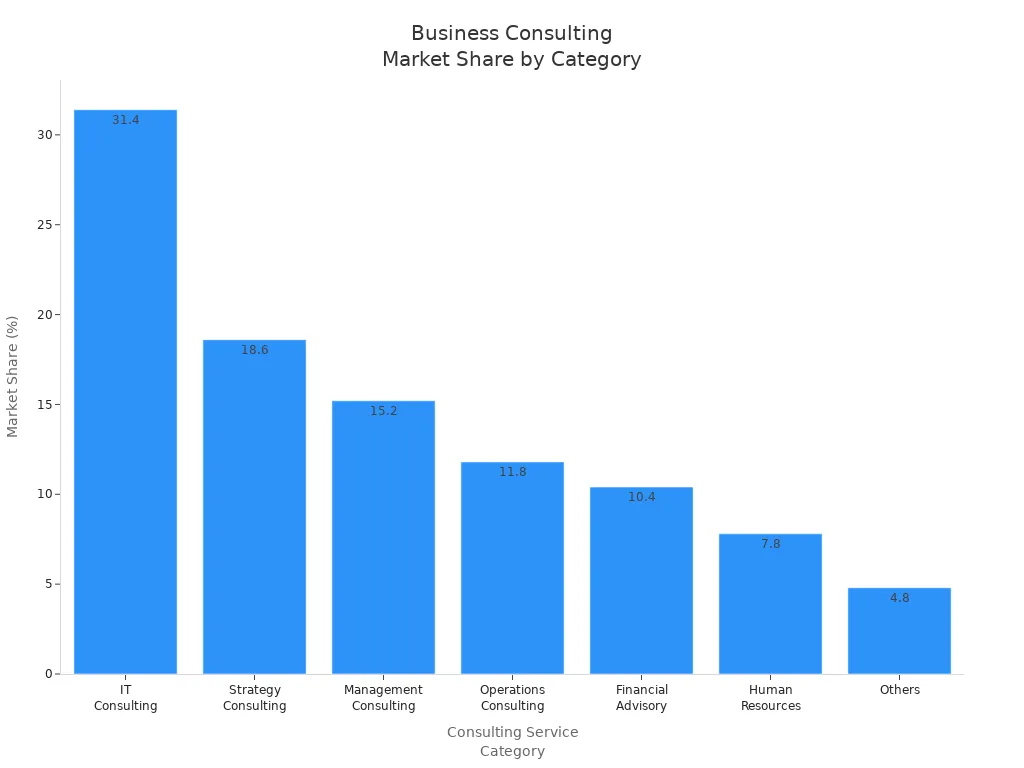
Business consulting covers several main categories, each designed to address specific business needs. The market for these services is diverse, with some areas holding a larger share than others. The following table shows the market share for each major consulting service category:
Consulting Service Category | Market Share (%) | Market Value (USD) |
|---|---|---|
IT Consulting | 31.4 | 111.9 billion |
Strategy Consulting | 18.6 | N/A |
Management Consulting | 15.2 | N/A |
Operations Consulting | 11.8 | N/A |
Financial Advisory Consulting | 10.4 | N/A |
Human Resources Consulting | 7.8 | N/A |
Others | 4.8 | N/A |
Strategy Consulting
Strategy consulting helps organizations define their direction and make informed decisions. Consultants in this field use proven methods to analyze the business environment and set clear goals.
Business Planning
Business planning forms the foundation of any successful company. Consultants guide leaders through the process of setting objectives, allocating resources, and creating action plans. They use tools like SWOT Analysis, which examines strengths, weaknesses, opportunities, and threats. This approach helps companies build on their strengths and address areas for improvement.
Competitive Analysis
Competitive analysis allows businesses to understand their position in the market. Consultants use frameworks such as PESTLE Analysis and Porter’s Five Forces. PESTLE looks at political, economic, social, technological, legal, and environmental factors. Porter’s Five Forces examines industry competition. These tools help companies identify opportunities and threats, leading to better strategies and a stronger competitive edge.
Operations Consulting
Operations consulting focuses on improving the efficiency and effectiveness of business processes. This area of management consulting supports companies in streamlining workflows and boosting productivity.
Process Improvement
Process improvement aims to make daily operations smoother and more cost-effective. Consultants introduce data analytics to track performance and spot inefficiencies. Companies using advanced analytics report a 12% increase in overall efficiency. IBM’s consultancy has shown that businesses can achieve a 20% improvement in operational efficiency within six months.
Supply Chain
Supply chain consulting helps organizations manage the flow of goods and services. Consultants recommend strategies that reduce logistics costs by up to 10%. Improved supply chain management can lead to a 14% increase in operating profit margins and a 33% faster order-to-delivery cycle. Many global companies now invest in sustainable operations to meet regulations and consumer expectations.
Financial Consulting
Financial consulting supports businesses in managing money, reducing risks, and increasing profits. This area of business consulting is vital for long-term stability.
Financial Planning
Financial planning involves setting budgets, forecasting revenue, and preparing for future growth. Consultants help organizations recognize and address financial risks, such as market changes and new regulations. A study by Deloitte found that 60% of businesses using financial consulting saw less financial uncertainty in the first year.
Cost Reduction
Cost reduction strategies focus on lowering expenses without sacrificing quality. Consultants conduct risk assessments and develop plans to protect financial health. For example, Ernst & Young helped a multinational company lower its risk burden by 30% through careful financial planning.
Tip: Choosing the right management consulting service can help businesses achieve growth, improve efficiency, and manage risks more effectively.
IT Consulting
IT consulting helps businesses use technology to solve problems and reach their goals. Many companies seek IT consulting to guide them through digital transformation. This process changes how a business operates by using new technology. Digital transformation can improve customer experiences, make operations faster, and help companies stay competitive.
Digital Transformation
Digital transformation stands as a top priority for many organizations. IT consultants lead businesses through each step of this journey. They assess current systems, recommend new tools, and help teams adapt to change. Digital transformation often includes moving data to the cloud, automating tasks, and using analytics to make better decisions. Companies that complete digital transformation report higher productivity and better customer satisfaction.
Some of the most common IT consulting services requested by businesses in 2024 include:
Automation through AI
Predictive analytics
Cyberattack prevention
Cloud consulting and migration
Data and analytics
IT strategy and digital transformation
Cybersecurity and risk management
Software development and integration
IT infrastructure and networking
Compliance and regulations
Digital transformation also involves training employees and updating security practices. IT consultants help businesses avoid risks and keep information safe during transformation. They use proven methods to make sure digital transformation brings real results.
Technology Implementation
Technology implementation means putting new systems and software into action. IT consultants manage projects, test solutions, and train staff. They use agile methods to deliver results quickly. Consultants set up smart devices, connect networks, and make sure everything works together. They also help with pipeline setup, thorough testing, and change management.
A successful technology implementation supports digital transformation. It allows companies to use the latest tools and stay ahead in their industry. IT consultants focus on making technology easy to use and reliable for everyone in the business.
HR Consulting
HR consulting supports companies as they manage people and build strong teams. This type of consulting helps with talent management and guides organizations through change. HR consultants design strategies for hiring, training, and keeping top talent.
Talent Management
Talent management covers finding, developing, and keeping skilled employees. HR consultants create plans for talent acquisition, diversity, and fair pay. They use data to compare compensation and make sure companies attract the best people. In 2024, talent acquisition strategy, diversity and inclusion advisory, and compensation benchmarking are the highest-demand service lines.
Organizational Change
Organizational change happens when a company grows or shifts direction. HR consultants help leaders communicate changes and support employees. They design programs for training and development. Consultants also guide companies through mergers, new leadership, or changes in structure.
The table below shows important facts about HR consulting in 2024:
Aspect | Detail |
|---|---|
Growth Rate | The global human resources consulting segment is estimated to have grown by approximately 8.3% in 2024. |
Demand Drivers | Talent acquisition strategy, diversity and inclusion advisory, and compensation benchmarking are among the highest-demand service lines. |
Future Projections | The segment is projected to grow at a CAGR of 6.9% from 2026 to 2034, driven by the shift toward skills-based workforce models. |
HR consulting helps businesses manage transformation and prepare for the future. Consultants give advice that supports both leaders and employees during times of change.
How Consulting Services Drive Growth

Business consulting plays a vital role in helping organizations achieve growth. Consulting firms use proven methods to analyze business performance, identify opportunities, solve problems, and implement solutions. Management consulting provides a clear and objective perspective, which helps companies see new possibilities and overcome challenges. These services offer customized strategies that support business model transformation and long-term success.
Identifying Opportunities
Consultants help businesses find new ways to grow. They use market research, data analytics, and industry trend monitoring to spot gaps and emerging opportunities. Management consulting professionals define market intelligence goals and gather data from reliable sources. They filter and categorize this information, then analyze trends to identify areas where the business can expand or innovate.
Market Expansion
Consulting firms guide organizations through the process of entering new markets. They assess market readiness, identify promising geographic regions, and prepare strategies for successful entry. Consultants focus on scaling operations, increasing revenue, and growing the customer base. The table below shows common strategies used in market expansion:
Strategy Type | Description |
|---|---|
Assists clients in preparing for and executing merger, acquisition, and divestiture activities. |
Consultants also help businesses align their operations with long-term goals. They optimize resources to boost productivity and reduce costs. By identifying new markets, management consulting supports sustainable growth and a stronger market position.
Product Development
Business consulting services support organizations in developing new products or improving existing ones. Consultants leverage customer feedback and data analytics to understand market needs. They identify gaps in the current product lineup and recommend innovations that meet customer demands. Management consulting teams use technology advancements to create solutions that set businesses apart from competitors. This approach helps companies stay relevant and competitive in changing markets.
Solving Problems
Consulting firms excel at solving complex business challenges. They use structured problem-solving processes and set clear goals for each engagement. Management consulting professionals leverage technology to enhance operational efficiency and effectiveness.
Operational Bottlenecks
Operations consulting focuses on removing barriers that slow down business processes. Consultants analyze workflows, identify inefficiencies, and recommend improvements. They use systematic approaches to address operational issues and help companies achieve better results. The table below outlines effective strategies for solving operational problems:
Strategy | Description |
|---|---|
Structured Problem-Solving Process | Emphasizes a systematic approach to identify and address operational issues effectively. |
Clear Goals | Establishing well-defined objectives to guide the consulting engagement and ensure alignment. |
Leveraging Technology | Utilizing modern technological tools and solutions to enhance operational efficiency and effectiveness. |
By optimizing operations, management consulting helps businesses increase productivity and reduce unnecessary costs.
Change Management
Change management consulting supports organizations during periods of transformation. Consultants assess organizational readiness and evaluate leadership commitment. They develop communication strategies to address employee concerns and reduce uncertainty. The table below highlights key roles of consulting services in change management:
Role of Consulting Services in Change Management | Description |
|---|---|
Effective Communication | Consultants help build trust with stakeholders through strong communication skills, which is essential for reducing resistance to change. |
Employee Involvement | Involving team members in the change process enhances engagement and ownership, crucial for successful change leadership. |
Assessing Organizational Readiness | Consultants evaluate the culture and leadership commitment to identify potential obstacles, setting the stage for successful implementation. |
Developing Communication Strategies | They craft messages to address employee concerns, reducing uncertainty and building confidence during transitions. |
Establishing Success Metrics | Selecting appropriate metrics aligned with business objectives ensures effective tracking of change initiatives. |
Change management consulting ensures that organizations adapt smoothly to new strategies and business model transformation.
Implementing Solutions
Consulting services do not stop at planning. Consultants help businesses put strategies into action and ensure that changes deliver real results. Management consulting professionals follow proven processes for consistency and efficiency.
Project Management
Consultants manage projects by setting clear goals, assigning roles, and breaking down tasks into manageable steps. They schedule regular check-ins and use shared documents for updates. The table below summarizes best practices for project management during solution implementation:
Strategy | Description |
|---|---|
Set clear goals | Establish specific objectives to guide the project. |
Maintain communication | Regular updates and meetings to keep everyone informed. |
Monitor progress | Use KPIs and progress reports to track advancements. |
Evaluate results | Assess outcomes to ensure consultant recommendations lead to improvements. |
Consulting firms assign a main contact person for questions and ensure that every action item has a deadline. This approach keeps projects on track and supports successful implementation.
Training and Support
Consultants provide training and ongoing support to help employees adapt to new processes and technologies. They develop programs that build skills and confidence. Management consulting teams commit to continuous learning and improvement, adapting their approach to fit the company culture. This support ensures that solutions become part of daily operations and drive lasting business growth.
Tip: Consulting services help organizations achieve growth by providing objective analysis, customized strategies, and hands-on support throughout the transformation process.
Measuring Results
Consulting services help organizations track progress and validate the impact of their growth strategies. Measuring results ensures that every change delivers value and supports business objectives. Consultants use clear metrics to monitor outcomes and guide continuous improvement.
KPIs
Key Performance Indicators (KPIs) serve as the foundation for measuring consulting success. Consultants select KPIs that align with business goals and reflect the effectiveness of interventions. These metrics provide objective data, making it easier for leaders to assess progress and make informed decisions.
The following table outlines common metrics used to evaluate consulting interventions:
Metric Type | Description |
|---|---|
Participation and Engagement Metrics | Measures reach and uptake, including enrolment, attendance, and completion rates, as well as participant feedback. |
Skill Attainment Metrics | Assesses improvement in skills through pre- and post-training assessments, certification rates, and skill demonstrations. |
Application and Behaviour Change Metrics | Evaluates if skills are applied on the job, using performance indicators and behavioral assessments. |
Organisational and Industry Outcomes | Reflects broader impacts like productivity gains, quality improvements, and employee retention. |
Return on Investment Metrics | Compares monetary value of outcomes to costs, including ROI analysis and cost per participant. |
Consultants at systems and teams use these metrics to track the effectiveness of their strategies. They monitor participation rates, skill development, and behavioral changes within client organizations. By focusing on organizational outcomes and return on investment, consultants ensure that growth initiatives deliver measurable benefits.
Tip: Selecting the right KPIs helps organizations validate their efforts and motivates teams by showing clear progress.
Continuous Improvement
Continuous improvement keeps organizations moving forward after initial results are measured. Consultants encourage clients to set clear goals, collect baseline data, and choose relevant metrics. They help build the infrastructure needed to gather and analyze information accurately.
Set clear goals using SMART criteria linked to business objectives.
Identify baseline performance to measure improvement.
Select key performance indicators that reflect the impact of changes.
Ensure systems can collect and analyze data effectively.
Involve team members in metric selection and data collection.
Clients at systems and teams achieve sustained growth by making measurement a team effort. Consultants involve those closest to the process, fostering accountability and transparency. Regular reviews of KPIs and outcomes support strategic decision-making and motivate employees to embrace new practices.
Effectively measuring progress with lean improvement metrics validates the resources invested and provides quantifiable proof of effectiveness. It also fosters a culture of accountability and transparency across the organization. Continuous improvement ensures that growth remains simple and attainable, even as business needs evolve.
Benefits of Business Consulting Services
Expertise and Objectivity
Business consulting brings a high level of expertise to every project. Consultants have experience across many industries and understand the latest trends. They use this knowledge to help business leaders make better decisions. Consultants can spot bottlenecks and redundancies that internal teams may miss. They look at processes with fresh eyes and find areas for improvement.
Consultants do not get involved in office politics or personal agendas. Their outside perspective helps align teams around a common strategy. This approach builds trust and encourages collaboration. Business consulting also gives leaders access to objective analysis. Consultants use industry data and proven methods to guide decisions. Leaders can rely on these insights instead of making choices based on assumptions.
Tip: An external viewpoint from consultants often uncovers opportunities that drive growth and innovation.
The table below shows the main benefits reported by clients who use management consulting:
Benefit | Description |
|---|---|
Better decision-making | Enables leaders to make informed decisions based on evidence rather than assumptions. |
High flexibility | Services can be customized to the specific needs and goals of the business. |
Stronger execution | Helps translate strategies into realistic action plans with clear milestones. |
Lasting and sustainable | Tools and skills acquired can be transferred to internal teams, ensuring long-term value. |
Business consulting helps organizations move forward with confidence. Consultants provide the expertise and objectivity needed for lasting success.
Efficiency and Scalability
Management consulting improves efficiency by refining workflows and making better use of resources. Consultants analyze current operations and suggest ways to streamline tasks. They often recommend automation tools for repetitive work and cloud-based platforms for better collaboration. These solutions help reduce overhead costs and free up time for more important activities.
Consultants also focus on scalability. They design systems that support growth without overextending resources. For example, many organizations use Enterprise Resource Planning (ERP) software to manage data and processes as they expand. Consultants help set up these systems so businesses can grow smoothly.
Consultants refine workflows and improve resource allocation.
They implement scalable systems that support sustainable growth.
Consulting services help avoid costly mistakes by applying proven strategies.
Automation and cloud platforms reduce overhead and boost productivity.
Management consulting ensures that businesses can adapt to new challenges. Consultants help leaders build a foundation for growth that lasts. By improving efficiency and planning for the future, consulting supports organizations at every stage.
Choosing the Right Consulting Partner

Assessing Needs
Every business must start by understanding its unique requirements before selecting a consulting partner. Management consulting helps organizations clarify their goals and identify areas needing improvement. Consultants guide leaders through this process, making sure objectives are clear and measurable. Business consulting provides tools for defining both short-term and long-term targets.
A table below shows important criteria for assessing needs:
Criteria | Description |
|---|---|
Define business needs and objectives | Understand short-term and long-term goals to guide decision-making. |
Evaluate expertise and experience | Assess the consultant's industry knowledge and past project outcomes. |
Assess approach and methodology | Determine if the consultant's problem-solving methods align with your business culture. |
Check compatibility with culture | Ensure the consultant's values and working style match your organization. |
Review references and reputation | Speak with former clients and check independent reviews to gauge the consultant's track record. |
Understand pricing structures | Clarify the cost and value of services offered by the consultant. |
Business consulting firms recommend that leaders define their needs before reaching out. This step helps management consulting professionals match their expertise to the business’s challenges. Consulting services become more effective when companies know what they want to achieve.
Tip: Clearly outlining business needs allows consulting firms to deliver tailored solutions and measurable results.
Evaluating Experience
Experience matters when choosing a consulting partner. Management consulting relies on proven strategies and industry knowledge. Consultants with a strong track record understand the challenges businesses face. They use their experience to offer practical advice and guide organizations through complex situations.
Business consulting firms encourage leaders to research potential partners. They suggest reviewing case studies and testimonials. Speaking with former clients gives insight into the consultant’s approach and results. Management consulting professionals who have worked with similar businesses can provide solutions that fit the industry.
A list of steps for evaluating experience includes:
Check references and reputation in the industry.
Speak directly with former clients for objective views.
Request case studies and testimonials to understand the consultant’s track record.
Consulting services with experienced consultants help businesses avoid common mistakes and achieve growth faster.
Checking References
References play a key role in the selection process. Business consulting firms advise leaders to contact previous clients. Management consulting professionals often provide references to demonstrate their success. Leaders should ask about the consultant’s communication, reliability, and impact.
Consulting firms with positive references show they can deliver results. Business consulting relies on trust and proven outcomes. Leaders should also check independent reviews and industry reputation. This step ensures the consulting partner meets expectations and aligns with company values.
Note: Checking references helps businesses confirm the consultant’s ability to support growth and transformation.
Consulting services that offer strong references and clear communication build confidence. Management consulting partners with a solid reputation help businesses move forward with certainty.
Ensuring Fit
Selecting a consulting partner requires more than checking credentials or reviewing case studies. Businesses must ensure that the consultant fits both culturally and operationally. This step helps organizations build trust and achieve lasting results.
Consultants bring their own values, methods, and leadership styles. These must align with the company’s culture. Leaders often use a data-driven culture audit process to assess fit. This process includes surveys and interviews that reveal how well the consultant understands the organization’s values and behaviors. Companies look for consultants who bridge the gap between stated values and everyday actions.
A strong fit supports change and growth. Consultants who demonstrate clear return on investment and shareholder value show their impact. Leaders want partners who provide transparent metrics and continuous tracking. This approach helps organizations measure progress and adjust strategies as needed.
Businesses evaluate consultants using several key factors:
Experience in change management and relevant industries.
Approach to problem-solving and leadership support.
Ability to conduct thorough culture audits with valid tools.
Commitment to aligning values with daily behavior.
Use of transparent metrics for ongoing tracking.
Leaders also review the consultant’s change-leadership playbook. This playbook outlines how the consultant guides teams through transformation. It shows the consultant’s ability to support leadership and drive cultural change. Companies prefer consultants who involve employees and encourage participation.
References and case studies help leaders gauge compatibility. These resources show how the consultant worked with similar organizations. Leaders ask about communication, reliability, and impact. They look for evidence of successful cultural alignment and operational improvement.
The following table summarizes important steps for ensuring fit:
Step | Description |
|---|---|
Culture Audit | Use surveys and interviews to assess cultural alignment. |
Review Change-Leadership Playbook | Examine the consultant’s methods for supporting leadership and driving change. |
Align Values and Behavior | Ensure the consultant helps bridge the gap between stated values and daily actions. |
Transparent Metrics | Select consultants who provide ongoing tracking and clear measurement of progress. |
References and Case Studies | Use past projects to evaluate compatibility and effectiveness. |
Tip: A consulting partner who fits well with the organization’s culture and operations can help drive successful change and long-term growth.
Ensuring fit reduces resistance and builds confidence. Consultants who understand the company’s values and goals support smoother transitions. Leaders who follow these steps find partners who deliver measurable results and lasting value.
Business consulting services simplify growth for organizations by providing expert guidance and practical solutions. Management consulting helps leaders make informed decisions, optimize workflows, and build sustainable strategies. Consulting firms support businesses of all sizes through systematic execution, strategic focus, and collaboration. The table below highlights compelling reasons to consider consulting:
Reason | Description |
|---|---|
Better decision-making | Enables leaders to use evidence for choices. |
High flexibility | Customizes services for unique business needs. |
Stronger execution | Translates strategies into action plans. |
Lasting and sustainable | Transfers skills for long-term benefits. |
Improved efficiency | Eliminates inefficiencies and boosts productivity. |
Developing Growth Strategies | Creates plans for sustainable growth. |
Consulting firms recommend these steps for business owners:
Define needs and identify challenges.
Set clear goals for management consulting.
Research consulting firms for expertise.
Communicate openly and build trust.
Create action plans and monitor progress.
Plan for continuous improvement.
Management consulting offers high-value specialization and premium pricing, helping businesses create profitable practices. Consulting firms encourage leaders to reach out to systems and teams for expert guidance and support.
FAQ
What do consulting firms do for businesses?
Consulting firms analyze business challenges, design solutions, and guide companies through change. They help leaders make better decisions, improve efficiency, and reach growth goals. These firms offer expertise in strategy, operations, finance, IT, and human resources.
How do consulting firms charge for their services?
Most consulting firms use hourly rates, project fees, or retainers. The cost depends on the project’s size and complexity. Leaders should ask for a clear pricing structure before starting any engagement.
When should a business consider hiring a consultant?
A business should consider hiring a consultant when facing growth challenges, operational inefficiencies, or major changes. Consultants provide objective advice and specialized skills that may not exist within the company.
Can small businesses benefit from consulting services?
Small businesses often gain the most from consulting services. Consultants help them solve problems, plan for growth, and compete with larger companies. They offer practical solutions tailored to each business’s needs.
How long does a typical consulting project last?
The length of a consulting project varies. Some projects last a few weeks, while others continue for several months. The timeline depends on the project’s goals and complexity.
What should leaders look for when choosing a consulting partner?
Leaders should check experience, industry knowledge, references, and cultural fit. They should also review the consultant’s approach to problem-solving and communication style.
Do consulting firms help with implementation or just give advice?
Many consulting firms support both planning and implementation. They guide businesses through every step, from strategy development to execution and follow-up.
Tip: Leaders should ask about ongoing support before selecting a consulting partner.


